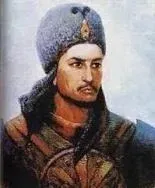
Jalal ad-Din Mingburnu
The last Khwarazmshah (1220–1231), a commander who fought the armies of Genghis Khan for eleven years and defeated the Mongols at the Battle of Parwan.
- Occupation:
- Historical figure, Politician, Military officer
- Born:
- c. 1199 — 1231
- Birthplace:
- Khorezm
- Father:
- Alouddin Muhammad
- Mother:
- Oychechak
Biography
Jalal ad-Din Mingburnu was born around 1199 in Gurganj, the capital of the Khwarazmian state (today Köneürgenç in Turkmenistan). He was the eldest son of the Khwarazmshah Ala ad-Din Muhammad II; his mother, Ay-Chichek, was of Turkmen origin. Sources give his year of birth as 1198 or 1199, and the spelling and meaning of his Turkic byname are read in several ways.
At first his father named not him but his younger half-brother Uzlagh-Shah as heir, at the insistence of Terken Khatun, Jalal ad-Din’s grandmother and a powerful figure at court. Jalal ad-Din was given Ghazna and the neighbouring provinces, in what is now Afghanistan, as his appanage. In 1219–1220 the armies of Genghis Khan invaded Transoxiana and took Bukhara and Samarkand. Muhammad II, in retreat, died at the end of 1220 on an island in the Caspian Sea, having passed the throne to his eldest son.
Fearing a plot among the emirs of Gurganj, Jalal ad-Din left the capital, defeated a Mongol detachment near Nasa and reached Ghazna. With the army he gathered there he routed the corps of Shigi Qutuqu at Parwan, north of Kabul, in 1221 — one of the heaviest defeats the Mongols suffered during Genghis Khan’s western campaign. Soon afterwards his allied emirs quarrelled over the spoils and withdrew their troops, and at the end of the same year the Khwarazmshah was beaten by Genghis Khan himself on the Indus. According to tradition, he leapt on horseback from the high bank into the river and swam across; his family perished.
With some four thousand men Jalal ad-Din spent about three years fighting local rulers in the Punjab and Sind; Iltutmish, the Sultan of Delhi, refused him refuge. In 1224 he returned to Iran and brought under his rule Kerman, Fars and Persian Iraq, where his brother Ghiyath ad-Din Pir-Shah had been ruling. In 1225 he took Tabriz, the capital of the Eldiguzids, and made it his seat.
In August of that year he defeated a Georgian army at Garni, and in 1226 he captured Tbilisi. In 1227–1228 he fought a hard battle against the Mongols outside Isfahan. His constant wars, however, united his neighbours against him: in 1230, after taking Akhlat following a long siege, he was defeated that August at Yassıçemen near Erzincan by an alliance of the Seljuk sultan Kayqubad I and the Ayyubid al-Ashraf.
In 1231 a new Mongol army under Chormaqan invaded Azerbaijan. Left almost without troops, Jalal ad-Din withdrew into the mountains near Diyarbakır, where he was killed by a Kurd in August of that year. His death ended the rule of the Khwarazmshah dynasty.
Most of what is known about him comes from the biography written by his secretary, Shihab ad-Din al-Nasawi, and from the histories of Juvayni and Juzjani. In Uzbekistan he is honoured as a national hero: the 800th anniversary of his birth was marked in 1999, when a memorial complex opened in Urgench, and in 2000 the military Order of Jaloliddin Manguberdi was established. He is also remembered in Turkmenistan and Turkey.
Career
Life path
- 1199Birth
Born in Gurganj, the eldest son of the Khwarazmshah Ala ad-Din Muhammad II.
- 1220Heir to the throne
His dying father, on an island in the Caspian Sea, passed the throne to him; fearing a plot in Gurganj, he headed south for Ghazna.
- 1221Battle of Parwan
Routed the Mongol corps of Shigi Qutuqu north of Kabul.
- 1221Battle of the Indus
Defeated by Genghis Khan himself, he swam the river on horseback and withdrew to India.
- 1221–1224In India
Fought local rulers in the Punjab and Sind; Iltutmish, the Sultan of Delhi, refused him refuge.
- 1224Return to Iran
Brought Kerman, Fars and Persian Iraq under his rule.
- 1225Tabriz and Garni
Took Tabriz, the Eldiguzid capital, and made it his seat; in August defeated a Georgian army at Garni.
- 1226Capture of Tbilisi
Took the Georgian capital.
- 1230Akhlat and Yassıçemen
Took Akhlat after a long siege, but was defeated near Erzincan by the Seljuks and the Ayyubids.
- 1231Death
Retreating before the Mongol army of Chormaqan, he was killed in the mountains near Diyarbakır.
Legacy
Jalal ad-Din Mingburnu is remembered as one of the rulers who resisted the Mongol conquest longest and most stubbornly. His contemporaries dwelt on his personal courage, while modern historians set his military talent against his failings as an administrator and diplomat. In Uzbekistan he is regarded as a national hero: Maqsud Shayxzoda wrote the drama “Jaloliddin Manguberdi” about him, a military order of the country bears his name, and monuments to him stand in Urgench.
Era: The Mongol conquests, early 13th century- Maqsud Shayxzoda wrote the historical drama “Jaloliddin Manguberdi” (1944)
- The 800th anniversary of his birth was marked and a memorial complex opened in Urgench (1999)
- The Order of Jaloliddin Manguberdi was established (2000)
- The Uzbek-Turkish television series “Mendirman Jaloliddin” went on air (2021)
- A new monument to Jalal ad-Din was unveiled in the centre of Urgench (2022)