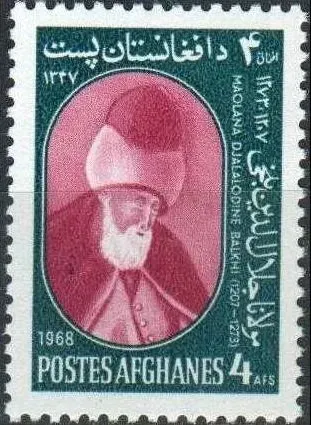
Jalal al-Din Rumi
Thirteenth-century Persian-language poet and Sufi thinker, author of the “Masnavi” and the “Divan of Shams of Tabriz”; he lived in Konya, and the Mevlevi Sufi order traces itself to him.
- Occupation:
- Writer, Religious figure, Poet
- Real name:
- Jalal al-Din Muhammad Balkhi
- Nickname:
- Mevlana
- Born:
- 1207 — December 17, 1273
- Father:
- Baha al-Din Walad
- Mother:
- Mu'mina Khatun
- Spouse:
- Gawhar Khatun, Kira Khatun
- Children:
- Sulton Valad, Alouddin Chalabiy, Amir Olim Chalabiy, Malika xotun
Biography
Jalal al-Din Muhammad Rumi was born, by the traditional date, on 30 September 1207. For a long time Balkh was taken to be his birthplace, but modern scholars place his birth in the small town of Vakhsh, which belonged to the province of Balkh and lies in today’s Tajikistan. His father, Baha al-Din Walad, was a theologian, jurist and preacher; his mother was Mu'mina Khatun. He is also known by the honorific Mawlana (“our master”), while the name “Rumi” refers to Rum, as Asia Minor, where he spent most of his life, was then called.
When he was about five, the family lived for a time in Samarkand. In the second half of the 1210s, on the eve of the Mongol invasion, Baha al-Din Walad set out westwards with his household. Legend has it that in Nishapur the young Jalal al-Din met the poet Farid al-Din Attar. After Baghdad and Mecca the family travelled through Syria and the towns of Anatolia to Larende (today’s Karaman), where they stayed for about seven years. There, in 1225, Jalal al-Din married Gawhar Khatun, the daughter of Sharaf al-Din Lala of Samarkand; their sons were Sultan Walad and Ala al-Din Chalabi. His mother also died in Larende. In 1228, at the invitation of the Seljuk sultan of Rum, Ala al-Din Kayqubad I, the family moved to the sultanate’s capital, Konya.
When his father died in 1231, Jalal al-Din took his place, teaching at a madrasa, preaching in the mosques and issuing legal opinions. In 1232 his father’s disciple Burhan al-Din Muhaqqiq Tirmidhi arrived in Konya and guided him on the Sufi path for nearly nine years. On his advice Jalal al-Din went to Syria and studied at the Hanafi Halawiyya madrasa in Aleppo and then in Damascus. After Burhan al-Din’s death in 1240–1241, Rumi went on living in Konya as a respected jurist and teacher.
The turning point of his life was his meeting with Shams al-Din of Tabriz, a wandering dervish who came to Konya in November 1244. Their closeness drew Rumi away from teaching and preaching and angered his students and the city’s scholars. Shams left for Damascus for a time and was brought back by Sultan Walad, but in 1247 or 1248 he vanished for good. The loss turned Rumi to poetry: he signed many of his ghazals with Shams’s name, and they were later gathered as the “Divan of Shams of Tabriz” (“Divan-e Kabir”), some 35,000 couplets of ghazals and odes and about 2,000 quatrains.
After Shams, Rumi’s closest companion was Salah al-Din Zarkub, a goldsmith of Konya, and after his death in 1258 his disciple Husam al-Din Chalabi. At Husam al-Din’s request Rumi began, in the late 1250s, to dictate the “Masnavi-yi Ma'navi” (“Spiritual Couplets”), and he worked on it for the rest of his life. In six books and more than 25,000 couplets, the poem sets out Sufi teaching through stories, fables and commentary on the Quran and hadith; the sixth book was left unfinished. It was held in such esteem in Persian literature that it was called “the Quran in Persian”.
His prose includes “Fihi Ma Fihi”, his talks as written down by his disciples, “Majalis-e Sab'a”, a collection of seven sermons, and “Maktubat”, his letters to disciples, family and officials. Rumi wrote mainly in Persian, also composed verse in Arabic and used Turkish and Greek words in some couplets. After Gawhar Khatun’s death he married Kira Khatun, who bore him Amir Alim Chalabi and Malika Khatun.
Rumi died in Konya on 17 December 1273 and was buried beside his father; accounts say that Christians and Jews joined the city’s Muslims at his funeral. The mausoleum with the Green Dome, completed over his grave in 1274, has been the Mevlana Museum since 1927. After Husam al-Din Chalabi’s death in 1284, Sultan Walad organised his father’s followers into the Mevlevi order, whose sema ceremony UNESCO proclaimed a Masterpiece of the Oral and Intangible Heritage of Humanity in 2005. UNESCO marked the 800th anniversary of his birth by declaring 2007 the Year of Rumi. The poet Jamol Kamol translated all six books of the “Masnavi” into Uzbek.
Education
- Halawiyya Madrasa (Aleppo)Madrasa · Hanafi law and the religious sciences
Career
- Mevlevi Sufi orderPir (the order was organised after his death by his son, Sultan Walad)
Life path
- 1207Birth
Born, by the traditional date, on 30 September in Vakhsh in the province of Balkh; older sources give Balkh as his birthplace.
- c. 1212Samarkand
The family lived for a time in Samarkand.
- 1215–1220Journey west
On the eve of the Mongol invasion the family travelled through Nishapur, Baghdad, Mecca and Syria towards Asia Minor.
- 1225Marriage in Larende
In Larende (Karaman) he married Gawhar Khatun, daughter of Sharaf al-Din Lala of Samarkand.
- 1228Konya
At the invitation of Sultan Ala al-Din Kayqubad I the family moved to the capital of the Seljuk sultanate of Rum.
- 1231His father’s successor
After his father’s death he began teaching at a madrasa and preaching in the mosques.
- 1232–1241Disciple of Burhan al-Din
Followed the Sufi path under Burhan al-Din Muhaqqiq Tirmidhi and studied in Aleppo and Damascus.
- 1244Meeting Shams
In November he met the dervish Shams al-Din of Tabriz, a meeting that transformed his life.
- 1247–1248Shams disappears
After Shams vanished, Rumi began composing ghazals in his name; they were collected as the “Divan of Shams of Tabriz”.
- 1258The “Masnavi” begins
After Salah al-Din Zarkub’s death he began dictating the “Masnavi-yi Ma'navi” at Husam al-Din Chalabi’s request.
- 1273Death
Died in Konya on 17 December and was buried beside his father.
Works
- “Masnavi-yi Ma'navi” (“Spiritual Couplets”)Narrative poem (masnavi)
A didactic Sufi poem in six books and more than 25,000 couplets, dictated to Husam al-Din Chalabi from the late 1250s until the poet’s death; the sixth book is unfinished.
- “Divan of Shams of Tabriz” (“Divan-e Kabir”)Lyric collection
Ghazals and odes signed with the name of Shams of Tabriz (some 35,000 couplets) and about 2,000 quatrains.
- “Fihi Ma Fihi”Prose
Rumi’s talks as recorded by his disciples.
- “Majalis-e Sab'a” (“Seven Sessions”)Sermons
Seven sermons interpreting the Quran and hadith.
- “Maktubat” (“Letters”)Letters
Letters to his disciples, family and statesmen.
Legacy
The “Masnavi-yi Ma'navi” is one of the most authoritative works of Persian Sufi literature and has been read and commented on for centuries wherever Persian was read. The Mevlevi order, which bears his name, spread widely in the Ottoman Empire and is known for its sema ceremony of whirling dervishes; it has been led by the poet’s descendants. Since the late 20th century English translations have made Rumi one of the most widely read poets in the United States. His works have also been translated into Uzbek.
Era: 13th century, the Seljuk sultanate of Rum; Persian Sufi poetry- Met Shams al-Din of Tabriz in Konya (1244)
- Died in Konya (1273)
- The Green Dome mausoleum was completed over his grave (1274)
- The mausoleum became the Mevlana Museum (1927)
- UNESCO proclaimed the Mevlevi sema ceremony a Masterpiece of Intangible Heritage (2005)
- UNESCO marked his 800th anniversary as the Year of Rumi (2007)