Biography
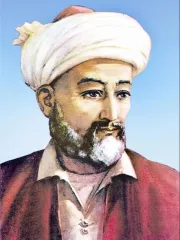
Kamal ud-Din Behzad was born about 1455 (sources give dates between 1450 and 1460) in Herat, the capital of Timurid Khorasan. Almost nothing is known of his family: according to Qazi Ahmad, he was orphaned young and was brought up and trained as a painter by the court artist and calligrapher Mirak Naqqash (Amir Ruhullah). Some sources also name Pir Sayyid Ahmad Tabrizi among his teachers. Behzad had at least two siblings, whose descendants later became his pupils.
According to the Herat historian Khwandamir, Behzad worked first for Alisher Navoi and then for Sultan Husayn Bayqara, in both cases in the workshop run by Mirak Naqqash. In his “Khulasat al-akhbar”, written in 1499–1500, Khwandamir already praises him among the skilled painters of the court. Later Behzad headed the sultan’s kitabkhana, the court workshop where manuscripts were copied and decorated; sources date his appointment differently, from 1486 to the 1490s. Babur, who knew his work, called it very delicate but remarked that he painted beardless faces less well than bearded ones.
The only manuscript whose signatures of Behzad are accepted as genuine is a “Bustan” of Sa’di copied for Husayn Bayqara’s library by the calligrapher Sultan Ali Mashhadi in 1488 (now in the National Library of Egypt in Cairo). In its double-page frontispiece and four miniatures the painter worked his name into inscriptions on buildings or placed it discreetly on an object; two of the paintings are dated 1488–89. Among them is the famous scene of Yusuf fleeing Zulaikha, in which the locked rooms of a palace carry the tension of the story. On grounds of style, paintings in a number of other Herat manuscripts are attributed to him or his immediate circle — Sharaf al-Din Ali Yazdi’s “Zafarnama”, Attar’s “Mantiq al-tayr”, and the “Khamsa” of Navoi and of Nizami.
Husayn Bayqara died in 1506, and in 1507 Herat was taken by Muhammad Shaybani Khan. Babur writes that Shaybani Khan took up the pen himself to “correct” the work of Behzad and of the calligrapher Sultan Ali Mashhadi. A portrait of Shaybani Khan attributed to Behzad is dated to these years; some scholars believe the painter lived in Bukhara in 1507–1510, but this is unproven. In 1510 Shaybani Khan was killed fighting the Safavid Shah Ismail I, and Herat passed to the Safavids.
When and how Behzad moved to Tabriz is unknown. A decree in the name of Shah Ismail dated 1522 puts him in charge of the calligraphers, painters, gilders and other craftsmen of the royal library, though some scholars doubt the document’s authenticity. Safavid authors describe Behzad as a painter of Shah Tahmasp I (r. 1524–1576); according to Qazi Ahmad, when he arrived in Tabriz the shah’s kitabkhana was already running under Sultan Muhammad. He moved there with his family: his nephew, the calligrapher Rustam Ali, and his grandnephews, the painters Muhibb Ali and Muzaffar Ali, trained in Tabriz.
Behzad died in 1535 or 1536. According to Dust Muhammad, he remained in Shah Tahmasp’s service until his death and was buried in Tabriz beside the grave of the poet Kamal Khujandi; Qazi Ahmad, however, places his tomb in Herat, on the hill of Koh-i Mukhtar.
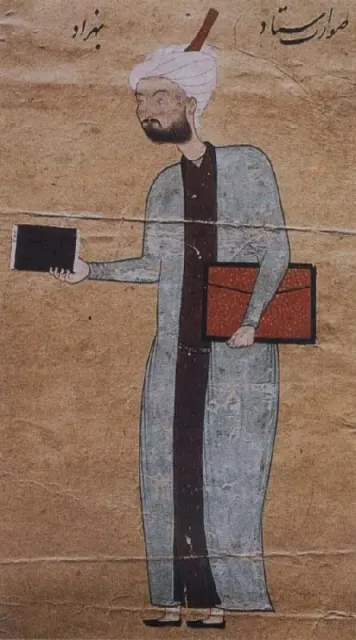
Behzad’s miniatures are marked by carefully balanced compositions, a clear construction of space and lively, individual figures, and he liked to include scenes of everyday life — builders at work, bath attendants, camel drivers. Already under the Safavids his name became a byword for mastery, and his compositions served as models for painters in Bukhara, Tabriz and Mughal India. In Uzbekistan the National Institute of Arts and Design and a memorial garden museum in Tashkent bear his name.
Career
- Court of Husayn Bayqara in HeratCourt painter, later head of the kitabkhana (library workshop) · …–1506Everyone who held this post →
- Safavid court in TabrizCourt painter, head of the royal kitabkhana · …–1535Everyone who held this post →
Life path
- c. 1455Born in Herat
Born in the capital of Timurid Khorasan; orphaned early and raised by Mirak Naqqash.
- 1470s–1480sIn the service of Navoi and Husayn Bayqara
Worked in the court workshop run by Mirak Naqqash.
- 1486–1490sHead of the sultan’s kitabkhana
Headed Husayn Bayqara’s court book workshop; sources date the appointment differently.
- 1488Sa’di’s “Bustan”
Painted the miniatures of the only manuscript that bears his signature.
- 1494–1495Nizami’s “Khamsa”
The miniatures of the manuscript now in the British Library are attributed to him.
- 1507–1510Under Shaybani Khan
Worked for Shaybani Khan after he took Herat; the khan’s portrait is dated to these years.
- 1520sMove to Tabriz
Moved with his family to the Safavid capital; a decree dated 1522 puts him at the head of the royal library.
- 1524–1535In the service of Shah Tahmasp
Worked at the Safavid court until his death.
- 1535/1536Death
Buried in Tabriz or, by another account, in Herat.
Works
- Miniatures for Sa’di’s “Bustan” (1488)Manuscript painting
The frontispiece and four miniatures of a manuscript copied for Husayn Bayqara’s library, among them “Yusuf Fleeing Zulaikha”; the only manuscript with Behzad’s signatures. National Library of Egypt, Cairo.
- Miniatures for Sharaf al-Din Ali Yazdi’s “Zafarnama”Manuscript painting (attributed)
A manuscript on the campaigns of Amir Timur; the Mughal emperor Jahangir noted that all its paintings were by Behzad. Johns Hopkins University Library, Baltimore.
- Miniatures for Attar’s “Mantiq al-tayr”Manuscript painting (attributed)
A Herat manuscript of 1483, some of whose paintings are attributed to Behzad. Metropolitan Museum of Art, New York.
- Miniatures for Navoi’s “Khamsa” (1485)Manuscript painting (attributed)
The manuscript is divided between the Bodleian Library, Oxford, and the John Rylands Library, Manchester.
- Miniatures for Nizami’s “Khamsa” (1495)Manuscript painting (attributed)
A manuscript of 1494–95 with scenes such as “The Building of the Castle of Khawarnaq” and “Harun al-Rashid in the Bathhouse”; Jahangir attributed most of its paintings to Behzad. British Library, London.
- Portrait of Muhammad Shaybani Khan (1507)Portrait (attributed)
Thought to have been painted about 1507, when Shaybani Khan took Herat.
- Portrait of Sultan Husayn BayqaraPortrait (attributed)
A single-page portrait of the ruler of Herat.
- “Two Fighting Camels”Single-page painting
Fighting camels and their keepers; an inscription says Behzad painted it in his seventieth year. From an album made for the Mughal emperor Jahangir.
Legacy
Behzad is regarded as the most celebrated master of the Herat school of miniature painting: his balanced compositions, clear construction of space and lively figures shaped the later development of Persian painting. Through his pupil Shaykhzada his manner passed to the Bukhara school, and it influenced the painters of the Tabriz workshop; the Mughal rulers collected manuscripts attributed to him, and their court painters copied his compositions. The miniaturists of Orhan Pamuk’s novel “My Name Is Red” revere him as one of the greatest masters.
Era: Timurid Herat and early Safavid Tabriz- Uzbekistan’s Cabinet of Ministers decided to mark the 545th anniversary of Behzad’s birth and to build a memorial garden museum in Tashkent (1997)
- The Kamoliddin Behzod National Institute of Arts and Design was founded (1997)
- Orhan Pamuk’s novel “My Name Is Red”, in which Behzad is invoked, was published (1998)
- A state scholarship named after Kamoliddin Behzod was established for art students (2020)