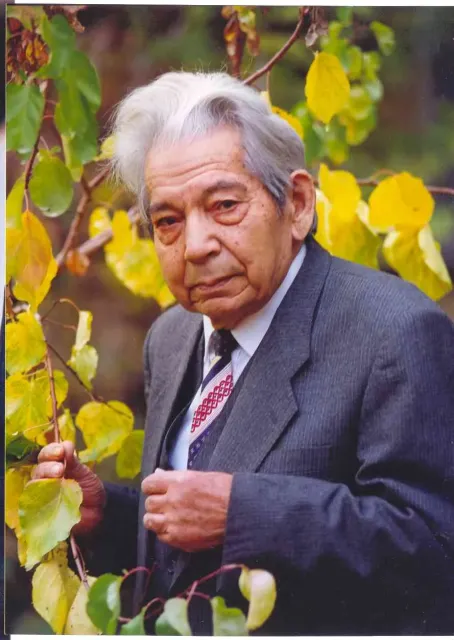
Said Ahmad
Uzbek prose writer and playwright, Hero of Uzbekistan, a master of the humorous short story and author of the “Ufq” (“Horizon”) trilogy and the widely staged comedy “The Revolt of the Daughters-in-Law”.
- Occupation:
- Writer, Prose writer, Playwright
- Real name:
- Saidakhmad Khusankhodzhaev
- Born:
- June 10 1920(87 years old) ♊ — December 5, 2007
- Birthplace:
- Tashkent
- Father:
- Husanxo'ja Dadaxo'ja o'g'li
- Spouse:
- Saida Zunnunova
- Children:
- Nodira Husanxo'jayeva
Biography
Said Ahmad (born Saidahmad Husanxo'jayev) was born on 10 June 1920 into the family of an office worker in the Samarqand Darvoza quarter of Tashkent. His father, Husanxo'ja Dadaxo'ja o'g'li, spoke good Russian and for a time gave the poet Elbek a home in his courtyard. According to the writer’s memoirs, his father was arrested by the NKVD in 1938 and died while under investigation.
After secondary school he studied at the Benkov art college and, in 1940–1943, at the Nizami Pedagogical Institute in Tashkent. His sketches and stories began to appear in newspapers and magazines in the late 1930s, and his first collection of stories, “Tortiq” (“The Gift”), came out in 1940. He worked for the satirical magazine “Mushtum” in 1941, for republican radio in 1942–1943, for the newspaper “Qizil O'zbekiston” in 1943–1947 and in the prose department of the magazine “Sharq yulduzi” in 1948–1950. These years produced the collections “Brave Heart” (1942), “Fergana Stories” (1948) and “Love” (1949), and a novella of village life, “Native Fields” (1949).
In November 1949 he married the poet Saida Zunnunova. On 10 May 1950 he was arrested as an “enemy of the people”. After nearly eleven months in solitary confinement he was sentenced without trial, by a Special Council, to ten years in the camps and sent to Jezkazgan in Kazakhstan. Saida Zunnunova was expelled from the Writers’ Union and left without work, but she did not renounce her husband. After Stalin’s death the case was reviewed, and in March 1955 the writer was released and returned to Tashkent.
The novella “The Verdict” (1958) and the collection “The Steppe Eagle” (1960), about the people who reclaimed the steppes of Central Fergana, led up to his largest work, the “Ufq” (“Horizon”) trilogy. Its books appeared as “Days of Parting” (1964), “On the Threshold of the Horizon” (1969) and “Forty-Five Days” (1974), the last of which opens the story. The trilogy follows people’s lives before, during and after the war, against the building of the Great Fergana Canal and the reclamation of the steppes, and in 1977 it won him the Hamza State Prize of the Uzbek SSR. His novel “Silence” (1988) exposed the hidden dramas behind the calm surface of the stagnation years.
Said Ahmad was known above all for his humorous and lyrical short stories, and he was among the founders of a theatre of satirical miniatures on Uzbek radio and television. His fame grew further with the comedy “Kelinlar qo'zg'oloni” (“The Revolt of the Daughters-in-Law”, 1976), about the domineering Farmonbibi, who shares a courtyard with her seven daughters-in-law. It was staged at the Uzbek National Academic Drama Theatre and in many countries abroad, and in 1984 Melis Abzalov filmed it at Uzbekfilm. His comedy “The Bridegroom” (1986), about the troubles of a lonely old man, was staged at the same theatre, and Uzbekfilm’s “Drama of Love” (1970) was made from his screenplay.
After independence he published the humorous collections “Xandon pista” (1994) and “The Price of a Kiss” (1995), the memoir essays “What I Lost and What I Found” (1998) about Ghafur Ghulam, Oybek, Abdulla Qahhor, Mirtemir, Shaykhzoda, Saida Zunnunova and other writers, the books “Dark-Eyed Majnun” (2001) and “Dawn Caught on the Eyelashes” (2003), and three volumes of selected works (2000). He was named People’s Writer of the Uzbek SSR in 1980 and Hero of Uzbekistan on 25 August 1999.
Said Ahmad died in Tashkent on 5 December 2007, aged 87, and was buried in the Chig'atoy cemetery. Saida Zunnunova had died long before, in 1977; their daughter is Nodira Husanxo'jayeva. On 10 June 2013 a monument to Said Ahmad and Saida Zunnunova was unveiled in the National Park in Tashkent. In 2019 the director Nozim Abbosov made the feature film “Said and Saida” about the couple’s fate during the repressions, with Nodira Husanxo'jayeva among the screenwriters.
Education
- Nizami Tashkent State Pedagogical UniversityUniversity · Tashkent · 1940–1943
- Benkov Republican Art CollegeCollege · Tashkent
Career
- Mushtum magazineStaff member · 1941–…
- Qizil O'zbekiston newspaperStaff member · Tashkent · 1943–1947
- «Sharq yulduzi» magazineProse department staff member · Tashkent · 1948–1950
- Uzbek RadioStaff member · Tashkent · 1942–1943
Awards
 Hero of Uzbekistan1999 · Uzbekistan
 Order «For Outstanding Merit»1997 · Uzbekistan
 Order «Do'stlik» (Friendship)1995 · Uzbekistan
 Medal «Shuhrat» (Glory)1994 · Uzbekistan
- People's Writer of the Uzbek SSR1980 · Uzbek SSR
 Honoured Worker of Culture of the Uzbek SSR1968 · Uzbek SSR
 Hamza State Prize of the Uzbek SSR1977 · Uzbek SSR
 Order of Lenin1991 · USSR
 Order of Friendship of Peoples1980 · USSR
 Medal «For Labour Distinction»1959 · USSR
Life path
- 1940First book
His first collection of stories, “Tortiq” (“The Gift”), was published.
- 1940–1943Pedagogical institute
Studied at the Nizami Pedagogical Institute in Tashkent.
- 1941–1950Magazine, radio and newspaper
Worked for the magazine “Mushtum” (1941), republican radio (1942–1943), the newspaper “Qizil O'zbekiston” (1943–1947) and the prose department of the magazine “Sharq yulduzi” (1948–1950).
- 1949Marriage
Married the poet Saida Zunnunova in November.
- 1950–1955Prison and camp
Arrested on 10 May 1950, sentenced by a Special Council to ten years and sent to the Jezkazgan camp; released in March 1955.
- 1964–1974The “Horizon” trilogy
The novels “Days of Parting” (1964), “On the Threshold of the Horizon” (1969) and “Forty-Five Days” (1974) were published.
- 1976“The Revolt of the Daughters-in-Law”
Wrote the comedy later staged in many countries and filmed in 1984.
- 1977Hamza State Prize
Awarded the State Prize of the Uzbek SSR for the “Horizon” trilogy.
- 1980People’s Writer of the Uzbek SSR
Received the honorary title and the Order of Friendship of Peoples on his 60th birthday.
- 1988“Silence”
Published his novel about the stagnation years.
- 1999Hero of Uzbekistan
Named Hero of Uzbekistan on 25 August.
- 2007Death
Died in Tashkent on 5 December and was buried in the Chig'atoy cemetery.
Works
- “The Gift” (“Tortiq”) (1940)Short-story collection
The writer’s first book.
- “Fergana Stories” (1948)Short-story collection
One of his collections of the post-war years.
- “Native Fields” (“Qadrdon dalalar”) (1949)Novella
A novella of village life, published shortly before the author’s arrest.
- “The Verdict” (1958)Novella
A novella on a rural theme, written after his return from the camps.
- “The Steppe Eagle” (1960)Short-story collection
Stories about the people who reclaimed the steppes of Central Fergana.
- “Horizon” (“Ufq”) (1974)Novel trilogy
“Days of Parting” (1964), “On the Threshold of the Horizon” (1969) and “Forty-Five Days” (1974): lives shaped by the war and the building of the Great Fergana Canal. Hamza State Prize, 1977.
- “The Revolt of the Daughters-in-Law” (“Kelinlar qo'zg'oloni”) (1976)Comedy
About Farmonbibi, who shares a courtyard with her seven daughters-in-law; staged in many countries and filmed in 1984.
- “The Bridegroom” (1986)Comedy
A play about the troubles of a lonely old man.
- “Silence” (1988)Novel
About the hidden dramas of the stagnation years.
- “Xandon pista” (1994)Humorous collection
Humorous stories from the first years of independence.
- “What I Lost and What I Found” (1998)Memoir essays
Memories of Ghafur Ghulam, Oybek, Abdulla Qahhor, Saida Zunnunova and other writers.
- “Dark-Eyed Majnun” (2001)Short stories
A book of stories tied to memories of the years of repression.
Legacy
Literary scholars describe Said Ahmad as a writer who learned psychological portraiture from Oybek, humour from Ghafur Ghulam and economy of style from Abdulla Qahhor, and who carried on Qahhor’s tradition of the humorous short story. Farmonbibi of “The Revolt of the Daughters-in-Law” became one of the best-known characters of the Uzbek stage, and his memoir essays on his teachers and contemporaries are counted among the notable examples of the genre in independent Uzbekistan. The loyalty of Said Ahmad and Saida Zunnunova during the repressions is the subject of a film, and a monument to them stands in Tashkent’s National Park.
Era: Uzbek prose and drama of the second half of the 20th century- “The Revolt of the Daughters-in-Law” was filmed at Uzbekfilm (1984)
- Named Hero of Uzbekistan (1999)
- A postage stamp dedicated to the writer was issued (2006)
- A monument to Said Ahmad and Saida Zunnunova was unveiled in Tashkent’s National Park (2013)
- The National Library opened an exhibition for his 95th anniversary (2015)
- Nozim Abbosov’s film “Said and Saida” was released (2019)
Filmography
| Title | Year |
|---|---|
| Drama of Love | 1971 |