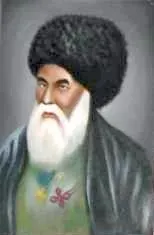
Komil Khorezmi
Khiva court official, poet, calligrapher and translator, creator of the “tanbur line”, a notation in which Uzbek melodies were first written down.
Biography
Komil Khorezmi is a pen name; his real name was Pahlavon Muhammadniyoz. He was born in Khiva in 1825 into the family of Abdulla Okhund, a madrasa teacher. He studied at a Khiva madrasa, learned Arabic and Persian, and began his career as a scribe at the khan’s court, first under Said Muhammad Khan.
Under Muhammad Rahim II (Feruz) he rose in the khan’s chancery and became mirzaboshi, the chief secretary. In 1873, as Russian troops approached Khiva, the text of the Gandimian peace treaty was written in his hand; the same year he was appointed devonbegi, a post he held until 1880. In 1873 and 1883 he travelled with the khan to Moscow and St Petersburg, and he visited Tashkent in 1891 and in 1896–1897.
As a poet Komil wrote more than eight thousand lines in ghazals, rubais, qasidas and murabbas, and his divan was printed by lithography in Khiva in 1881. He translated Persian works into Uzbek, wrote a preface to the Khiva edition of Alisher Navoi’s “Khamsa” and practised calligraphy.
His most lasting work was in music. At the khan’s request he devised the “tanbur line”, a notation whose lines correspond to the frets of the tanbur, to put folk and maqom melodies on paper. His son Muhammad Rasul Mirzaboshi carried the system further, and with it the Khorezm maqoms, including the Shashmaqom, were written down.
Komil Khorezmi died in Khiva in 1899. The hall for Quran readers he had built still stands over his grave and is now known as a house-museum in Khiva.
Career
- Court of the Khanate of KhivaMirzaboshi, devonbegi · Khiva
Works
- “Divan” (1881)Poetry collection
More than eight thousand lines in ghazals, rubais, qasidas, murabbas and other forms; its first edition was lithographed in Khiva.
- “Tanbur line”Notation system
A method of writing down Uzbek melodies and maqoms with lines that match the frets of the tanbur and a set of signs.
- “Murabbai Komil”Musical composition
A melody from Komil’s own compositions.
- “Peshravi Feruz”Musical composition
A melody from Komil’s own compositions.
- Translations from PersianTranslation
Rendered a number of Persian literary works into Uzbek.
Life path
- 1825Birth
Born in Khiva into the family of the madrasa teacher Abdulla Okhund.
- Before 1864Court scribe
After his madrasa studies he served as a scribe at the court of Said Muhammad Khan.
- 1873Gandimian treaty
Wrote the text of the peace treaty between Russia and the Khanate of Khiva; the same year he went to Moscow and St Petersburg.
- 1873–1880Devonbegi
Under Muhammad Rahim II he headed the khan’s chancery as devonbegi.
- 1870s–1880sThe “tanbur line”
At the khan’s request he devised a notation based on the frets of the tanbur to record Uzbek melodies.
- 1881Divan published
His collection of poems was lithographed in Khiva.
- 1883Journey to Moscow and St Petersburg
Travelled to Russian cities with Muhammad Rahim II.
- 1891, 1896–1897Visits to Tashkent
Spent time in Tashkent.
- 1899Death
Died in Khiva; the hall he built for Quran readers stands over his grave.
Legacy
The “tanbur line” became one of the first systems for writing down Uzbek melodies in notation; with it the Khorezm maqoms, including the Shashmaqom, were put on paper. Through his ghazals and translations Komil is also known as a notable figure of the 19th-century Khorezm literary circle. A house-museum in Khiva bears his name.
Era: Khanate of Khiva, second half of the 19th century- Gandimian peace treaty (1873)
- Divan printed by lithography in Khiva (1881)