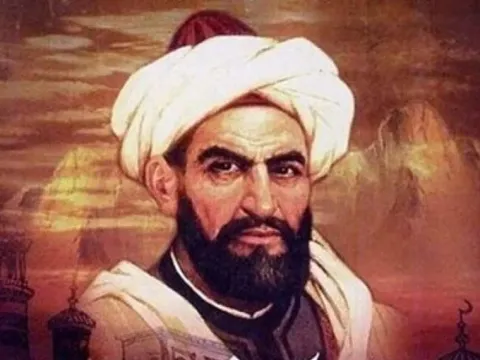
Mahmud al-Kashgari
Eleventh-century philologist, author of the “Dīwān Lughāt al-Turk”, the first comprehensive dictionary of the Turkic languages, and a founding figure of Turkology.
- Occupation:
- Scientist, Writer, Philologist
- Real name:
- Mahmud ibn al-Husayn ibn Muhammad al-Kashgari
- Born:
- c. 1029 — c. 1101
- Father:
- Husayn ibn Muhammad
Biography
Mahmud ibn al-Husayn ibn Muhammad al-Kashgari was an eleventh-century Turkic philologist and the author of the “Dīwān Lughāt al-Turk”. Little is known of his life, and nearly all of it comes from his own book; even his year of birth is uncertain — most often given as 1029, while some sources put it at 1005.
He was born in Barsgan, on the south-eastern shore of Lake Issyk-Kul, into a family related to the ruling Karakhanid dynasty; his father, Husayn ibn Muhammad, governed Barsgan. He was educated in Kashgar, one of the great cultural centres of the Turkic world of the time, and besides the Turkic dialects he knew Arabic and Persian well.
In 1057, after a palace conspiracy and the killing of members of the ruling house, Mahmud was forced to leave his homeland. By his own account, he spent many years travelling through the towns and steppes of the Turkic tribes, studying their dialects, customs, proverbs and songs. Later he came to Baghdad, the capital of the Abbasid Caliphate, which was then under Seljuk control.
There, in 1072–1074, he wrote the “Dīwān Lughāt al-Turk” (“Compendium of the Languages of the Turks”) in Arabic. The book was meant for Arabs wishing to learn Turkic: several thousand Turkic words are explained in Arabic and illustrated with proverbs, fragments of verse and sayings. It gathers information on the Turkic tribes, where they lived, their history and customs, and includes a round map of the world showing the lands of the Turks. The author dedicated the work to the Abbasid caliph al-Muqtadi.
Al-Kashgari also wrote a book on Turkic syntax, “Jawāhir al-naḥw fī lughāt al-Turk”, which has not survived. He is thought to have returned home late in life and to have lived in the village of Opal near Kashgar, where he died around 1101; other accounts give 1102 or 1126. A mausoleum stands over his grave in Opal.
The only surviving manuscript of the “Dīwān” is a copy made in Damascus in 1266. The bibliophile Ali Emiri found it in the Istanbul book market in 1914, and it now belongs to the Millet Library in Istanbul. The book was first printed in 1915–1917 and has since been translated into Turkish, Uzbek, English, Russian and other languages; Solih Mutallibov’s Uzbek translation came out in Tashkent in three volumes in 1960–1963. Al-Kashgari is regarded as one of the founders of Turkology, and his legacy is claimed by the Uzbeks, Uyghurs, Kyrgyz and other Turkic peoples.
Life path
- 1029Birth
Born in Barsgan on Lake Issyk-Kul into a family related to the Karakhanids; the year is approximate.
- Education in Kashgar
Studied in Kashgar, a major Karakhanid cultural centre, and mastered Arabic and Persian.
- 1057Leaving his homeland
Left Kashgar after a palace conspiracy and killings within the Karakhanid ruling house.
- Travels among the Turks
Journeyed through the towns and steppes of the Turkic tribes, recording their dialects, proverbs and songs.
- 1072–1074“Dīwān Lughāt al-Turk”
Wrote his encyclopaedic dictionary of Turkic words in Arabic in Baghdad.
- 1077Dedication to the caliph
Dedicated the “Dīwān” to the Abbasid caliph al-Muqtadi.
- 1101Death
Is thought to have died in the village of Opal near Kashgar, where he is buried; the year is approximate.
Works
- “Dīwān Lughāt al-Turk” (“Compendium of the Languages of the Turks”) (1074)Encyclopaedic dictionary
Written in Arabic in Baghdad in 1072–1074, the first major dictionary to explain Turkic words in Arabic. It collects proverbs, fragments of verse and information on the Turkic tribes, their history and customs; the author judged the Khaqani language the most elegant and the Oghuz dialect the easiest.
- World map (1074)Map
A round map in the “Dīwān”, centred on Balasagun, one of the Karakhanid capitals, and showing the lands inhabited by Turkic peoples. It is regarded as the earliest known map of the Turkic world.
- “Jawāhir al-naḥw fī lughāt al-Turk”Grammar
A work on Turkic syntax, mentioned by al-Kashgari in the “Dīwān”; it has not survived.
Legacy
The “Dīwān Lughāt al-Turk” is the single most important source on the Turkic languages, dialects and oral literature of the eleventh century and the foundation of Turkic historical lexicology and dialectology. Its proverbs, songs and fragments of verse preserve rare specimens of early Turkic literature, and its round map is the earliest known map of the Turkic world. The work has been translated into many languages and is studied by scholars in Uzbekistan, Kyrgyzstan, Turkey and beyond, above all in the Turkic-speaking countries.
Era: The Karakhanid and Seljuk era, 11th century- The only surviving copy of the “Dīwān” was made in Damascus (1266)
- The bibliophile Ali Emiri found the manuscript in Istanbul (1914)
- The first printed edition began to appear in three volumes (1915–1917) (1915)
- Solih Mutallibov’s Uzbek translation began to appear (1960–1963, three volumes) (1960)
- UNESCO declared 2008 the Year of Mahmud al-Kashgari (2008)
- The manuscript of the “Dīwān” was inscribed on UNESCO’s Memory of the World Register (2017)
- An international conference on the 950th anniversary of the “Dīwān” was held at UNESCO headquarters (2024)