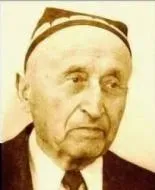
Biography
Mirkarim Osim was born in Tashkent on 14 August 1907 into a family of intellectuals. He attended an old-method school, then the Shams ul-urfon primary school (1917–1920), and in 1921–1924 the Narimanov technical college, where Oybek was his fellow student. His first novella, “The New Canal” (1925), was never published: it was judged to idealise the age of the khans.
In 1926–1930 he studied at the Faculty of History and Economics of the Moscow State Pedagogical Institute. He then taught at teacher-training courses in Samarkand (1930), worked as an editor at the State Publishing House (1931), and from 1932 to 1949 was a research fellow at the Research Institute of Pedagogical Sciences in Tashkent, compiling history manuals and textbooks. In 1944 he was named Honoured Teacher of the Uzbek SSR.
He began with poetry but soon turned to historical prose. His first major work was the novella “Astrabad” (1940), drawn from the life of Alisher Navoi; it was followed by “Alisher Navoi and Darvesh Ali” (1941), “Exile”, “Ulugbek and Navoi” and other stories about the poet, printed in periodicals on the eve of Navoi’s 500th anniversary.
In the 1940s Mirkarim Osim fell victim to the Stalinist repressions and spent several years in labour camps. Back in Tashkent in the 1950s, he went on writing about history, and in 1959–1972 worked as an editor at the Publishing House of Literature and Art (now named after Ghafur Ghulom).
His novellas cover the history of Central Asia from antiquity to 1917. Ancient legend inspired “Tomyris”, about the queen of the Massagetae, “Shiroq”, about the shepherd who led the army of Darius into the desert, and “Iskandar and Spitamenes”; resistance to the Mongol invasion is the subject of “Otrar”, “Temur Malik” and “Mahmud Torobiy”. Scholars and poets are at the centre of “Light in the Darkness” (1963), about Navoi, “Clouds over the Oxus” (1973), written for the millennium of al-Biruni, “The Story of Ibn Sina”, “The Birth of Algebra” (1983), about al-Khwarizmi, and “The Broken Setor”, about Mashrab. Everyday life of past centuries fills “The Envoys” (1960, later retitled “On the Caravan Roads”) and “Mohlaroyim and Xonposhsha”.
Osim translated into Uzbek the second book of Mikhail Sholokhov’s “And Quiet Flows the Don”, Sergei Borodin’s novel “Bayazid the Thunderbolt”, a novella by Lidiya Bat and other works. His own books also appeared in Russian: “The Envoys” (1963), “The Envoy of Khwarazm” (1974) and “The Silent Witness” (1981).
In 1977, on his 70th birthday, he was named Honoured Worker of Culture of the Uzbek SSR. He died in Tashkent in 1984. In 2001 he was posthumously awarded the Order “For Outstanding Merit” (Buyuk xizmatlari uchun). His novellas are still reprinted, including editions for schoolchildren.
Education
- Shams ul-urfon schoolSchool · Tashkent · 1917–1920
- Narimanov Pedagogical CollegeCollege · 1921–1924
- Moscow State Pedagogical InstituteUniversity · 1926–1930 · Faculty of History and Economics
Career
- Ghafur Ghulam Publishing House of Literature and ArtEditor · Tashkent · 1959–1972
- State Publishing House of UzbekistanEditor · Tashkent · 1931–1931
- Research Institute of Pedagogical SciencesResearch fellow · Tashkent · 1932–1949
Awards
 Order «For Outstanding Merit»2001, posthumously · Uzbekistan
 Honoured Worker of Culture of the Uzbek SSR1977 · Uzbek SSR
Life path
- 1917–1924Schooling in Tashkent
The Shams ul-urfon school, then the Narimanov technical college.
- 1926–1930Studies in Moscow
Graduated from the Faculty of History and Economics of the Moscow State Pedagogical Institute.
- 1930–1931Samarkand and the State Publishing House
Taught at teacher-training courses, then worked as an editor at the State Publishing House.
- 1932–1949Research Institute of Pedagogical Sciences
Research fellow; compiled history manuals and textbooks. Named Honoured Teacher in 1944.
- 1940–1941Novellas about Navoi
“Astrabad” and “Alisher Navoi and Darvesh Ali” were published.
- 1940s–1950sRepression
Fell victim to the repressions and spent several years in labour camps; returned to Tashkent in the 1950s.
- 1959–1972Publishing editor
Worked at the Publishing House of Literature and Art (now named after Ghafur Ghulom).
- 1960“The Envoys”
The novella later retitled “On the Caravan Roads” came out; a Russian edition followed in 1963.
- 1963“Light in the Darkness”
A novella about the life of Alisher Navoi.
- 1973“Clouds over the Oxus”
A novella for the millennium of al-Biruni.
- 1977Honoured Worker of Culture
Named Honoured Worker of Culture of the Uzbek SSR on his 70th birthday.
- 1983–1984Last years
Wrote “The Birth of Algebra” about al-Khwarizmi; died in Tashkent in 1984.
Books
- “Astrabad”1940 · Historical novella
His first major work, drawn from the life of Alisher Navoi.
- “Alisher Navoi and Darvesh Ali”1941 · Historical novella
A continuation of his Navoi cycle.
- “The Envoys” (“On the Caravan Roads”)1960 · Historical novella
About embassies and caravan routes; published in Russian in 1963.
- “Light in the Darkness”1963 · Biographical novella
About the life of Alisher Navoi.
- “The Magic Word”1968 · Story cycle
Stories about different moments in Navoi’s life.
- “Clouds over the Oxus”1973 · Biographical novella
About the young al-Biruni and Khwarazm, written for the scholar’s millennium.
- “The Birth of Algebra”1983 · Biographical novella
About al-Khwarizmi and the origins of algebra.
- “Tomyris”· Historical novella
The queen of the Massagetae against the Persian king.
- “Shiroq”· Historical novella
The shepherd who led the army of Darius into the desert.
- “Otrar”· Historical novella
Otrar at the time of the Mongol invasion.
- “The Story of Ibn Sina”· Biographical novella
Ibn Sina’s youth and his path to learning.
- “The Broken Setor”· Biographical novella
About the poet Boborahim Mashrab.