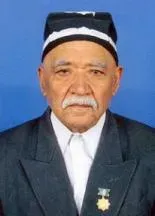
Biography
Mirumar Asadov was born in Samarkand in 1927. In 1939 a school of national crafts opened in the city, with its classes held in the Sherdor madrasa. His grandfather, a master known locally as Abdulavaz-aksakal, brought him there: Asadov himself came from a hereditary family of restorers.
At the school his teacher was the Bukhara master Shirin Murodov, from whom he learned the practical skills and trade secrets of the craft. During the Second World War an art institute was evacuated from Moscow to Samarkand and its specialists also taught the pupils; Asadov later recalled that they gave him the basics of technical drawing and painting. In 1941 he graduated from the Samarkand school of monument restoration.
In the 1940s Asadov travelled to Tashkent with several other pupils of the Samarkand school and Murodov, where the Samarkand masters decorated the Alisher Navoi Opera and Ballet Theatre and the Muqimi Theatre in the national style; the ganch carving and tilework of both buildings are their work. According to biographical accounts, in the 1950s he took part in restoring the Ulugh Beg madrasa, the Gur-Emir mausoleum, the Bibi-Khanym mosque and the Tilla-Kari madrasa in Samarkand, the Mir-i Arab madrasa and the Bahauddin Naqshband mausoleum in the Bukhara region, and the Yunuskhan madrasa and the Kaldirgochbi mausoleum in Tashkent.
In the 1960s he was invited to Dushanbe and worked on revered monuments of Tajikistan, among them the mausoleum of Sadriddin Ayni and the mausoleum of Rudaki in Panjakent. Before him these buildings had mostly been restored by specialists sent from Leningrad.
After independence the first major project of his career was the Bahauddin Naqshband mausoleum in the Bukhara region, restored by a special government decision. He went on to work on the mausoleum of Imam al-Bukhari, the Registan ensemble, the Bibi-Khanym mosque, Gur-Emir, the Shah-i-Zinda complex and the Hazrat Khizr mosque, and was known as a master of ganch carving, mosaic and stone carving.
Asadov received the Medal for Labour Distinction (1957) and the Hamza State Prize of the Uzbek SSR (1974); in 1996 a presidential decree made him a Hero of Uzbekistan. With his brothers, masters Mirusmon and Mir-Said, he carried on a dynasty of restorers; his son Sodiq Asadov is one of the masters working on the restoration of the Sherdor madrasa. Mirumar Asadov died in 2010.
Education
- Samarkand school of national crafts (in the Sherdor madrasa)School · Samarkand · 1939–1941 · Restorer
Awards
 Hero of Uzbekistan1996 · Uzbekistan
 Hamza State Prize of the Uzbek SSR1974 · Uzbek SSR
 Medal «For Labour Distinction»1957 · USSR
Life path
- 1927Birth
Born in Samarkand.
- 1939–1941School of national crafts
Studied under Shirin Murodov at the school of national crafts in the Sherdor madrasa; graduated from the restoration school in 1941.
- 1940sTashkent theatres
Helped decorate the Navoi Opera and Ballet Theatre and the Muqimi Theatre with other Samarkand masters.
- 1950–1955Monuments of Samarkand, Bukhara and Tashkent
Took part in restoring the Ulugh Beg madrasa, Gur-Emir, the Bibi-Khanym mosque, Tilla-Kari and other monuments.
- 1957Labour medal
Awarded the Medal for Labour Distinction.
- 1960sIn Tajikistan
Worked on the restoration of the Sadriddin Ayni and Rudaki mausoleums in Dushanbe and Panjakent.
- 1974Hamza Prize
Became a laureate of the Hamza State Prize of the Uzbek SSR.
- After 1991Bahauddin Naqshband mausoleum
His first major work after independence was the restoration of the Bahauddin Naqshband mausoleum near Bukhara, followed by the Imam al-Bukhari complex, the Registan, Shah-i-Zinda and others.
- 1996Hero of Uzbekistan
Awarded the title Hero of Uzbekistan by presidential decree.
- 2010Death
Died.
Works
- Decoration of the Navoi Opera and Ballet Theatre (Tashkent) (1947)Theatre decoration
Took part in decorating the theatre in the national style, with ganch carving and tilework.
- Decoration of the Muqimi Theatre (Tashkent)Theatre decoration
Decorated the theatre in the national style together with other Samarkand masters.
- Ulugh Beg madrasa (Samarkand)Restoration
Took part in the restoration work of the 1950s.
- Gur-Emir mausoleum (Samarkand)Restoration
Took part in restoring the mausoleum of Amir Timur.
- Mausoleums of Sadriddin Ayni and Rudaki (Tajikistan)Restoration
Took part in the 1960s restoration of the mausoleums in Dushanbe and Panjakent.
- Bahauddin Naqshband mausoleum (Bukhara region)Restoration
His first major project after independence; the mausoleum was restored by a special government decision.
- Imam al-Bukhari complexRestoration
Contributed ganch, tile and stone work.
- Shah-i-Zinda memorial complex (Samarkand)Restoration
Took part in restoration and decorative work.