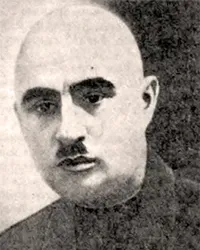
Literary scholar, folklorist and art historian, a graduate of Istanbul University who studied the history of Uzbek literature and theatre; arrested in 1937 and shot in 1938, a victim of the repressions.
- Occupation:
- Scientist, Philologist
- Lived:
- 1891 — October 4, 1938
- Birthplace:
- Tashkent
Biography
Miyon Buzruk Solikhov was a literary scholar, folklorist and art historian. He was born in 1891 in Tashkent's Qashqarcha quarter. He finished Istanbul University in 1927 and came back to Uzbekistan the same year.
Once home, he spent 1927–1931 teaching Uzbek language and literature in the oriental faculty of Central Asian University. In 1931–1932 he was an instructor at the Tajik State Institute of Education; in 1932–1933 he did research at the Uzbek Research Institute of Cultural Construction, and in 1934–1935 at the Institute of Language and Literature attached to the Committee of Sciences. He also taught at the Tashkent Pedagogical Institute, Samarkand State University (1936) and the Bukhara Pedagogical Institute (April 1936).
Among the young people to whom Solikhov lectured on the history of Uzbek and Eastern literature were Izzat Sultan, Hamid Sulaymon, Imomkhon Husankhojayev, Mumtoz Muhamedov and Shuhrat. In his work he collaborated with Professor Fitrat, E. D. Polivanov, G‘ozi Olim Yunusov, Abdulla Avloniy, the researchers Qayum Ramazon, Shorasul Zunnun and Ulug‘ Tursunov, the translator L. Sacerdotova and others.
He wrote on the history of literature and theatre, folklore and ethnography, and questions of the Uzbek language and translation: “O‘zbek”, “Bedil” (1928), “On ‘Mehrobdan chayon’” (1929), “A General View of the History of Central Asian and Uzbek Literature” (1930), “Uzbek Folklore Before October”, “On Sufizoda and His Work” (1934) and “Materials for the History of the Uzbek Theatre” (1935). Documents in the archive of the Academy of Sciences indicate that he also researched the work of Sadriddin Aini, the founder of Tajik Soviet literature, and translated Aini's novel “Dokhunda” from Tajik into Uzbek; the translation came out in Tashkent in 1932.
Solikhov was arrested on 7 August 1937 and, branded an “enemy of the people”, shot on 4 October 1938. After independence he was recognised as a victim of the repressions and rehabilitated, and study of his scholarly legacy began.
Education
- Istanbul UniversityUniversity · 1927
Career
- First Central Asian State UniversityLecturer in Uzbek language and literature at the oriental faculty · Tashkent · 1927–1931now National University of Uzbekistan
- Institute of Language and LiteratureResearcher (under the Committee of Sciences) · Tashkent · 1934–1935
Life path
- 1891Born
In the Qashqarcha neighbourhood of Tashkent.
- 1927Graduated from Istanbul University
Returned to Uzbekistan the same year.
- 1927–1931At Central Asian University
Lecturer in Uzbek language and literature at the oriental faculty.
- 1931–1935At scholarly and teaching institutions
Tajik Institute of Education (1931–1932), Institute of Cultural Construction (1932–1933), Institute of Language and Literature (1934–1935).
- 1932Translation of “Dokhunda”
The Uzbek translation of Sadriddin Aini's novel was published in Tashkent.
- 1936At higher schools
Lecturer at Samarkand University and the Bukhara Pedagogical Institute.
- 1937Arrested
On 7 August.
- 1938Executed
On 4 October as an “enemy of the people”; rehabilitated later.
Works
- «O'zbek»Article
- «Bedil» (1928)Article
- «„Mehrobdan chayon“ haqida» (1929)Article
- «O'rta Osiyo va o'zbek adabiyoti tarixiga umumiy qarash» (1930)Scholarly book
- «Oktyabrgacha bo'lgan o'zbek folklori»Scholarly book
- «Sufizoda va uning ijodi haqida» (1934)Article
- «O'zbek teatri tarixi uchun materiallar» (1935)Scholarly book
- Sadriddin Ayniy, «Doxunda» (tarjima) (1932)Translation