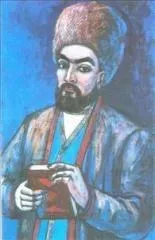
Munis Khorezmi
Poet, historian and translator of the Khanate of Khiva, author of the divan “Munis ul-ushshoq” and the chronicle “Firdaws al-iqbal”, uncle and teacher of Agahi.
Biography
Shermuhammad, son of Avaz-biy, known by the pen name Munis, was born in 1778 in the village of Qiyot near Khiva. He came from the Uzbek Yuz clan, and his father and forebears served the khans of Khiva as mirabs — the officials who allotted irrigation water. According to the Uzbek Wikipedia his mother belonged to the Nayman clan. He received his first schooling in his home village and then studied in the madrasas of Khiva.
In 1800, after his father’s death, Munis entered court service as chronicler and secretary, first under Avaz Inaq, then under his son Eltuzar and under Muhammad Rahim Khan I. Later he held the office of mirab as well, which his family had long filled; after his death it passed to his nephew Agahi.
Munis wrote verse in nearly every genre of classical poetry. In 1804 he composed the poem “Savodi ta’lim”, devoted to the Arabic alphabet, and compiled his first divan, “Munis ul-ushshoq” (“Friend of the Lovers”). The divan was later enlarged, and his poetic legacy is estimated at about ten thousand couplets. Manuscripts and lithograph editions of it are held at the Beruni Institute of Oriental Studies in Tashkent.
In 1806, at the order of Khan Eltuzar, he began a history of Khorezm, “Firdaws al-iqbal” (“Paradise of Fortune”). It has an introduction, five chapters and a conclusion: it opens with Adam, goes on to the Turco-Mongol rulers and Eltuzar’s forebears, and ends with the events of the author’s own time. The eighteenth century is told in particular detail, apparently from the accounts of contemporaries and perhaps of the author’s own father. Munis brought the narrative down to 1812–1813 and then turned to translation.
From 1819 he worked on an Uzbek translation of Mirkhond’s Persian chronicle “Rawdat al-safa”. In 1823–1826, at his request, Khudoyberdi ibn Qushmuhammad made an abridged translation of Sharaf al-Din Ali Yazdi’s “Zafarnama”. In this way a Khivan school of translation and historical writing grew up around Munis. He is also known for a treatise, “Arnalar”, on irrigation canals and land relations.
Munis died in 1829 at the age of 51 and was buried in Khiva. He had finished only the first volume of the Mirkhond translation and had carried the chronicle only into the early nineteenth century; Agahi completed both. “Firdaws al-iqbal” has been studied by N. Muravyov, V. Bartold, S. Tolstov and others, and in 1999 Yuri Bregel published an English translation of it.
Career
- Court of the Khanate of KhivaCourt chronicler and secretary; mirab · Khiva · 1800–1829
Life path
- 1778Birth
Born in the village of Qiyot near Khiva, into the family of the mirab Avaz-biy.
- 1800Court service
After his father’s death he became court chronicler and secretary to the khans of Khiva.
- 1804“Savodi ta’lim” and the first divan
Composed the poem on the Arabic alphabet and compiled the divan “Munis ul-ushshoq”.
- 1806Start of “Firdaws al-iqbal”
Began the history of Khorezm at the order of Khan Eltuzar.
- 1812–1813Chronicle brought to these years
The narrative reached the early nineteenth century, after which the khan set him to translation.
- 1819Translation of “Rawdat al-safa”
Began translating Mirkhond’s chronicle from Persian into Uzbek.
- 1823–1826Abridged “Zafarnama”
At his request Khudoyberdi ibn Qushmuhammad translated Yazdi’s work in abridged form.
- 1829Death
Died aged 51 and was buried in Khiva; Agahi carried his work on.
Works
- “Munis ul-ushshoq” (“Friend of the Lovers”) (1804)Divan
A collection of poems compiled in 1804–1805 and later enlarged; the poet’s whole legacy runs to about ten thousand couplets.
- “Savodi ta’lim” (1804)Poem
A verse primer devoted to learning the Arabic alphabet.
- “Firdaws al-iqbal” (“Paradise of Fortune”) (1806)Historical chronicle
A history of Khorezm from antiquity; Munis took it into the early nineteenth century and Agahi completed it.
- Translation of Mirkhond’s “Rawdat al-safa” (1819)Translation
An Uzbek translation of the Persian chronicle; Munis finished the first volume and Agahi the rest.
- “Arnalar”Treatise
A treatise on irrigation canals and land and water relations at the turn of the nineteenth century.
Legacy
With Agahi, Munis founded the Khivan school of historical writing and translation: “Firdaws al-iqbal” remains a valuable source for the history of Khorezm and the Khanate of Khiva and its relations with the Turkmen and Karakalpaks. The chronicle has been studied by N. Muravyov, N. Veselovsky, V. Bartold, S. Tolstov, Ya. Gulomov and others; an English translation by Yuri Bregel was published in Leiden in 1999.
Era: Khanate of Khiva under the Qungrat dynasty, turn of the 18th and 19th centuries- First divan, “Munis ul-ushshoq”, compiled (1804)
- Work on “Firdaws al-iqbal” begins (1806)
- Munis dies; Agahi becomes mirab (1829)
- Yuri Bregel’s English translation of “Firdaws al-iqbal” published (1999)