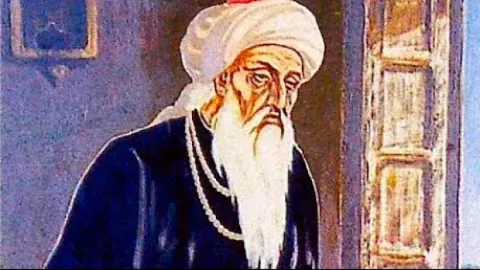
Najm al-Din Kubra
Khwarazmian Sufi master of the 12th–13th centuries and founder of the Kubrawiyya order, who refused to leave Gurganj during the Mongol siege of 1221 and died defending the city.
- Occupation:
- Religious figure, Writer
- Real name:
- Ahmad ibn Umar
- Nickname:
- Abu al-Jannab
- Born:
- c. 1145 — 1221
- Birthplace:
- Khiva, Khorezm
- Father:
- Umar
Biography
Najm al-Din Kubra — in full Abu al-Jannab Ahmad ibn Umar al-Khiwaqi al-Khwarazmi — was born, according to tradition, in 540 AH (1145) in Khiva, in Khwarazm. The date is only approximate: accounts that he was about eighty at the time of the Mongol invasion make scholars treat it with caution. He grew up in a merchant family that valued religious learning. His byname Kubra is short for the Qur’anic phrase al-tammat al-kubra, “the greatest catastrophe”, one of the names of the Day of Judgement; his teacher is said to have given it to him because no one could beat him in a debate.
As a young man he left home to study and heard hadith from scholars in Nishapur, Hamadan, Isfahan, Mecca and Alexandria. By his own account, the Prophet appeared to him in a dream in Alexandria and gave him the kunya Abu al-Jannab, “the one who keeps away from the world”. At about thirty-five he gave up the outward sciences and began looking for a spiritual guide. The sources tell the story of his Sufi training in two ways, but both name the same three masters: Ismail al-Qasri of Dezful, Ammar ibn Yasir al-Bidlisi, a successor of Abu al-Najib Suhrawardi, and Ruzbihan al-Wazzan al-Misri, who lived in Cairo. According to one version, Ruzbihan gave him his daughter in marriage, and in Tabriz, where he was studying hadith, the ecstatic dervish Baba Faraj turned him wholly to the Sufi path.
In 580 AH (1184) Najm al-Din returned to Khwarazm, built a khanqah in its capital Gurganj (Urgench, today Konye-Urgench in Turkmenistan) and spent the rest of his life training disciples. The Kubrawiyya order dates from that year. The sources name some sixty of his successors, among them Majd al-Din Baghdadi, Najm al-Din Daya Razi, Radi al-Din Ali Lala, Sa’d al-Din Hamuya and Sayf al-Din Bakharzi; because he raised so many masters he was called wali-tarash, “the shaper of saints”. Abd al-Rahman Jami also counts Baha al-Din Walad, the father of Jalal al-Din Rumi, among his disciples, but neither Baha al-Din Walad’s writings nor Rumi’s bear this out. Najm al-Din was on good terms with the court of the Khwarazmshahs and met the philosopher Fakhr al-Din al-Razi in Khwarazm. According to legend, when Khwarazmshah Muhammad had his disciple Majd al-Din Baghdadi put to death, the shaykh never forgave the sultan and foretold disaster for the country.
At the centre of Kubra’s teaching is the analysis of the visions a Sufi sees during dhikr and spiritual exercises. In “The Fragrances of Beauty” he described them from his own experience: the seeker sees lights of different colours, and each colour points to a state of the heart — green light means the heart is alive, yellow light that it is sick; when the light rising from the heart meets the light descending from the Throne, the Qur’anic “light upon light” is reached. He held that man is a small world containing the whole universe. He set out his views in several treatises in Arabic, the best known being “The Ten Principles”; quatrains in Persian are also attributed to him. Late in life he was working on a commentary on the Qur’an.
In 618 AH (1221) the armies of Genghis Khan besieged and destroyed Gurganj. According to Rashid al-Din’s “Compendium of Chronicles”, Genghis Khan allowed the shaykh to leave the city, but he refused to save his own life while the city burned. The historian al-Yafi’i writes that he ordered his disciples, among them Sa’d al-Din Hamuya and Radi al-Din Ali Lala, to leave, then went into battle himself and was killed. Rashid al-Din reports that his body was never found among the many dead; another account says he was buried in his ruined khanqah.
A tomb attributed to him and a Sufi lodge beside it survive in Konye-Urgench. In the 1330s the traveller Ibn Battuta visited the shaykh’s mausoleum and noted that travellers were fed at the lodge. The present mausoleum was built in the first half of the 14th century and restored in the 19th by Muhammad Amin Khan of Khiva; in 2005 it was inscribed on the UNESCO World Heritage List as one of the monuments of Kunya-Urgench. In 1995 Uzbekistan marked the 850th anniversary of his birth, and his quatrains have been translated into Uzbek several times.
Career
- Kubrawiyya Sufi orderFounder (pir) · 1184–1221
Life path
- c. 1145Born in Khiva
Born into a merchant family that valued religious learning; the year of birth is approximate.
- Studying hadith
Heard hadith from scholars in Nishapur, Hamadan, Isfahan, Mecca and Alexandria.
- Turning to Sufism
At about thirty-five he gave up the outward sciences and trained on the Sufi path under Ismail al-Qasri, Ammar ibn Yasir al-Bidlisi and Ruzbihan al-Wazzan al-Misri.
- Egypt and Tabriz
According to tradition, he married Ruzbihan’s daughter in Cairo, and a meeting with the dervish Baba Faraj in Tabriz turned him wholly to the Sufi path.
- 1184Return to Khwarazm
Built a khanqah in Gurganj and began training disciples; the Kubrawiyya order dates from that year.
- 1184–1221The khanqah in Gurganj
Raised some sixty successors and became known as wali-tarash; wrote “The Fragrances of Beauty” and “The Ten Principles”.
- 1221Defence of Gurganj and death
During the Mongol siege he refused to leave the city, sent his disciples away and was killed in the fighting.
Works
- “The Fragrances of Beauty and the Openings of Majesty” (“Fawa’ih al-jamal wa fawatih al-jalal”)Treatise (in Arabic)
The author’s visions and experiences on the Sufi path: coloured lights, states of the heart and the soul, love and annihilation in God. One of the most original works in the history of Sufism; Fritz Meier’s critical edition was published in Wiesbaden in 1957, and it has been translated into Turkish and French.
- “The Ten Principles” (“Al-Usul al-ashara”)Treatise (in Arabic)
His best-known and most influential work, also called “The Nearest Path”: on repentance, renunciation, trust in God, contentment, seclusion, dhikr, turning to God, patience, vigilance and acceptance. Sayyid Ali Hamadani translated it into Persian, and Abd al-Ghafur Lari and Kamal al-Din Khwarazmi wrote Persian commentaries on it.
- “Epistle to the Wanderer Who Fears the Blame of the Blamer”Treatise (in Arabic)
On ten conditions for drawing near to God — purity, seclusion, silence, fasting, constant dhikr, surrender to the master and others. The author also made a Persian version of it himself.
- “The Manners of the Sufis” (“Adab al-sufiyya”)Treatise (in Persian)
Seven chapters on wearing the Sufi cloak, sitting and rising, entering the khanqah, receiving guests, sama and travel.
- QuatrainsPoetry (in Persian)
Persian rubais scattered through Sufi anthologies; some of them may well be his. They have been translated into Uzbek several times and were published in Tashkent in 1994 as “Jamoling menga bas”.
Legacy
Together with the Yasawiyya and the Khwajagan, the Kubrawiyya is counted among the three great Sufi orders that arose in Central Asia. Through his successors it spread in the 13th and 14th centuries from Central Asia to Iran, Iraq and India: Sayf al-Din Bakharzi established it in Bukhara and Sayyid Ali Hamadani took it to Kashmir. The analysis of visionary experience he began was carried on by Najm al-Din Daya Razi and Ala al-Dawla Simnani. The order later split into several branches, one of which, the Dhahabiyya, still exists in Iran. In Khwarazm Najm al-Din Kubra is revered as a saint who died for his city, and his mausoleum in Konye-Urgench has been a place of pilgrimage for centuries.
Era: Late 12th – early 13th century, the Khwarazmian Empire- A khanqah was founded in Gurganj, the beginning of the Kubrawiyya order (1184)
- The Mongols took Gurganj; Najm al-Din Kubra died defending the city (1221)
- The critical edition of “The Fragrances of Beauty” was published in Wiesbaden (1957)
- Uzbekistan marked the 850th anniversary of Najm al-Din Kubra’s birth (1995)
- The monuments of Kunya-Urgench, his mausoleum among them, were inscribed on the UNESCO World Heritage List (2005)