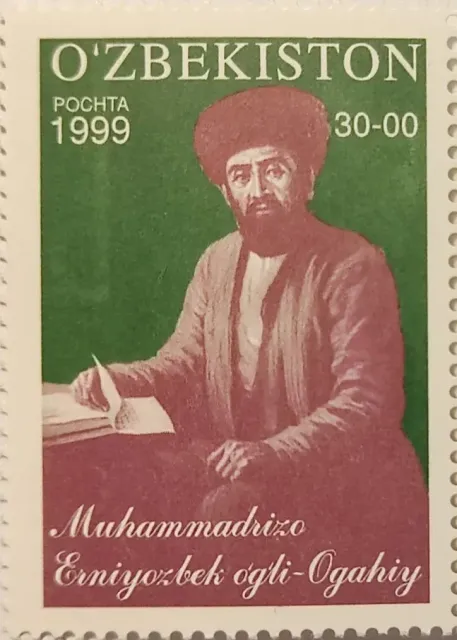
Agahi
Khivan poet, historian and translator, nephew and pupil of Munis, author of chronicles of the Khanate of Khiva, the divan “Amulet of Lovers” and more than twenty translations from Persian.
- Occupation:
- Writer, Scientist, Poet
- Real name:
- Muhammad Riza Erniyazbek oghli
- Born:
- December 17 1809(64 years old) ♐ — December 14, 1874
- Birthplace:
- Xiva District, Khorezm
- Father:
- Erniyazbek
Biography
Agahi was the pen name of Muhammad Riza, son of Erniyazbek. He was born on 17 December 1809 in the village of Qiyot (Kiyat) near Khiva. His family belonged to the Uzbek nobility of the Yuz tribe, and several generations of his forebears had served the khans of Khiva as mirabs, the officials who allotted irrigation water. His father died when he was very young, and he was brought up by his uncle, the poet and historian Shermuhammad Munis, who taught him to read and write and introduced him to the circle of Khorezm poets.
Muhammad Riza studied at the madrasas of Khiva, gained a good command of Arabic and Persian, and read Navoi, Fuzuli, Bedil and other classics. While still a student he compiled an anthology of Persian ghazals by Jami, Navoi, Hafiz, Bedil and Fuzuli and added fifteen ghazals and two mukhammases of his own. When Munis died of cholera in 1829, Allah Quli Khan appointed Agahi mirab in his place. The post kept him travelling around the oasis, and he came to know the hardships of its farmers at first hand. In 1845 he fell from his horse and lost the use of a leg, and in 1857 he gave up his office; he spent the rest of his life in want and poor health.
In 1839–1840, on Allah Quli Khan's orders, Agahi took up Munis's history of Khorezm, “Firdaws al-iqbal”, which Munis had brought only as far as 1812, and completed it with the first years of Allah Quli's own reign. After that he chronicled each reign in turn: “Riyaz al-dawla” is devoted to Allah Quli Khan, “Zubdat al-tawarikh” to Rahim Quli Khan, “Jami al-waqiat-i sultani” to Muhammad Amin Khan, “Gulshan-i dawlat” to Sayyid Muhammad Khan and “Shahid-i iqbal” to Muhammad Rahim Khan II; the last breaks off with the events of 1872, on the eve of the Russian capture of Khiva. The orientalist Vasily Bartold observed that from Rahim Quli's reign onwards these works become the notes of an eyewitness. Written in an ornate style with passages of verse, the chronicles give a detailed account of the Uzbeks, Turkmens, Karakalpaks and Kazakhs of the khanate and of its dealings with its neighbours; the historian Bayani carried Agahi's chronicle further.
Agahi did as much as a translator, rendering more than twenty historical, literary and moral works from Persian into Uzbek. They include Saadi's “Gulistan”, abridged so that a wide readership could follow it; Nizami's “Haft Paykar”, retold in prose; Jami's “Yusuf and Zulaykha” and Hilali's “The King and the Beggar”, translated almost couplet by couplet; the “Qabusnama”; Kashifi's “Akhlaq-i Muhsini”; histories by Mirkhond and Mahdi Khan Astarabadi; and the memoirs of Vasifi. His translations of Yazdi's “Zafarnama”, Jami's “Salaman and Absal” and Amir Khusrau's “Hasht Bihisht” have not been found.
Among the people Agahi is known above all as a lyric poet. In 1872 he gathered his scattered verse into the divan “Ta'wiz al-'ashiqin” (“Amulet of Lovers”): some 18,000 lines, including 470 ghazals, 89 mukhammases, 80 rubais, 19 qasidas and poems in some fifteen other forms, among them 1,300 lines in Persian. Love is its main theme, but it also has much to say about the times and his contemporaries, lamenting injustice and hypocrisy. Agahi lengthened the ghazal to as many as 23 couplets and devised a new form of the mustazad, and his ghazals fit the melodies of the Shashmaqam and of Khorezm folk tunes. He set out his advice to a ruler in the “Qasida of Counsel”, addressed to Muhammad Rahim Khan II, himself a poet under the name Feruz; the khan had Agahi's couplets carved in marble in the halls where petitions were heard.
Agahi died on 14 December 1874. His divan was lithographed in Khiva in 1905–1909, a six-volume edition of his works appeared in Tashkent in 1971–1980, and parts of his chronicles were published in Russian translation in 1938 in “Materials on the History of the Turkmens and Turkmenia”. The Khorezm Regional Music and Drama Theatre in Urgench, streets and schools bear his name; in Qiyot there is a park named after him with his house museum and a creative school. In 1999 Uzbekistan issued a postage stamp dedicated to the poet.
Career
- Court of the Khanate of KhivaMirab (1829–1857) and court historian · Khiva · 1829–1872
Life path
- 1809Birth
Born on 17 December in the village of Qiyot near Khiva, into the family of the mirab Erniyazbek.
- 1810sIn Munis's household
After his father's early death he grew up with his uncle, the poet and historian Munis.
- 1820sThe madrasas of Khiva
Studied Arabic and Persian and compiled an anthology of Persian ghazals with poems of his own.
- 1829Mirab
After Munis's death Allah Quli Khan appointed him mirab.
- 1839–1840Chronicler
On the khan's orders began to continue Munis's “Firdaws al-iqbal”.
- 1844“Riyaz al-dawla”
Completed the chronicle of Allah Quli Khan's reign.
- 1845A fall from his horse
After the fall he lost the use of a leg.
- 1857Retirement
Left the post of mirab; completed the chronicle of Muhammad Amin Khan.
- 1865“Gulshan-i dawlat”
The chronicle of Sayyid Muhammad Khan's reign.
- 1872The divan and the last chronicle
Compiled the divan “Amulet of Lovers”; the chronicle “Shahid-i iqbal” breaks off with the events of that year.
- 1874Death
Died on 14 December.
- 1905–1909The divan in print
The divan was lithographed in Khiva.
Works
- “Paradise of Felicity” (“Firdaws al-iqbal”)Chronicle, continuing Munis
The history of Khorezm begun by Munis; Agahi carried it to the first years of Allah Quli Khan's reign.
- “Gardens of the State” (“Riyaz al-dawla”) (1844)Chronicle
The reign of Allah Quli Khan, events of 1825–1842.
- “The Cream of Chronicles” (“Zubdat al-tawarikh”) (1846)Chronicle
The reign of Rahim Quli Khan, events of 1843–1846.
- “Compendium of Royal Events” (“Jami al-waqiat-i sultani”) (1857)Chronicle
The reign of Muhammad Amin Khan, events of 1846–1855.
- “Flower Garden of Fortune” (“Gulshan-i dawlat”) (1865)Chronicle
The reign of Sayyid Muhammad Khan, events of 1856–1865.
- “Witness of Fortune” (“Shahid-i iqbal”) (1872)Chronicle (unfinished)
The first years of Muhammad Rahim Khan II; breaks off with the events of 1872, on the eve of the fall of Khiva.
- “Amulet of Lovers” (“Ta'wiz al-'ashiqin”) (1872)Divan
Some 18,000 lines of lyric verse in about twenty forms, including 1,300 lines in Persian; lithographed in Khiva in 1905–1909.
- “Qasida of Counsel” (“Qasida-yi nasihat”)Qasida
Addressed to Muhammad Rahim Khan II (Feruz), on what a just ruler should be.
- Saadi's “Gulistan”Translation from Persian
An abridged version meant for a wide readership.
- Jami's “Yusuf and Zulaykha”Translation from Persian
A verse translation of the poem made almost couplet by couplet.
Legacy
Together with Munis, Agahi created the official history of the Khanate of Khiva, carried down to the eve of the Russian conquest; his chronicles are among the chief sources for the nineteenth-century history of Khorezm and of its Uzbeks, Turkmens and Karakalpaks. His translations of more than twenty Persian books opened them to Uzbek readers, and his close rendering of the original is regarded as new for its time. His ghazals were set to the melodies of the Shashmaqam, his lines are sung in the song “Feruz”, his counsel influenced the poet-khan Feruz, and Bayani continued his chronicle.
Era: The Khanate of Khiva under the Qungrat dynasty, from Allah Quli Khan to Muhammad Rahim Khan II (1820s–1870s)- Appointed mirab after the death of Munis (1829)
- Began to continue the “Firdaws al-iqbal” (1839)
- Compiled the divan “Amulet of Lovers” (1872)
- Russian troops took Khiva, and the khanate became a Russian protectorate (1873)
- Lithographic printing of the divan began in Khiva (1905)
- Parts of the chronicles were published in Russian in “Materials on the History of the Turkmens and Turkmenia” (1938)
- A six-volume edition of his works began to appear (1971)
- Uzbekistan issued a postage stamp dedicated to him (1999)