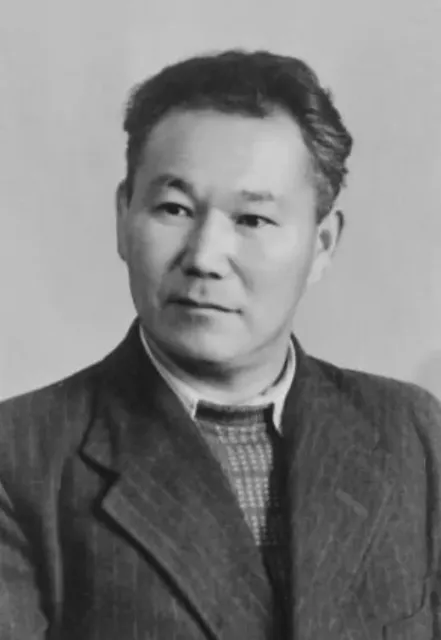
Ural Tansykbayev
Uzbek painter of Kazakh descent, a master of landscape and one of the founders of easel painting in Uzbekistan; People's Artist of the USSR (1963) and full member of the USSR Academy of Arts.
Biography
Ural Tansykbayev was born in Tashkent on 14 January 1904 (1 January Old Style) into a working-class family of Kazakh origin. After a seven-year school he worked at a tobacco factory and then at a winery. He took up painting in earnest at about twenty, and his first pictures were shown in the factory club.
From 1924 to 1928 he studied at the art studio of the Tashkent Museum of Arts under Nikolai Rozanov, and in 1928–1929 at the Penza Art and Pedagogical College under Ivan Goryushkin-Sorokopudov and Nikolai Petrov. In 1929 he visited Moscow, where the museums showed him recent Western European, above all French, painting — an encounter that shaped his early experiments. He began to exhibit that year, and in 1932 he joined the board of the newly founded Union of Artists of Uzbekistan.
His canvases of the late 1920s and early 1930s — “Portrait of an Uzbek” (1927), “Nomad Camp” (1931), “Crimson Autumn” (1931) — reflect Post-Impressionism and Fauvism, with resonant decorative colour and simplified forms. They earned him the nickname “the Uzbek Gauguin”, and after the exhibitions of Uzbek art in Moscow and Philadelphia in 1934 critics called him the leader of the Uzbek colourists. In 1938 he designed the sets and costumes for the first Kazakh ballet, Vasily Velikanov's “Kalkaman and Mamyr”, at the opera and ballet theatre in Alma-Ata.
From the later 1930s landscape became his main genre, and his manner grew more restrained and realistic. In 1942 he went to the front near Moscow with a delegation from Uzbekistan and afterwards painted the series “On the Roads of War”. He was named an Honoured Art Worker of the Uzbek SSR in 1943 and a People's Artist of the Uzbek SSR in 1944. After the war he painted mountain and rural landscapes, among them “Native Land” and “Evening on Issyk-Kul” (both 1951), and in 1952–1955 he worked with other artists on murals for the Uzbek SSR pavilion at the All-Union Agricultural Exhibition in Moscow.
He was elected a corresponding member of the USSR Academy of Arts in 1954 and a full member in 1958. He chaired the board of the Union of Artists of the Uzbek SSR in 1956–1960, was secretary of the board of the Union of Artists of the USSR in 1957–1968 and a deputy of the Supreme Soviet of the Uzbek SSR in 1959–1972. His “Morning at the Kairakkum Hydroelectric Station” (1957) is in the State Museum of Oriental Art in Moscow. He won silver medals at the All-Union Art Exhibition of 1957 and at the 1958 Brussels World's Fair, became a People's Artist of the USSR in 1963 and received the Order of Lenin in 1964.
In the 1960s and 1970s he painted the mountains of the Pamirs, the Alai and Kyrgyzstan and the construction sites of Uzbekistan: “The Mountain Road from Angren to Kokand” (1962), “At the Charvak Construction Site” (1970) and “My Song” (1972) from the series “Native Uzbekistan”. In 1973 he received the Hamza State Prize of the Uzbek SSR. Tansykbayev died on 18 April 1974 in Nukus, where he had come to choose works from the Karakalpak art museum for a solo exhibition, and was buried at the Chigatai cemetery in Tashkent.
More than five hundred of his works are held by the Savitsky State Museum of Arts of Karakalpakstan in Nukus; others are in the State Museum of Arts of Uzbekistan, the State Museum of Oriental Art in Moscow and the Kasteyev State Museum of Arts of Kazakhstan in Almaty. In 1981 the house in Tashkent where he lived from 1967 to 1974 opened as the Ural Tansykbayev Memorial House-Museum, with his widow Yelizaveta Tansykbayeva as its director. In 2001 he was posthumously awarded the Order “For Outstanding Merit”. A college of decorative and applied arts in Almaty bears his name.
Education
- Art studio of the Tashkent Museum of ArtsOther · Tashkent · 1924–1928 · Painting under Nikolai Rozanov
- Penza Art and Pedagogical CollegeCollege · 1928–1929 · Painting under Ivan Goryushkin-Sorokopudov and Nikolai Petrov
Career
- Supreme Soviet of the Uzbek SSRDeputy · Tashkent · 1959–1972
- Union of Artists of UzbekistanChairman of the board · Tashkent · 1956–1960Everyone who held this post →
- Union of Artists of the USSRSecretary of the board · 1957–1968
- USSR Academy of ArtsCorresponding member (1954), full member (1958) · 1954–1974
Awards
 Order «For Outstanding Merit»2001, posthumously · Uzbekistan
 People's Painter of the Uzbek SSR1944 · Uzbek SSR
- Honoured Art Worker of the Uzbek SSR1943 · Uzbek SSR
 Hamza State Prize of the Uzbek SSR1973 · Uzbek SSR
 People's Painter of the USSR1963 · USSR
 Order of Lenin1964 · USSR
 Order of the Red Banner of Labour1951 · USSR
- Order of the Red Banner of Labour1955 · USSR
- Order of the Red Banner of Labour1957 · USSR
Life path
- 1924–1928Rozanov's studio
Studied painting at the art studio of the Tashkent Museum of Arts.
- 1928–1929Penza college
Studied at the art and pedagogical college under Ivan Goryushkin-Sorokopudov and Nikolai Petrov.
- 1929First exhibitions
Saw recent Western European painting in the Moscow museums and began to exhibit.
- 1934Exhibitions in Moscow and Philadelphia
After the shows of Uzbek art critics called him the leader of the Uzbek colourists.
- 1938The ballet “Kalkaman and Mamyr”
Designed the first Kazakh ballet at the opera and ballet theatre in Alma-Ata.
- 1942At the front
Visited the front near Moscow with a delegation from Uzbekistan; the series “On the Roads of War”.
- 1943–1944Honorary titles of the Uzbek SSR
Honoured Art Worker (1943) and People's Artist of the Uzbek SSR (1944).
- 1954–1958USSR Academy of Arts
Corresponding member (1954), full member (1958); a silver medal at the 1958 Brussels World's Fair.
- 1956–1960Head of the Union of Artists
Chairman of the board of the Union of Artists of the Uzbek SSR.
- 1963People's Artist of the USSR
Awarded the honorary title; the Order of Lenin followed in 1964.
- 1973Hamza Prize
Laureate of the Hamza State Prize of the Uzbek SSR.
- 1974Death
Died on 18 April in Nukus; buried in Tashkent.
Works
- “Portrait of an Uzbek” (1927)Painting
An early decorative canvas; State Museum of Oriental Art, Moscow.
- “Nomad Camp” (1931)Painting
From his Post-Impressionist period; State Museum of Oriental Art, Moscow.
- “Crimson Autumn” (1931)Painting
A canvas with colour heightened in the Post-Impressionist manner.
- “Kalkaman and Mamyr” (1938)Stage design
Sets and costumes for the first Kazakh ballet, with music by Vasily Velikanov, Alma-Ata.
- “On the Roads of War” (1942)Series of paintings
Painted after a visit to the front near Moscow with a delegation from Uzbekistan.
- “Native Land” (1951)Painting
A generalised image of his native landscape; State Museum of Arts of Uzbekistan.
- “Evening on Issyk-Kul” (1951)Painting
A mountain landscape; State Museum of Arts of Uzbekistan.
- Murals for the Uzbek SSR pavilion at the All-Union Agricultural Exhibition (1952)Monumental painting
Made with other artists in 1952–1955 for the exhibition in Moscow.
- “Morning at the Kairakkum Hydroelectric Station” (1957)Painting
An industrial landscape; State Museum of Oriental Art, Moscow.
- “The Mountain Road from Angren to Kokand” (1962)Painting
The mountain road linking Angren with the Fergana Valley.
- “At the Charvak Construction Site” (1970)Painting
The building of the Charvak hydroelectric dam; collection of the Union of Artists of the USSR.
- “My Song” (1972)Painting
From the landscape series “Native Uzbekistan”.
Legacy
Tansykbayev was among the first painters from Uzbekistan's native peoples to master European easel painting, and over half a century he made landscape one of the leading genres of Uzbek art, from the decorative canvases of the 1920s and 1930s to the large landscape paintings of the 1950s–1970s. His works are held by museums in Nukus, Tashkent, Moscow and Almaty, and his memorial house-museum is open in Tashkent.
Era: The formation of Uzbek easel painting, 1920s–1970s- Exhibitions of Uzbek art in Moscow and Philadelphia (1934)
- Named People's Artist of the USSR (1963)
- His memorial house-museum opened in Tashkent (1981)
- Posthumously awarded the Order “For Outstanding Merit” (2001)