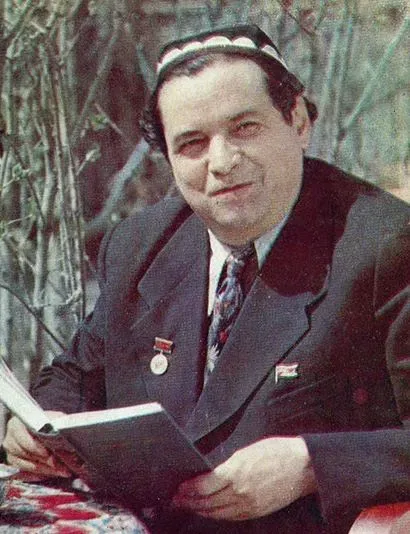
Oybek
Uzbek novelist, poet and literary scholar, author of the novels “Sacred Blood” (“Qutlug' qon”) and “Navoi”, People’s Writer of the Uzbek SSR and a member of the Academy of Sciences of Uzbekistan.
- Occupation:
- Writer, Poet, Prose writer
- Real name:
- Musa Tashmukhamedov
- Born:
- January 10 1905(63 years old) ♑ — July 1, 1968
- Birthplace:
- Tashkent
- Father:
- Toshmuhammad
- Spouse:
- Zarifa Saidnosirova
- Children:
- Omon, Bekjon Toshmuhammedov, Suyunbek, Gulrang
Biography
Oybek (born Muso Toshmuhammad o'g'li, known in Russian as Musa Tashmukhamedov) was born on 10 January 1905 in Tashkent into a weaver’s family. His father took his cloth from village to village to sell and sometimes brought his son along; the writer later described these years in his memoir “Childhood”. He studied at Munavvar Qori Abdurashidxonov’s “Namuna” school and in 1922–1925 at the Tashkent Technical College of Education. In 1927 he went to study at the Leningrad Institute of National Economy, but the climate damaged his health, and he returned to Tashkent, graduating from the Faculty of Social Sciences of the Central Asian State University in 1930.
He began as a poet: his first poem, “The Sound of the Instrument”, was printed in the magazine “Armug'on” in 1922. The collections “Feelings” (1926) and “Reeds of the Heart” (1929), written under the influence of Cho'lpon’s poetry, were followed by the collection “The Torch” (1932) and the narrative poems “Dilbar, Daughter of the Age”, “Revenge” and “Baxtigul and Sog'indiq”. In 1936 he translated Pushkin’s “Eugene Onegin” into Uzbek. In the 1930s he taught language, literature and political economy at several colleges and worked as a researcher at the Research Institute of Cultural Development (1933) and the Institute of Language and Literature (1934–1937).
In the mid-1930s Oybek wrote a critical study of Abdulla Qodiriy’s work; historians note that it was later cited as evidence in the case against Qodiriy. In 1937 Oybek himself was accused of sympathising with “nationalists”, dismissed and persecuted; only at the end of 1938 was he taken on as a translator and editor at the Educational and Pedagogical Publishing House. In those years he wrote the novel “Sacred Blood” (“Qutlug' qon”) about life in and around Tashkent on the eve of the 1916 uprising and the fate of the farmhand Yo'lchi and Gulnor (written in 1938, published in 1940). A film of the same name was made from it in 1956.
During the war he finished the novel “Navoi”, for which he had studied the poet’s life and 15th-century Khorasan in depth. It came out in 1944 and won a first-class Stalin Prize in 1946; the National Encyclopedia of Uzbekistan credits it with starting the historical-biographical novel in Uzbek literature. In the same years he wrote patriotic poems and the libretto of the opera “Mahmud Torobiy” (1944), and travelled to the front. In 1943 he was elected a full member of the newly founded Academy of Sciences of Uzbekistan and headed its social sciences division until 1950; after Hamid Olimjon’s death he led the Writers’ Union of Uzbekistan and edited the magazine “Sharq yulduzi”. He was a deputy of the Supreme Soviet of the USSR (1946–1950, 1958–1966) and joined the Communist Party in 1948.
In 1949 he published “Winds of the Golden Valley”, a novel about the post-war village, and a trip to Pakistan gave him the material for the narrative poem “Zafar and Zahro”. In 1950–1952 he was director of the Institute of Language and Literature. In 1951 a severe stroke left him almost unable to use his hand or to speak; from then on he dictated his books to his wife, the chemist Zarifa Saidnosirova. In this way he produced the novel “The Sun Will Not Fade” (1958) about Uzbek soldiers in the Second World War, the novella “In Search of Light”, the autobiographical “Childhood” (1962) and the novel “The Great Road” (1967), a sequel to “Sacred Blood”. “Childhood” won him the Hamza State Prize of the Uzbek SSR in 1964, and in 1965 he was named People’s Writer of the Uzbek SSR. From 1958 to 1968 he was editor-in-chief of the journal “O'zbek tili va adabiyoti”.
Oybek also worked widely as a translator and literary scholar: he translated Lermontov’s “Masquerade”, Molière’s “Tartuffe”, the Armenian epic “David of Sassoun” and works by Heine, Krylov and Belinsky into Uzbek. His articles on Navoi were collected in “Navoiy gulshani”, and with A. Deich he wrote an essay on Navoi in Russian. As one of the leaders of the Writers’ Union and the Academy of Sciences, he directed the preparations for the 500th anniversary of Navoi’s birth.
Oybek died in Tashkent on 1 July 1968 and was buried in the Chig'atoy cemetery. His complete works were published in 20 volumes in 1975–1985, and in 2000 he was posthumously awarded the Order “For Outstanding Merit” (“Buyuk xizmatlari uchun”). In 1980 the Tashkent house where he lived became a museum; a metro station and a street in Tashkent bear his name, and his centenary was marked nationally in 2005. Oybek and Zarifa Saidnosirova raised four children — Omon, Bekjon, Suyunbek and Gulrang; their son Bekjon Toshmuhammedov became a biophysicist and a member of the Academy of Sciences of Uzbekistan.
Education
- Tashkent Technical College of EducationCollege · Tashkent · 1922–1925
- Leningrad Institute of National EconomyUniversity · 1927
- Namuna schoolSchool · Tashkent
- National University of UzbekistanUniversity · Tashkent · 1930 · Faculty of Social Sciences (then the Central Asian State University)
Career
- Academy of Sciences of UzbekistanAcademician; head of the social sciences division, director of the Institute of Language and Literature (1950–1952) · Tashkent · 1943–1968
- «Sharq yulduzi» magazineEditor · Tashkent
Awards
 Order «For Outstanding Merit»2000, posthumously · Uzbekistan
- People's Writer of the Uzbek SSR1965 · Uzbek SSR
 Hamza State Prize of the Uzbek SSR1964 · Uzbek SSR
 Order of Lenin1944 · USSR
- Order of Lenin1950 · USSR
- Order of Lenin1957 · USSR
 Order of the Red Banner of Labour1955 · USSR
 Order of the Badge of Honour1951 · USSR
 Stalin Prize1946 · USSR
Life path
- 1922–1930Education
Tashkent Technical College of Education (1922–1925), Leningrad Institute of National Economy (from 1927), Faculty of Social Sciences of the Central Asian State University (graduated in 1930).
- 1922–1926First poems
His first poem appeared in the magazine “Armug'on”; the collection “Feelings” came out in 1926.
- 1930–1937Teaching and research
Taught at colleges and worked as a researcher at the Institute of Language and Literature; translated “Eugene Onegin” in 1936.
- 1937–1938Persecution
Accused of sympathising with “nationalists” and dismissed; at the end of 1938 taken on as a translator and editor at a publishing house.
- 1940“Sacred Blood”
His first novel, written in 1938, was published.
- 1943Academician
Elected a full member of the Academy of Sciences of Uzbekistan; headed its social sciences division until 1950.
- 1944–1946The novel “Navoi”
Published in 1944 and awarded a Stalin Prize in 1946.
- 1950–1952Institute of Language and Literature
Director of the institute.
- 1951Serious illness
After a stroke he dictated his books to his wife, Zarifa Saidnosirova.
- 1958–1968“O'zbek tili va adabiyoti” journal
Editor-in-chief; the novel “The Sun Will Not Fade” came out in 1958.
- 1962–1965“Childhood” and the title
Hamza State Prize of the Uzbek SSR for “Childhood” (1964); People’s Writer of the Uzbek SSR (1965).
- 1968Death
Died in Tashkent on 1 July and was buried in the Chig'atoy cemetery.
Works
- “Feelings” (1926)Poetry collection
The poet’s first collection.
- “The Torch” (1932)Poetry collection
A collection of his free verse of the early 1930s.
- Translation of “Eugene Onegin” (1936)Translation
Pushkin’s novel in verse in Uzbek.
- “Sacred Blood” (1940)Novel
Life in Tashkent on the eve of the 1916 uprising; filmed in 1956.
- “Navoi” (1944)Historical-biographical novel
About Alisher Navoi and 15th-century Khorasan; awarded a Stalin Prize in 1946.
- “Winds of the Golden Valley” (1949)Novel
About life in the post-war village.
- “Zafar and Zahro” (1950)Narrative poem
Written from his impressions of a trip to Pakistan.
- “The Sun Will Not Fade” (1958)Novel
About Uzbek soldiers in the Second World War; completed during his illness.
- “Childhood” (1962)Autobiographical novella
The writer’s memories of his childhood; awarded the Hamza State Prize of the Uzbek SSR in 1964.
- “The Great Road” (1967)Novel
A sequel to “Sacred Blood”, following its characters in the 1920s.
- “Guli and Navoi” (1968)Narrative poem
One of his last narrative poems.
Legacy
The National Encyclopedia of Uzbekistan credits “Navoi” with starting the historical-biographical novel in Uzbek literature and preparing the way for later books such as “Ulugbek’s Treasure” and “Starry Nights”. The novel has been translated into many languages, Russian among them, and “Sacred Blood” was filmed. His translations of “Eugene Onegin”, “Masquerade” and “Tartuffe” enriched the Uzbek school of literary translation. A house museum, a metro station and a street in Tashkent bear his name.
Era: 20th-century Uzbek Soviet literature- The novel “Navoi” won a Stalin Prize (1946)
- The film “Sacred Blood” was made (1956)
- The Oybek House Museum was founded in Tashkent (1980)
- Posthumously awarded the Order “For Outstanding Merit” (2000)
- His centenary was marked (2005)