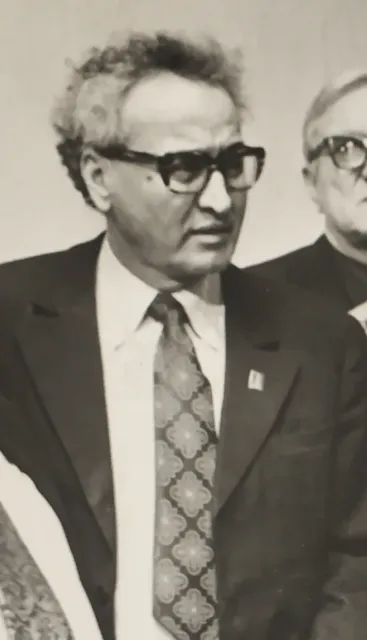
Tashkent-born satirist, fabulist and translator who worked at Mushtum and Sharq Yulduzi, co-founded the Nashtar film magazine and was an Honoured Worker of Culture of the Uzbek SSR.
- Occupation:
- Writer, Prose writer, Screenwriter
- Lived:
- February 22 1922 ♓ — 1990
- Birthplace:
- Tashkent
Biography
Sami Abduqahhor was born in Tashkent on 22 February 1922. He is remembered in Uzbek literature chiefly as a satirist, fabulist and author for children, and he also worked as a screenwriter, film-dubbing specialist and translator.
After finishing seven years of school in 1936 he attended the party-press school of the Uzbek Communist Party's Central Committee (graduating in 1938) and in 1939 enrolled in the philology faculty of Samarkand State University. From April 1942 to May 1946 he served in the border troops.
His first satirical stories and sketches appeared in 1937, and from 1938 he worked at the magazine Mushtum. He later headed a department at the newspaper Yosh Leninchi, served as a senior editor at the state publishing house, and in 1956 became executive secretary of the Fergana branch of the Writers' Union. From 1958 he was an editor at Uzbekfilm, and in 1960–1966 he ran the prose department of Sharq Yulduzi.
In 1966 he co-founded, with Anatoly Kabulov, the satirical film magazine Nashtar and was its executive secretary; he wrote scripts for more than fifty issues and directed some of them. He also wrote for the Soviet newsreel Fitil, and in 1972 co-wrote the television film Tashvish davri with Dmitry Bulgakov.
His first book, Frontline Stories, came out in 1945. About 38 of his books appeared in Uzbek and Russian during his lifetime: fables, satirical stories, verse for children, novellas and plays (The Adventures of Samad, 1973). He translated Lermontov, Herzen, Chekhov, Andersen, Molière, Krylov, Gorky, Marshak, Tagore and the Finnish author Martti Larni into Uzbek, and dubbed over forty-five feature films into Uzbek.
In 1977 he was named Honoured Worker of Culture of the Uzbek SSR. He belonged to the USSR Writers' and Cinematographers' Unions. He died in Tashkent in 1990 and was buried at Chigatay cemetery; a street in Sherabad bears his name. Sources disagree on the day of death (9 January or 9 February), so only the year is given.
Education
- Samarkand State UniversityUniversity · Samarkand · 1939 · Faculty of philology
Career
- Mushtum magazineStaff member · 1938–…
- «Sharq yulduzi» magazineHead of the prose department · Tashkent · 1960–1966
- Union of Soviet WritersMember
- Uzbekfilm studioEditor and screenwriter · Tashkent · 1958–…
Awards
 Honoured Worker of Culture of the Uzbek SSR1977 · Uzbek SSR
Life path
- 1937First publications
His first satirical stories and sketches were printed.
- 1938At Mushtum magazine
Joined the staff of the satirical magazine.
- 1939Samarkand University
Admitted to the philology faculty.
- 1942–1946Military service
Served in the border troops.
- 1945Frontline Stories
His first book was published.
- 1956Fergana branch of the Writers' Union
Became executive secretary.
- 1958Editor at Uzbekfilm
Began working as an editor at the film studio.
- 1960–1966Sharq Yulduzi
Headed the magazine's prose department.
- 1966Nashtar film magazine
Co-founded it with A. Kabulov and served as executive secretary.
- 1972Tashvish davri
Co-wrote the television film script with D. Bulgakov.
- 1977Title
Named Honoured Worker of Culture of the Uzbek SSR.
- 1990Death
Died in Tashkent.
Works
- «Front hikoyalari» (1945)Short stories
- «Basni» (1954)Fables
- «Nachalo zhizni» (1959)Novella
- «Uchyonyy gus i mnogie drugie» (1964)Collection
- «Valijan-shutnik» (1968)Children's verse
- «Samadning sarguzashtlari» (1973)Play
- «Tashvish davri» (1972)Screenplay (with D. Bulgakov)
- «Berezhite muzhchin»Collection
- «Tashkenbay iz Afriki» (1989)Novella and stories