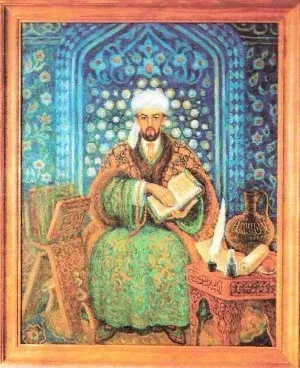
Biography
Sayf-i Sarayi was a 14th-century Turkic poet and translator. Very little is known about his life; the main source is his own work and the poems copied alongside it. His nisba, Sarayi, shows that he grew up in Sarai, the capital of the Golden Horde. His birth is usually dated to 1321. Opinions on his birthplace differ: Tatar scholars place it in the town of Kamyshly on the Volga, some sources name Saraichik on the Ural (Yaik) River, and Uzbek literary historians the village of Qamishli in Khorezm.
Some researchers believe that he spent his youth in Khorezm and received his first schooling there. He went on to study in Sarai, where he made his name as a poet. His verse shows a well-read man with a good command of Persian language and literature; Uzbek sources add that he also knew Arabic. His naziras — poems written in response to works by Khwarazmi, author of the “Muhabbatnama”, and by Hasanoghlu — show that he could write with ease in other literary varieties of Turkic as well.
In the second half of the 14th century the Golden Horde was torn by struggles for the throne, and many poets and scholars left for calmer lands such as Turkestan and Mamluk Egypt. Sayf-i Sarayi also moved to Egypt, though when and by what route is uncertain. Tatar and Russian sources say he moved in the 1380s, and Tatar scholars hold that he served in the sultan's chancery there. According to Uzbek sources, he left his homeland because of the wars between Timur and Tokhtamysh and reached Egypt by way of Iran and Anatolia.
In Egypt, at the request of the Mamluk emir Batkhas, Sayf-i Sarayi translated Saadi of Shiraz's “Gulistan” into Turkic. The book, titled “Gulistan bi't-Turki” (“The Turkic Gulistan”), was completed on 1 Shawwal 793 AH, that is, 1 September 1391, and is regarded as the first translation of the “Gulistan” into a Turkic language. The prose of the original is rendered in prose and its verse in verse; the translator shortened some passages and expanded others with his own stories and poems and with ghazals by other poets. Like Saadi's work, it has eight chapters — on kings, on the ways of dervishes, on contentment, on silence, on love and youth, on old age, on education and on the rules of conduct. Linguists count it among the most important written monuments of Kipchak Turkic.
In 1394 he wrote the poem “Suhayl and Guldursun”, a masnavi of about eighty couplets preserved in a small manuscript collection known as the “Yadigarnama”, together with poems by Tughli Khoja, Mawlana Ishaq and Ahmad Urganji. It tells the tragic love story of a captive young man, Suhayl, and Guldursun, set against the destruction of Urgench by Timur's army in 1388, and condemns the cruelty of war and of unjust rulers. More than ten of his ghazals also survive, along with qasidas, qit'as and rubais, among them a rubai on the arrival of Ahmad Jalayir in Egypt in 1393. Uzbek sources also mention a translation of the “Sindbadnama”, which has not survived.
Sayf-i Sarayi died in Egypt some time after 1394, around 1396 according to most sources. The only manuscript of the “Gulistan bi't-Turki” is kept in the library of Leiden University in the Netherlands, and a photocopy is held at the Institute of Oriental Studies in Tashkent. The book was published in facsimile in Ankara in 1954, in Tashkent in 1968, in Budapest in 1969 with an English translation, in Alma-Ata in 1975 with a study by the Turkologist Emir Najip, and in Kazan in 1980. Tatar, Kazakh, Uzbek and Turkish literary scholarship each study his legacy as part of their own literary history.
Life path
- c. 1321Birth
His birthplace is disputed: Kamyshly on the Volga, Saraichik on the Yaik, or the village of Qamishli in Khorezm.
- Studies in Sarai
Studied in Sarai, the capital of the Golden Horde, and became known there as a poet; some researchers think he had his first schooling in Khorezm.
- 1380s (probably)Move to Egypt
Left the troubled Golden Horde for Mamluk Egypt; when and by what route is uncertain.
- 1391“Gulistan bi't-Turki”
On 1 September completed his Turkic translation of Saadi's “Gulistan” for the Mamluk emir Batkhas.
- 1393Rubai for Ahmad Jalayir
Wrote a rubai on the arrival in Egypt of Sultan Ahmad Jalayir.
- 1394“Suhayl and Guldursun”
Completed his poem of love set during Timur's campaign against Urgench.
- c. 1396Death
Died in Egypt some time after 1394.
Works
- “Gulistan bi't-Turki” (1391)Translation, prose and verse
The first Turkic translation of Saadi's “Gulistan”: eight chapters expanded with the translator's own stories and poems. The only manuscript is at Leiden University.
- “Suhayl and Guldursun” (1394)Poem (masnavi)
A poem of about eighty couplets on the tragic love of the captive Suhayl and Guldursun, set against Timur's destruction of Urgench.
- GhazalsLyric poetry
More than ten ghazals survive, on love, friendship and human dignity, as well as social themes.
- Rubai for Ahmad Jalayir (1393)Rubai
Written on the arrival in Egypt of Sultan Ahmad Jalayir.
- Qasidas, qit'as and rubaisLyric poetry
Poems preserved in the manuscript of the “Gulistan bi't-Turki” and in the “Yadigarnama” collection.
- Naziras to Khwarazmi and HasanoghluNazira
Poems written in response to works by well-known poets.
- “Sindbadnama”Translation (lost)
A translation mentioned in Uzbek sources that has not survived.
Legacy
The “Gulistan bi't-Turki” is the first Turkic translation of Saadi's book and one of the largest monuments of Turkic literature from the Golden Horde and Mamluk Egypt. Linguists regard it as the most important record of Kipchak Turkic after the Codex Cumanicus, while “Suhayl and Guldursun” reflects Timur's campaign against Khorezm. The poet is studied in the literary histories of the Tatars, Kazakhs, Uzbeks and Turks, and his works have been published in Ankara, Tashkent, Budapest, Alma-Ata and Kazan.
Era: The Golden Horde and Mamluk Egypt, 14th century- The “Gulistan bi't-Turki” completed in Egypt (1391)
- The poem “Suhayl and Guldursun” written (1394)
- Facsimile edition of the “Gulistan bi't-Turki” published in Ankara (1954)
- The poet's verse and his “Gulistan” published in Tashkent (1968)
- Edition with an English translation published in Budapest (1969)
- Emir Najip's two-volume study published in Alma-Ata (1975)
- The “Gulistan bi't-Turki” published in Kazan (1980)