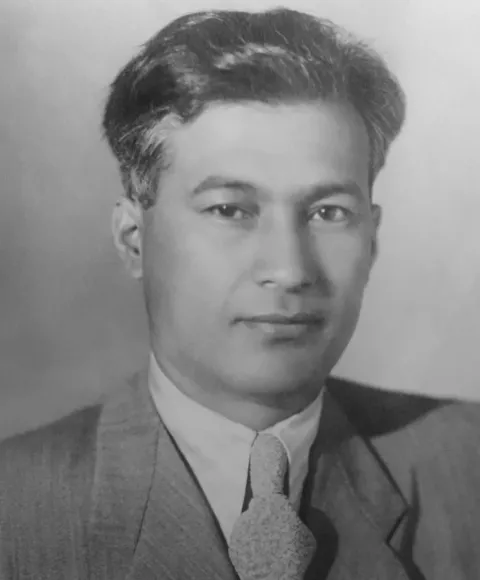
Sharof Rashidov
Soviet Uzbek party and state leader and writer; First Secretary of the Central Committee of the Communist Party of Uzbekistan from 1959 to 1983 and twice Hero of Socialist Labour.
- Occupation:
- Politician, Writer
- Born:
- November 6 1917(65 years old) ♏ — October 31, 1983
- Birthplace:
- Jizzakh
- Father:
- Rashid Khalilov
- Mother:
- Kuysinoy Khalilova
- Spouse:
- Khursan Rashidova
- Children:
- Sayyora Rashidova, Dilorom, Gulnora Rashidova, Svetlana Rashidova, Ilhom Rashidov
Biography
Sharof Rashidovich Rashidov was born on 6 November 1917 into a peasant family in the Sovungarlik quarter of Jizzakh. His father, Rashid Khalilov, was a cotton grower on a collective farm, and his mother, Kuysinoy, kept the household. After graduating from the Jizzakh Pedagogical College in 1935 he worked as a schoolteacher. From 1937 he was executive secretary, deputy editor and then editor of the Samarkand regional newspaper Lenin yo'li (now Zarafshon), while studying at the philological faculty of the Uzbek State University in Samarkand (now Samarkand State University), from which he graduated in 1941. He had been a member of the Communist Party since 1939.
After the outbreak of the war with Germany he was called up in 1941 and, as a junior lieutenant, fought in the battles near Moscow; severely wounded on the Volkhov Front, he returned to Uzbekistan, and in 1942 he was awarded the Order of the Red Star. He went back to editing Lenin yo'li, served as a secretary of the Samarkand regional party committee in 1944–1947 and as executive editor of the republican newspaper Qizil O'zbekiston in 1947–1949. In 1948 he completed the party school of the Central Committee of the All-Union Communist Party by correspondence, and in 1949–1950 he chaired the board of the Writers’ Union of Uzbekistan.
In August 1950 he was elected chairman of the Presidium of the Supreme Soviet of the Uzbek SSR, a post he held until 1959, serving at the same time as a deputy chairman of the Presidium of the Supreme Soviet of the USSR. In March 1959 he became First Secretary of the Central Committee of the Communist Party of Uzbekistan and led the republic for the rest of his life — almost a quarter of a century. From 1961 he was a member of the Central Committee of the CPSU and a candidate member of its Presidium (later the Politburo). He also took part in Soviet foreign policy: in 1957 he accompanied Kliment Voroshilov to Indonesia, Burma, China and Vietnam, in 1962 he led a Soviet delegation to Cuba, and in 1966 he helped prepare the Tashkent talks between the leaders of India and Pakistan, which ended in the Tashkent Declaration.
Under Rashidov cotton became Uzbekistan’s all-dominant crop: the Hungry, Karshi and Jizzakh steppes were brought under cultivation, the irrigated area grew, and Moscow’s cotton quotas rose year after year. In the same period the Muruntau gold deposit was developed and large enterprises such as the Tashkent aircraft and tractor plants expanded; after the 1966 earthquake Tashkent was rebuilt with the help of builders from across the Soviet Union, and in 1977 the city opened the first metro in Central Asia. Alongside this construction, the National Encyclopedia of Uzbekistan notes the damage done to the environment by the extensive use of land; the diversion of river water to the cotton fields was one of the causes of the shrinking of the Aral Sea. Historians also point to the widespread patronage and nepotism in the republic’s leadership of those years.
Rashidov began his literary career as a poet: his narrative poem “The Border Guard” (“Chegarachi”) appeared in 1937 and his collection of wartime verse “My Wrath” in 1945. He wrote the novellas “The Victors” (1951), about the reclamation of virgin land, and “Kashmiri Song” (1956), based on an Indian legend, and the novels “Stronger than the Storm” (1958) and “The Mighty Wave” (1964), about work on the home front during the war. “Kashmiri Song” was made into the animated film “Nargis” (1965) and “The Mighty Wave” into a feature film (1969); his works were published in Russian in five volumes (1979–1980). The National Encyclopedia of Uzbekistan observes that in his writing ideological aims outweighed artistic ones. He was twice made a Hero of Socialist Labour, in 1974 and 1977, received ten Orders of Lenin and was awarded the Lenin Prize in 1980.
In February 1983 the Politburo of the CPSU ordered an investigation into abuses in Uzbekistan’s cotton industry. Rashidov died on 31 October 1983 in the Ellikqala District of the Karakalpak ASSR while touring the republic; according to the official account, the cause was a heart attack. He was buried in the centre of Tashkent, in the square opposite the Lenin Museum. After his death an investigative team of the USSR Prosecutor’s Office led by Telman Gdlyan and Nikolai Ivanov conducted a sweeping inquiry that became known as the “cotton affair” (or the “Uzbek affair”). By the investigators’ estimates, in the late 1970s and early 1980s millions of tonnes of cotton had been delivered only on paper, with large sums paid out of the state budget for a crop that did not exist; by 1989 some 790 criminal cases had been opened and about 4,500 people charged. In the central press and at party plenums Rashidov was condemned as the chief culprit, and in the mid-1980s his remains were moved from the city centre to the Chigatai cemetery.
The investigators’ methods were later criticised, and in 1990 Gdlyan was expelled from the party and dismissed from the Prosecutor’s Office. On 25 December 1991 Islam Karimov pardoned everyone serving a sentence in Uzbekistan in connection with the case. Assessments of Rashidov differ: in Russian and Western sources his name long stood for the padded figures, corruption and nepotism of the Brezhnev era, whereas the National Encyclopedia of Uzbekistan writes that after his death the centre blamed him for all the vices of the totalitarian system and condemned him unjustly, and many Uzbeks saw the “cotton affair” as a campaign against the republic.
After independence Rashidov was rehabilitated: in 1992, on Islam Karimov’s initiative, his 75th anniversary was celebrated and a memorial museum opened in Jizzakh, and in 1994 he was posthumously awarded the Alisher Navoi State Prize as the originator and creative head of the architectural complex of the Palace of Friendship of Peoples in Tashkent. Streets in Tashkent, Samarkand and Andijan and an avenue in Jizzakh bear his name; in 2016 the Jizzakh District was renamed the Sharof Rashidov District, in 2017 the centenary of his birth was widely marked under a resolution of President Shavkat Mirziyoyev and a monument to him was unveiled in Jizzakh, and in 2022 Samarkand State University was named after him. With his wife, Khursan Gafurovna Rashidova (1920–2003), he raised five children — daughters Sayyora, Dilorom, Gulnora and Svetlana and a son, Ilhom; his daughter Sayyora Rashidova, a chemist and member of the Academy of Sciences, served as the Oliy Majlis Commissioner for Human Rights.
Education
- Jizzakh Pedagogical CollegeCollege · Jizzakh · 1935
- Samarkand State UniversityUniversity · Samarkand · 1941 · Faculty of Philology (then the Uzbek State University)
- All-Union Party School of the Central Committee of the VKP(b)Other · 1948 · By correspondence
Career
- Qizil O'zbekiston newspaperExecutive editor · Tashkent · 1947–1949
- Writers' Union of UzbekistanChairman of the board · Tashkent · 1949–1950Everyone who held this post →
- Zarafshon newspaperExecutive secretary, deputy editor, editor (the paper was then called Lenin yo'li) · Samarkand · 1937–1944
- Supreme Soviet of the Uzbek SSRChairman of the Presidium · Tashkent · 1950–1959Everyone who held this post →
- Communist Party of UzbekistanSecretary of the Samarkand regional committee (1944–1947), First Secretary of the Central Committee (1959–1983) · Tashkent · 1944–1983
- Communist Party of the Soviet UnionMember (from 1939); member of the Central Committee and candidate member of the Politburo (1961–1983) · 1939–1983
Awards
- Alisher Navoi State Prize of Uzbekistan1994, posthumously · Uzbekistan
 Hero of Socialist Labour1974 · USSR
- Hero of Socialist Labour1977 · USSR
 Order of Lenin1950 · USSR
- Order of Lenin1957 · USSR
- Order of Lenin1965 · USSR
- Order of Lenin1967 · USSR
- Order of Lenin1971 · USSR
- Order of Lenin1973 · USSR
- Order of Lenin1974 · USSR
- Order of Lenin1976 · USSR
- Order of Lenin1977 · USSR
- Order of Lenin1980 · USSR
 Order of the October Revolution1982 · USSR
 Order of the Red Banner of Labour1951 · USSR
 Order of the Red Star1942 · USSR
- Order of the Red Star1946 · USSR
 Order of the Badge of Honour1944 · USSR
 Lenin Prize1980 · USSR
Life path
- 1935–1937Schoolteacher
Graduated from the Jizzakh Pedagogical College and taught at a school.
- 1937–1941Lenin yo'li and university
Executive secretary, deputy editor and editor of the Samarkand regional newspaper; graduated from the philological faculty of the Uzbek State University in 1941.
- 1941–1942At the front
Fought as a junior lieutenant in the battles near Moscow and was severely wounded on the Volkhov Front.
- 1943–1949Newspapers and party work
Editor of Lenin yo'li, secretary of the Samarkand regional party committee (1944–1947), executive editor of Qizil O'zbekiston (1947–1949).
- 1949–1950Head of the Writers’ Union
Chairman of the board of the Writers’ Union of Uzbekistan.
- 1950–1959Chairman of the Presidium of the Supreme Soviet
Chairman of the Presidium of the Supreme Soviet of the Uzbek SSR and deputy chairman of the Presidium of the Supreme Soviet of the USSR.
- 1959First Secretary
Elected First Secretary of the Central Committee of the Communist Party of Uzbekistan, a post he held until his death.
- 1961In the CPSU leadership
Member of the Central Committee of the CPSU and candidate member of its Presidium (later the Politburo).
- 1966Tashkent Declaration and the earthquake
Helped prepare the Tashkent talks between the leaders of India and Pakistan; the rebuilding of Tashkent began after the earthquake.
- 1974, 1977Twice Hero of Socialist Labour
The titles were conferred by decrees of 30 December 1974 and 4 November 1977.
- 1983Death
Died on 31 October while touring Karakalpakstan; after his death came the sweeping investigation known as the “cotton affair”.
- 1992–2017Rehabilitation and memory
75th anniversary and a museum in Jizzakh (1992), the Alisher Navoi State Prize (1994), a district named after him (2016), centenary (2017).
Works
- “The Border Guard” (“Chegarachi”) (1937)Narrative poem
The author’s first major work.
- “My Wrath” (1945)Poetry collection
Poems of the war years.
- “The Victors” (1951)Novella
About the reclamation of virgin land.
- “Kashmiri Song” (1956)Novella
A lyrical novella based on an Indian legend; made into the animated film “Nargis” in 1965.
- “Stronger than the Storm” (1958)Novel
Continues the story of the characters of “The Victors”.
- “The Mighty Wave” (1964)Novel
About work on the home front during the war; filmed in 1969.
- Collected works in five volumes (1979)Collected works
Published in Russian in Moscow (1979–1980).
Legacy
Rashidov led Soviet Uzbekistan for almost a quarter of a century. Under him the republic’s industry and agriculture grew rapidly, Tashkent was rebuilt after the earthquake and given a metro, and anniversaries such as the 2,500th of Samarkand (1970) and the millennium of al-Biruni (1973) were widely celebrated. At the same time the cotton monoculture was entrenched, with serious environmental consequences. After his death he was condemned in connection with the “cotton affair”; since independence he has been rehabilitated and is honoured in Uzbekistan as a leader who defended the republic’s interests, while in Russian and Western sources his record remains contested.
Era: Soviet Uzbekistan, 1950–1983- The Tashkent Declaration was signed; the rebuilding of Tashkent began after the earthquake (1966)
- The Tashkent Metro opened (1977)
- Died; the investigation into the “cotton affair” began (1983)
- Islam Karimov pardoned those convicted in the “cotton affair” (1991)
- His 75th anniversary was marked and a memorial museum opened in Jizzakh (1992)
- Posthumously awarded the Alisher Navoi State Prize (1994)
- The Jizzakh District was renamed the Sharof Rashidov District (2016)
- His centenary was marked and a monument unveiled in Jizzakh (2017)
- Samarkand State University was named after him (2022)