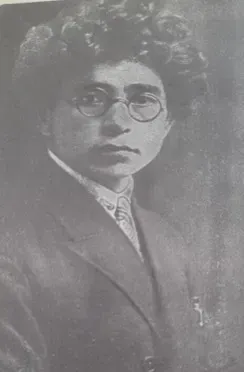
Shokir Sulaymon
Poet, prose writer, literary scholar and teacher from Kokand who helped shape Uzbek free verse and children’s literature; arrested in 1941 and executed during the Stalin-era repressions.
- Occupation:
- Writer, Educator, Poet, Prose writer, Children's writer
- Born:
- 1900 — 1942
- Birthplace:
- Kokand, Fergana
- Father:
- Sobirxo'ja
- Mother:
- Tiniqoy
- Spouse:
- Zaynab Mirsalimova
Biography
Shokir Sulaymon (born Shokir Sulaymonov) was born in 1900 in Kokand, on the eve of Navruz. His father Sobirkhoja was an educated man and the boy’s first teacher; Shokir then studied at the Irfon school of the Kokand Jadid Abduvahob Ibodiy and later at a Russian-native school.
In 1916–1917 he went to the Husayniya madrasa in Orenburg, where he came to know Jadid ideas at first hand. He studied at the Uzbek regional education institute in Tashkent (1920–1922), at a workers’ faculty in Moscow (1922–1924) and then at the Krupskaya Higher Pedagogical Academy (until 1926). In Moscow he took part in a literary circle of Turkestani students and wrote letters and articles for the press. He began writing poetry in 1919.
In 1926 he returned to Samarkand, then the republic’s capital, and taught Uzbek at a party school. He helped found the Qizil Qalam literary society (1926–1930) and later the Writers’ Union of Uzbekistan and its Samarkand branch. From 1927 to 1930 he was executive secretary of the journals Maorif va o‘qituvchi and Yer yuzi, and from 1931 to 1937 an assistant and then docent at the Uzbek State University.
He wrote the poetry collections “Erk kuylari” (1926), “G‘alaba marshi” (1928) and “Davr hayqirig‘i” (1932), and the long poems “Yangi saroy” (1931) and “O‘tganlarni eslaganda” (1933). With poems such as “Qul”, “Qutulish alangasi”, “Qonli devor” and “Sharq qizi” he helped establish free verse in Uzbek poetry. He also wrote short stories, books for children (“Oq negr”, “Yama ham Hama”, “Hindistonda”, “Butun dunyoga sayohat”) and translated children’s books from Russian. A volume of his selected works appeared in 1934 for the first congress of Uzbek writers.
He also took an interest in oral folk literature: in 1923 he published the articles “Xalq adabiyoti” and “Milliy kuy va ashulalarimiz” in the newspaper Farg‘ona, urging that folklore be collected. In 1938 he was an editor at the State Publishing House of Uzbekistan, and in 1940–1941 a senior researcher at the Institute of Language and Literature.
On 27 August 1941 he was arrested on charges of belonging to the organizations Ittihodi Tolibon and Milliy Ittihod, branded counter-revolutionary, and of nationalism; he was shot in 1942 (sources give different dates). He was rehabilitated in September 1956, and in 1964 his stories were published as the collection “O‘ch”.
Education
- Husayniya Madrasa in OrenburgMadrasa · 1916
- Uzbek Regional Education Institute in TashkentOther · Tashkent · 1920–1922
- Krupskaya Higher Pedagogical AcademyUniversity · 1924–1926
Career
- Writers' Union of UzbekistanTook part in founding the union · Tashkent
- State Publishing House of UzbekistanEditor · Tashkent · 1938–1938
- Institute of Language and LiteratureSenior researcher · Tashkent · 1940–1941
Life path
- 1900Born in Kokand
His family was educated; he had his first lessons from his father and then at the Irfon school.
- 1916–1917Husayniya madrasa, Orenburg
At a centre of Tatar reformers he came to know Jadid ideas.
- 1920–1926Studies in Tashkent and Moscow
The regional education institute, a Moscow workers’ faculty and the Higher Pedagogical Academy.
- 1926Return to Samarkand
Taught Uzbek at a party school and joined the Qizil Qalam society; “Erk kuylari” appeared.
- 1927–1930Executive secretary of journals
Worked at Maorif va o‘qituvchi and Yer yuzi.
- 1931–1937University teaching
Assistant and docent at the Uzbek State University.
- 1934Selected works
A volume of selected works was issued for the first congress of Uzbek writers.
- 1938–1941Publishing and research
Editor at the State Publishing House of Uzbekistan, then senior researcher at the Institute of Language and Literature.
- 1941Arrest
On 27 August he was charged with membership in Ittihodi Tolibon and Milliy Ittihod and with nationalism.
- 1942Execution
Sources give 9 May, 8 August or 22 December.
- 1956Rehabilitation
Rehabilitated in September.
- 1964“O‘ch” collection
His stories were published as a separate book.
Works
- “Erk kuylari” (1926)Poetry collection
His first major poetry collection.
- “G‘alaba marshi” (1928)Poetry collection
Poems about the new life, joy and sorrow.
- “Davr hayqirig‘i” (1932)Poetry collection
A collection from the early 1930s.
- “Yangi saroy” (1931)Long poem
A poem close to free verse.
- “O‘tganlarni eslaganda” (1933)Long poem
A long poem about the past.
- “Achchiq xotiralar” (1930)Stories
A group of prose works.
- “Baxtli Halima” (1931)Story
A story about the new way of life.
- “Oq negr”Children’s work
One of the books through which he helped shape Uzbek children’s literature.
- “Yama ham Hama”Story
A work about the clash between old and new ways.
- “Saylanma asarlar to‘plami” (1934)Selected works
Issued for the first congress of Uzbek writers.
- “O‘ch” (1964)Story collection
Stories published after his rehabilitation.