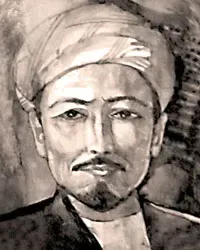
Sidqiy Khondayliqiy
Poet, calligrapher and translator from Bostanliq; author of a 1,502-line poem on the events of the 1917 revolution and of satirical and social verse.
- Occupation:
- Writer, Poet
- Real name:
- Sirojiddin Maxdum Mirzohidoxund o'g'li
- Nickname:
- Shevan, Shavkat
- Lived:
- 1884 — 1934
- Birthplace:
- Bo'stonliq District, Tashkent Region
Biography
Sidqiy Khondayliqiy was a poet, calligrapher and translator; his full name was Sirojiddin Makhdum, son of Mirzohidokhund. He was born in 1884 in the village of Khondayliq, in today's Bostanliq district, and died in 1934. He is known for the poem Rusiya inqilobi, written in March 1917, which portrayed the revolution's events on a broad canvas, and for his satirical and social poems.
In his youth he mastered Arabic and Persian. Drawn to calligraphy, he became a pupil of Muhammad Shohmurod kotib (1850–1922), the celebrated calligrapher of the age. He also carved and ornamented stone, drew, and cut seals.
Kamiy contributed greatly to his growth as a poet, and Sidqiy attended the literary circles Kamiy led. He wrote his earliest poems under the pen names Shavkat and Shevan («lament»); the collections Tuhfai Shavkat (1913) and Savg'oti Shavkat (1914) appeared under the name Shavkat. Later he published everything under the name Sidqiy Khondayliqiy.
His lyrics carry on the classical Uzbek tradition of earthly love and humaneness, but most of his legacy consists of satire and social poetry. The socio-political poems (Muhoraba, Yashasun yoshlar, Toza hurriyat) address major events of the day. He also wrote about the conscription of labourers: Rabo(t)chilar namoyishi and Rabo(t)chilar kelishi (1917).
Rusiya inqilobi counts among the first works to cover the Russian Revolution on a wide epic scale. It consists of 1,502 lines, of which 72 are in Persian-Tajik and the remainder in Uzbek. The narrative opens on 23 February, the revolution's first day, and then proceeds day after day. The poet greeted the February Revolution with open arms yet was unhappy with where it led. The poem closes with an appeal to everyone for unity and concord, a thought developed in the tarjibend Umidi ittifoq (1918).
He also wrote prose: Mezoni shariat (1915, 1917, 1992), Holoti Sidqiy, Zarbulmasali Sidqiy, Tazkirai Imomi A'zam and Sad irshodi mulla Sidqiy Xondayliqiy («A Hundred Counsels»), most of them on religious and moral themes. His translations include Hikoyai latifa, Bahrom va malikai Gulandom, Ajoyib ul-maxluqot, O'g'ri va qozi and Sa'di's Bustan.
The diwans, bayaz anthologies and treatises copied in his hand, the seals he made, stone tablets and the portraits he drew of Toychi Hofiz and Tavallo survive in private and state libraries. More than 20 of his printed and manuscript works are kept at the Institute of Oriental Studies of the Academy of Sciences of Uzbekistan.
In 1903 Sidqiy came to Tashkent to continue his schooling and studied at the city's madrasas, Beklarbegi among them. There he learned Arabic morphology and syntax and became a skilled calligrapher.
In 1924 he wrote an account of his own life, Holoti Sidqiy, and attached it to his work Iktisob. The text remains the chief source on his life and career: what is known about his youth, his literary circle and his pursuits comes largely from it. Among his prose translations is a rendering of Risolai Karima.
For decades his legacy stayed in the shadows. His writings appeared as a separate book only in 1984, in the collection Navbahor. Scholars such as the philologist A. Jalolov have studied him since, yet a complete edition of his works and an assessment of his place in modern Uzbek literature are still awaited.
Education
- Beklarbegi MadrasaMadrasa · Tashkent · 1903
Life path
- 1884Born
In the village of Khondayliq (now the Bostanliq district).
- 1913–1914First collections
Tuhfai Shavkat (1913) and Savg'oti Shavkat (1914), under the pen names Shavkat and Shevan.
- 1915–1917Mezoni shariat
A religious and moral work was published (1915, 1917; again 1992).
- 1917The poem Rusiya inqilobi
Written in March, 1,502 lines.
- 1918Umidi ittifoq
A tarjibend.
- 1934Death
Works
- «Tuhfai Shavkat» (1913)Poetry collection
- «Savg'oti Shavkat» (1914)Poetry collection
- «Rusiya inqilobi» (1917)Poem
A poem of 1,502 lines.
- «Rabo(t)chilar namoyishi» (1917)Work
- «Rabo(t)chilar kelishi» (1917)Work
- «Umidi ittifoq» (1918)Tarjibend
- «Mezoni shariat» (1915)Prose work
- «Tazkirai Imomi A'zam»Prose work
- «Sad irshodi mulla Sidqiy Xondayliqiy»Prose work
- «Zarbulmasali Sidqiy»Prose work
- «Holoti Sidqiy»Prose work
- «Hikoyai latifa»Translation
- «Bahrom va malikai Gulandom»Translation
- «Ajoyib ul-maxluqot»Translation
- «O'g'ri va qozi»Translation
- Sa'diy, «Bo'ston»Translation