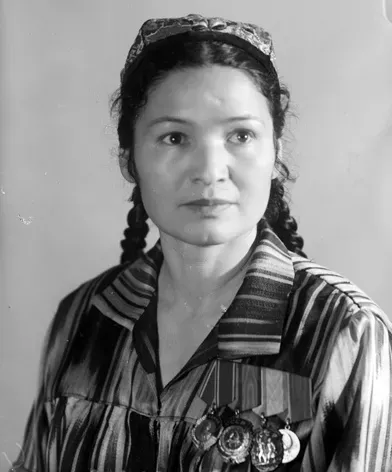
Sora Eshonto'rayeva
Uzbek stage actress, a leading performer of the Hamza Theatre and People’s Artist of the USSR from 1951; known for Ophelia, Desdemona, Guli and Jamila, and for many years head of the theatre.
- Occupation:
- Actress, Stage actor
- Born:
- November 8 1911(86 years old) ♏ — September 8, 1998
- Birthplace:
- Yangiqo'rg'on District, Namangan
- Spouse:
- Abror Hidoyatov
- Children:
- Goga Hidoyatov, Timur Hidoyatov
Biography
Sora Abdurahmonovna Eshonto'rayeva (Russian: Sara Ishanturaeva) was born on 8 November (26 October, Old Style) 1911 in the village of Beshbuloq, now in the Yangiqo'rg'on district of Namangan region, into a peasant family. Her father died early, and her mother had to give her and two other children to other families. From the age of eleven she was brought up at the Zebunniso boarding school for girls in Tashkent, took part in an amateur circle and then appeared in the crowd scenes of the Model Regional Drama Troupe.
In 1924 she joined a group of Uzbek young people sent from Tashkent to study in Moscow. In 1927 she graduated from the Uzbek State Drama Studio at the Uzbek House of Enlightenment in Moscow, where her teachers included R. Simonov, L. Sverdlin and I. Tolchanov. The graduates of the studio went on to form the core of the company of the future Hamza Uzbek Drama Theatre.
From 1927 Eshonto'rayeva was an actress of the Central State Model Uzbek Troupe in Samarkand; in 1929 it became the Hamza Uzbek State Drama Theatre, and the theatre later moved to Tashkent (since 2001 the Uzbek National Academic Drama Theatre). Among her first roles were Tursunoy in Vasily Yan and Cho'lpon’s play “Hujum” and Beatrice in Goldoni’s “The Servant of Two Masters”. From the 1930s she played the leading female parts in almost every production of the theatre. Her Ophelia in Shakespeare’s “Hamlet” (1935) made her famous.
Her repertoire included Jamila in Hamza’s “The Rich Man and the Hired Hand”, Guloyim in Hamid Olimjon’s “Muqanna”, Guli in Uyg'un and Izzat Sultan’s “Alisher Navoi”, and Onaxon in Komil Yashin’s “Honour and Love”; from world drama she played Desdemona (“Othello”), Goneril (“King Lear”), Jocasta (“Oedipus the King”), Katerina (“The Storm”) and Lyubov Yarovaya. She played Desdemona in a production in which her husband Abror Hidoyatov was Othello. In later years roles of mothers took a notable place in her work. She also acted in films, among them “The Rich Man and the Hired Hand” (Jamila), “Sinchalak” and “The Bell of Sayat”. In 1964 she visited England for the 400th anniversary of Shakespeare’s birth.
Beyond the stage she held demanding posts: she was director of the theatre in 1943–1946 and 1953–1960, and chair of the board of the Theatre Society of Uzbekistan in 1946–1955 and 1981–1985. She was a deputy of the Supreme Soviet of the Uzbek SSR from 1939 and of the Supreme Soviet of the USSR (2nd–4th convocations) in 1946–1958, a member of the Central Committee of the Communist Party of Uzbekistan and chair of the board of the republican Peace Fund.
In 1937 she was named People’s Artist of the Uzbek SSR. In 1949 she received a Stalin Prize, second class, for the role of Guli in “Alisher Navoi”; on 6 December 1951, at the time of the Decade of Uzbek Art in Moscow, she became People’s Artist of the USSR. In 1967 she won the Hamza State Prize of the Uzbek SSR and in 1977 the USSR State Prize for a role in the play “Zarya revolyutsii” (“Dawn of the Revolution”). In Soviet times she was awarded two Orders of Lenin (1945, 1971), the Order of the October Revolution, five Orders of the Red Banner of Labour, the Order of the Friendship of Peoples and other honours; after independence she received the Sog'lom avlod uchun order (1993) and, posthumously in 2004, the Order “Buyuk xizmatlari uchun”.
Sora Eshonto'rayeva died in Tashkent on 8 September 1998 (some sources say 7 September) and was buried in the Chig'atoy cemetery. Her husband Abror Hidoyatov (1900–1958) was a People’s Artist of the USSR; their sons are the historian Goga Hidoyatov (1930–2015) and Timur Hidoyatov (1932–2024), a doctor of architecture. In 2024 an exhibition of her archive documents and personal belongings was held.
Education
- Zebunniso Boarding School for GirlsSchool · Tashkent · 1922 · Pupil
- Uzbek State Drama Studio in MoscowOther · 1924–1927 · Acting
Career
- Supreme Soviet of the Uzbek SSRDeputy (from 1939) · Tashkent · 1939–…
- Uzbek National Academic Drama TheatreActress (from 1927), director of the theatre (1943–1946, 1953–1960) · Tashkent · 1927–…Everyone who held this post →
- Communist Party of UzbekistanMember of the Central Committee · Tashkent
- Supreme Soviet of the USSRDeputy of the 2nd–4th convocations · 1946–1958
- Theatre Society of UzbekistanChair of the board (1946–1955, 1981–1985) · Tashkent · 1946–1985Everyone who held this post →
Awards
 Order «For Outstanding Merit»2004, posthumously · Uzbekistan
 Order «For a Healthy Generation», 1st class1993 · Uzbekistan
 People's Artist of the Uzbek SSR1937 · Uzbek SSR
 Hamza State Prize of the Uzbek SSR1967 · Uzbek SSR
 People's Artist of the USSR1951 · USSR
 Order of Lenin1945 · USSR
- Order of Lenin1971 · USSR
 Order of the October Revolution1991 · USSR
 Order of the Red Banner of Labour1937 · USSR
- Order of the Red Banner of Labour1950 · USSR
- Order of the Red Banner of Labour1951 · USSR
- Order of the Red Banner of Labour1957 · USSR
- Order of the Red Banner of Labour1959 · USSR
 Order of Friendship of Peoples1981 · USSR
 Order of the Badge of Honour1939 · USSR
 Medal «For Labour Distinction»1944 · USSR
 Stalin Prize1949 · USSR
 USSR State Prize1977 · USSR
Life path
- 1911Birth
Born into a peasant family in the village of Beshbuloq (now Yangiqo'rg'on district, Namangan region).
- 1924–1927Studies in Moscow
Sent to Moscow with a group of Uzbek young people and graduated from the Uzbek State Drama Studio.
- 1927–1929The Samarkand troupe
Actress of the Central State Model Uzbek Troupe, which became the Hamza Theatre in 1929.
- 1935Ophelia
Her role in Shakespeare’s “Hamlet” made her famous.
- 1937People’s Artist of the Uzbek SSR
Awarded the honorary title; the same year she also received the Order of the Red Banner of Labour.
- 1943–1946, 1953–1960Director of the theatre
Headed the Hamza Theatre twice.
- 1946–1958Deputy of the USSR Supreme Soviet
Deputy of the 2nd–4th convocations; in 1946–1955 she was also chair of the Theatre Society of Uzbekistan.
- 1949Stalin Prize
Second-class prize for the role of Guli in “Alisher Navoi”.
- 1951People’s Artist of the USSR
Title conferred on 6 December, at the time of the Decade of Uzbek Art in Moscow.
- 1967 and 1977State prizes
The Hamza Prize in 1967 and the USSR State Prize in 1977.
- 1981–1985Chair of the Theatre Society
Again headed the board of the Theatre Society of Uzbekistan.
- 1998Death
Died in Tashkent on 8 September; buried in the Chig'atoy cemetery.
Works
- Ophelia — “Hamlet” (1935)Stage role
A role in Shakespeare’s tragedy that made the actress famous.
- Desdemona — “Othello”Stage role
A role in Shakespeare’s tragedy; Othello was played by her husband Abror Hidoyatov.
- Guli — “Alisher Navoi” (1948)Stage role
A role in the play by Uyg'un and Izzat Sultan, for which she received the Stalin Prize in 1949.
- Jamila — “The Rich Man and the Hired Hand”Stage role
A role in Hamza’s play, with a special place in her work.
- Guloyim — “Muqanna”Stage role
A role in Hamid Olimjon’s play.
- Onaxon — “Honour and Love”Stage role
A role in Komil Yashin’s play.
- Goneril — “King Lear”Stage role
A role in Shakespeare’s tragedy.
- Jocasta — “Oedipus the King”Stage role
A role in Sophocles’ tragedy.
- Katerina — “The Storm”Stage role
A role in Ostrovsky’s drama.
- Lyubov Yarovaya — “Lyubov Yarovaya”Stage role
The title role in Konstantin Trenyov’s play.