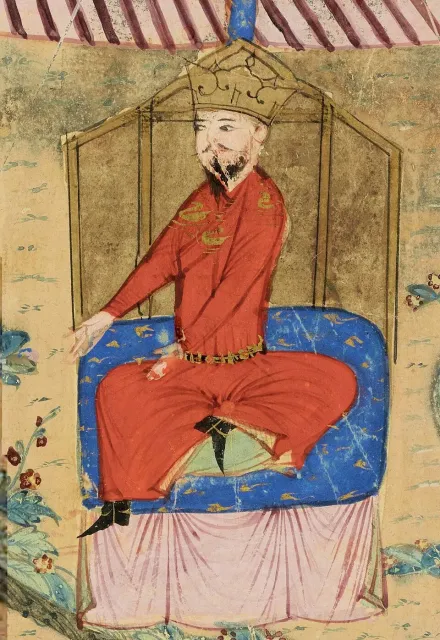
Ala ad-Din Tekish
Khwarazmshah of the Anushtegin dynasty (1172-1200) who annexed Khorasan and most of Iran, ended Seljuk rule in the west and took the title of sultan in 1194.
- Occupation:
- Historical figure, Politician, Ruler
- Real name:
- Ala ad-Din Tekish ibn Il-Arslan
- Lived:
- c. 1152 — July 3, 1200
- Father:
- Il-Arslan
- Mother:
- Terken Khatun (wife of Il-Arslan)
- Spouse:
- Terken Khatun
- Children:
- Nosiruddin MalikshohYunusxonAli-Shoh
Biography
Takash (Tekish), in full Ala ad-Din Tekish ibn Il-Arslan ibn Atsiz ibn Anushtegin, belonged to the Anushtegin dynasty and was Khwarazmshah from 1172 to 1200. His birth year is unknown; ziyouz.uz gives c. 1152. When his father Il-Arslan died he was governing the province of Jand.
Il-Arslan left the throne to a younger son, Sultanshah, and Tekish refused to recognise him. When an army was sent against him on the advice of Sultanshah's mother, he promised the Qara Khitai yearly tribute in return for military aid, took Gurganj and was enthroned on 11 December 1172. Sultanshah and his mother fled to Khorasan, but the contest for power lasted about twenty more years.
After Sultanshah died in 1193, the Khorasan lands along the Talaqan-Marw al-Rudh-Herat line passed to Tekish; he installed his son Malik-Shah in Merv and his son Muhammad in Nishapur. He corresponded with the Ghurids, the Seljuks, the Abbasid caliphs and at times the Qara Khitai, and some of the letters survive. In 1192-93 the Seljuk sultan Toghrul III gave a daughter to Tekish's son Yunus Khan and recognised Ray as a Khwarazmian possession, but later broke the treaty.
The caliph al-Nasir also opposed Toghrul and asked Tekish for help. In the battle of 4 March 1194 the Khwarazmshah routed Toghrul III's army and Toghrul was killed; Iran and Iraq-i Ajam passed to Khwarazm and the Seljuk dynasty came to an end. From that year Tekish used the title of sultan. A quarrel over the spoils soured relations with the caliph. In his last years he fought the Isma'ilis.
In 1200, with the dispute with the caliph flaring again, Tekish set out for Baghdad but died on 3 July at Shahristan, between Nishapur and Khwarazm. His body was taken to Gurganj and buried in a mausoleum beside the madrasa he had built; the mausoleum survives at Konye-Urgench. Medieval authors portray him as a just ruler, a skilled diplomat and commander; he loved music and played the oud well.
Tekish married Terken Khatun, a daughter of the Kipchak khan Jankishi. The Kipchaks who came with her later contributed to the state's decline. To his son Qutb ad-Din Muhammad (Muhammad II) he left a centralised realm and a strong army.
Career
- Khwarazmian EmpireKhwarazmshah (ruler) · 1172–1200
Life path
- 1172Took the Khwarazm throne
With Qara Khitai help he took Gurganj and became Khwarazmshah on 11 December.
- 1193Took Khorasan
After Sultanshah's death most of Khorasan passed to him, with his sons governing Merv and Nishapur.
- 1194Victory over Toghrul III
On 4 March he defeated the last Seljuk sultan; Iran passed to Khwarazm and Tekish took the title of sultan.
- 1200Died
Died at Shahristan on 3 July on the march to Baghdad; buried in Gurganj.