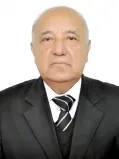
Biography
Talat Saatov (spelled Soatov in some sources) was born on 15 February 1940 in Tashkent. He graduated from the Tashkent Medical Institute in 1962 and did postgraduate study at the Uzbek Institute of Regional Medicine from 1962 to 1965.
He began his research with the proteins of the thyroid gland: he defended his candidate dissertation in 1966 and his doctoral dissertation, “Thyroglobulin and other iodinated proteins of the thyroid gland”, in 1974, with Academician Yalkin Turakulov as scientific consultant. From 1967 he worked at the Institute of Biochemistry of the Academy of Sciences of Uzbekistan — as a senior researcher, from 1975 as head of a laboratory and from 1979 as director of the institute.
Saatov isolated the iodine-containing thyroid proteins thyroglobulin and thyroalbumin in pure form and studied their composition and physicochemical properties. He put forward the hypothesis that goitre is linked to genetic defects and developed a method for determining the body’s sensitivity to insulin. Other studies of his deal with membrane lipids, liposomes and their interaction with cells.
He was made a professor in 1984. In 1985 he became a laureate of the Beruni State Prize of the Uzbek SSR for a series of works on cyclic nucleotides and the regulation of cell metabolism. In 1996 he received the title of Honoured Science Worker of Uzbekistan, and in 2000 he was elected a full member of the Academy of Sciences (academician).
In recent years he has headed the metabolomics laboratory at the Institute of Biophysics and Biochemistry attached to the National University of Uzbekistan, where he and colleagues study the biochemistry of brain tissue in animal models of neurodegenerative disease, including the effect of a liposomal form of quercetin. In 2025, on the 34th anniversary of independence, he was awarded the Order of Labor Glory (“Mehnat shuhrati”).
Education
- Tashkent Medical InstituteUniversity · Tashkent · 1962
Career
- Academy of Sciences of UzbekistanAcademician · Tashkent · 2000–present
- Institute of Biochemistry of the Academy of Sciences of UzbekistanSenior researcher, head of laboratory, director · Tashkent · 1967–…Everyone who held this post →
- Institute of Biophysics and Biochemistry at the National University of UzbekistanHead of the metabolomics laboratory · Tashkent · present
Awards
 Honoured Science Worker of Uzbekistan1996 · Uzbekistan
 Order of Labor Glory2025 · Uzbekistan
 Beruni State Prize of the Uzbek SSR1985 · Uzbek SSR
Life path
- 1940Birth
Born on 15 February in Tashkent.
- 1962Graduation from medical institute
Graduated from the Tashkent Medical Institute.
- 1962–1965Postgraduate study
Studied for a postgraduate degree at the Uzbek Institute of Regional Medicine.
- 1966Candidate dissertation
Defended a candidate dissertation on thyroid proteins.
- 1967–1975Senior researcher at the Institute of Biochemistry
Began work at the Institute of Biochemistry of the Academy of Sciences of Uzbekistan.
- 1974Doctoral dissertation
Defended a thesis on thyroglobulin and other iodinated thyroid proteins.
- 1975Head of laboratory
Took charge of a laboratory at the Institute of Biochemistry.
- 1979Director of the institute
Appointed director of the Institute of Biochemistry of the Academy of Sciences of Uzbekistan.
- 1984Professor
Received the academic title of professor.
- 1985Beruni State Prize
Became a laureate of the Uzbek SSR State Prize for a series of works on cyclic nucleotides.
- 1996Honoured Science Worker
Received the title of Honoured Science Worker of Uzbekistan.
- 2000Academician
Elected a full member of the Academy of Sciences of Uzbekistan.
- 2025Order of Labor Glory
Awarded the order on the 34th anniversary of independence.
Works
- “Iodoproteins of the Thyroid Gland” (1974)Monograph (co-authored)
A book on the iodine-containing proteins of the thyroid.
- “Cyclic Nucleotides and the Regulation of Cell Metabolism” (1983)Monograph (co-authored)
On the role of cyclic nucleotides in cell metabolism.
- “Biosynthesis and Functional Role of Blood Lipoproteins” (1987)Monograph (co-authored)
On how blood lipoproteins are formed and what they do.