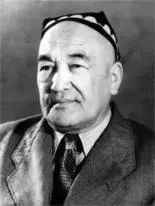
Toʻxtasin Jalilov
Composer, gijjak player and theatre director, a founder of the Uzbek musical drama; author of the music for “Tohir and Zuhra” and more than 200 songs and melodies.
Biography
Toʻxtasin Jalilov was born in 1896 (some sources give 1895) in the Soyguzar quarter of Andijan, into a poor family. He never attended a music school: he had his first dutar lessons from the master Yusufjon changchi, taught himself the gijjak and tanbur, and also took lessons from Orif Toshmatov, Mahmudjon Usmonov and Moʻminjon Jabborov. From his youth he was known in the Fergana Valley as a fine singer and skilled instrumentalist.
In 1918–1920 he performed as a singer and gijjak player in agitation brigades, took part in the “Eastern Evenings” that Hamza organised in 1919, and later worked in Hamza’s dramatic troupe. In 1923 he played at the agricultural exhibition in Moscow. From 1925 to 1927 he was a member of the Uzbek concert-ethnographic ensemble, touring Paris, Moscow, Leningrad, Kazan and Ufa.
His theatre career began in Andijan: in the 1920s he chose the melodies for plays by Komil Yashin and Sobir Abdulla staged by amateur troupes, and from the late 1920s until 1934 he was artistic director of the Andijan Music Theatre. In 1934 he was invited to Tashkent as music director of the musical theatre there, and in 1935 he took part in an international dance festival in London. In 1937, ahead of the decade of Uzbek literature and art in Moscow, he founded and led a song and dance ensemble at the Uzbek State Philharmonic; that year he was named People’s Artist of the Uzbek SSR.
From 1940 Jalilov was artistic director of the Muqimiy Uzbek State Theatre of Musical Drama and Comedy. His music for “Tohir and Zuhra” (after Sobir Abdulla’s play) and “Nurkhan” by Komil Yashin became the core of the theatre’s repertoire. He took part in creating more than forty Uzbek musical dramas and, with Boris Brovtsyn, wrote an opera of the same name from “Tohir and Zuhra” (1949, second version 1955). In 1942 he led the Uzbek group of a concert brigade that toured Iran.
He was the author of more than 200 songs and melodies. Best known are his settings of poems by Hamza, Sobir Abdulla, Chustiy, Furqat and Muqimiy, and the melodies “Otmagay tong”, “Ey quyosh” and “Toʻylar muborak”. He played the tanbur, dutar, gijjak and chang, giving folk tunes a fresh sound and meaning; his pupils included Ganijon Toshmatov and Komiljon Jabborov.
Toʻxtasin Jalilov died in Tashkent in May 1966. He held the Order of Lenin, two Orders of the Red Banner of Labour and the Order of the Badge of Honour, and in 2002 was posthumously given the Order “For Outstanding Merit”. The folk instruments orchestra of the Uzbek State Philharmonic bears his name; his daughter Etibor Jalilova became a People’s Artist of Uzbekistan, and his sons Dehqon Jalilov and Salohiddin Toʻxtasinov also worked in the arts.
Career
- Uzbek State PhilharmonicArtistic director of the song and dance ensemble · Tashkent · 1937–1940
- Muqimiy Uzbek State Musical TheatreArtistic director · Tashkent · 1940–1949Everyone who held this post →
Awards
 Order «For Outstanding Merit»2002, posthumously · Uzbekistan
 People's Artist of the Uzbek SSR1937 · Uzbek SSR
 Order of Lenin1959 · USSR
 Order of the Red Banner of Labour1937 · USSR
- Order of the Red Banner of Labour1950 · USSR
 Order of the Badge of Honour1939 · USSR
Life path
- 1918–1920In agitation brigades
Performed as a singer and gijjak player with agitation brigades.
- 1919Hamza’s “Eastern Evenings”
Took part in the “Eastern Evenings” organised by Hamza, then played in his dramatic troupe.
- 1925–1927Concert-ethnographic ensemble
As a member of the Uzbek concert-ethnographic ensemble, performed in Paris, Moscow, Leningrad, Kazan and Ufa.
- 1928–1934Andijan Music Theatre
Worked as artistic director; the theatre staged productions built on his music.
- 1934Tashkent musical theatre
Appointed music director of the musical theatre in Tashkent.
- 1935Festival in London
Took part, with other Uzbek artists, in an international dance festival in London.
- 1937People’s Artist title
Named People’s Artist of the Uzbek SSR at the time of the Uzbek literature and art decade in Moscow; founded a song and dance ensemble at the Philharmonic.
- 1940–1949Muqimiy Theatre
Artistic director of the Muqimiy Uzbek State Theatre of Musical Drama and Comedy; his music for “Tohir and Zuhra” and “Nurkhan” dates from these years.
- 1942Tour of Iran
Led the Uzbek group of a concert brigade touring Iran.
- 1949The opera “Tohir and Zuhra”
Wrote an opera with Boris Brovtsyn based on the musical drama (second version 1955).
- 1959Order of Lenin
Awarded the Order of Lenin on 18 March.
- 1966Death
Died in Tashkent.
Works
- “Tohir and Zuhra”Musical drama
Musical drama after Sobir Abdulla’s play; Jalilov’s melodies underpin one of the Muqimiy Theatre’s best-known productions.
- “Tohir and Zuhra” (opera) (1949)Opera
Co-written with Boris Brovtsyn; second version 1955.
- “Nurkhan”Musical drama
Music for the production based on Komil Yashin’s play.
- “Qurbon Umarov” (1941)Musical drama
Musical drama on a military-patriotic theme, after Sobir Abdulla’s text.
- “Gʻunchalar” (1945)Musical drama
After Zinnat Fatkhullin’s play; co-composed with Boris Brovtsyn.
- “Alpomish”Musical drama
After Sobir Abdulla’s play; co-composed with Boris Nadezhdin.
- “Muqimiy”Musical drama
After Sobir Abdulla’s play; co-composed with Grigory Mushel.
- “Ravshan and Zulkhumor” (1957)Musical drama
After Komil Yashin’s play; co-composed with Grigory Mushel.
- “Fergana Story” (1962)Musical drama
After Hamid Ghulam’s work; co-composed with Boris Zeidman — Jalilov’s last musical drama.
Songs
| # | Song | Listen |
|---|---|---|
| 1 | “Otmagay tong” | |
| 2 | “Ey quyosh” | |
| 3 | “Toʻylar muborak” (poem by Sobir Abdulla) | |
| 4 | “Bahor ayyomida” (ghazal by Furqat) | |
| 5 | “Gulistonim mening” (ghazal by Muqimiy) | |
| 6 | “Signal” | |
| 7 | “Dovruq” (poem by K. Ahmadiy) | |
| 8 | “Aziz Vatanim” (poem by Habibiy) | |
| 9 | “Kokiling” (poem by S. Zunnunova) | |
| 10 | “Yalla” | |
| 11 | “Oʻynasin” (poem by Uygʻun) | |
| 12 | “Dedication” (romance on the dedication of Pushkin’s “Ruslan and Lyudmila”) |