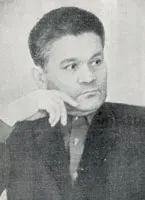
Turab Tula
Poet, playwright and screenwriter, People’s Poet of the Uzbek SSR and co-author of the words of the Uzbek SSR anthem of 1947.
- Occupation:
- Writer, Poet, Playwright, Screenwriter
- Born:
- December 24 1918 ♑ — 1990
- Spouse:
- Tamara Xachaturova
- Children:
- Muhabbat To'laxo'jayeva
Biography
Turab Tula (real surname Tulakhozhaev) was born on 24 December 1918 into a peasant family in the village of Turbat, then in Chimkent province and now in southern Kazakhstan. He studied in Tashkent, first at the theatre technical school (1934–1938) and then in the evening department of the language and literature faculty of the pedagogical institute (1938–1941). He began writing poetry at fifteen or sixteen, and his first collection, “Sheʼrlar” (“Poems”), appeared in 1939.
He started work in 1935 as a literary staff member of the newspaper “Yosh leninchi” and as an editor and announcer at the Uzbek State Radio Committee, where he stayed until 1948. He later served as literary secretary of “Qizil Oʻzbekiston”, as an instructor in party bodies and as an editor at the State Publishing House. In 1947, together with Temur Fattoh, he wrote the words of the anthem of the Uzbek SSR, set to music by Mutal Burhonov.
From the late 1950s he held senior posts in film and theatre: head of the script department of the Uzbekfilm studio (1957–1962), secretary of the Cinematographers’ Union (1962–1967), head of the Arts Department under the Ministry of Culture (1967–1976) and director of the Hamza Theatre (1977–1979). He wrote the script of the film “Maftuningman” (“Enchanted by You”, 1958) and, with M. Melkumov, of “Furqat” (1960); his poems such as “Doʻppi tikdim” became songs.
His poetry collections include “Shodligim” (1941), “Tabassum” (“Smile”, 1944), “Baxt tongotari” (“Dawn of Happiness”, 1948), “Oromijon” (1961), “Gulyor” (1968) and “Oftob nayzada” (“The Sun at Noon”, 1974); his narrative poems include “Hamiyat” (1948), “Zamon hukmi” (1968), “Suyuk momo” (1975) and “Tramvayda topilgan daftar” (“A Notebook Found on a Tram”, 1978). As a playwright he wrote “Qizbuloq” (1968) and “Nodirabegim” (first called “Quvvai qahqaha”, 1969) and the musical drama “Momo yer” after a novella by Chingiz Aitmatov, and he wrote opera and ballet libretti; he translated Schiller, Shakespeare, Pushkin, Lermontov and Nekrasov into Uzbek.
He was named Honoured Art Worker of the Uzbek SSR in 1967, received the Order of the Badge of Honour (1959) and the Order of the Red Banner of Labour (1978), and was given the title People’s Poet of the Uzbek SSR in 1988. From 1980 until his death he led the Tashkent regional branch of the Writers’ Union and the Centre for the Promotion of Literature.
Turab Tula died in Tashkent in 1990 and was buried at the Chigatai cemetery. A street in Tashkent once bore his name. His children are the art historian Mukhabbat Tulakhozhaeva and the film director and actor Nazim Tulakhozhaev.
Education
- Tashkent Theatre Technical SchoolCollege · Tashkent · 1934–1938
- Nizami Tashkent State Pedagogical UniversityUniversity · Tashkent · 1938–1941 · Language and literature faculty (evening department)
Career
- Qizil O'zbekiston newspaperLiterary secretary · Tashkent · 1948–1949
- Writers' Union of UzbekistanHead of the Tashkent regional branch · Tashkent · 1980–1990
- State Publishing House of UzbekistanEditor · Tashkent · 1953–1957
- Uzbek RadioEditor and announcer · Tashkent · 1935–1948
- Uzbek National Academic Drama TheatreDirector (when it was the Hamza Theatre) · Tashkent · 1977–1979Everyone who held this post →
- Yosh Leninchi newspaperLiterary staff member · Tashkent · 1935–1941
- Uzbekfilm studioHead of the script department · Tashkent · 1957–1962
Awards
- People's Poet of the Uzbek SSR1988 · Uzbek SSR
- Honoured Art Worker of the Uzbek SSR1967 · Uzbek SSR
 Order of the Red Banner of Labour1978 · USSR
 Order of the Badge of Honour1959 · USSR
Life path
- 1918Birth
Born on 24 December in the village of Turbat (now southern Kazakhstan) into a peasant family.
- 1934–1938Theatre school
Studied at the Tashkent theatre technical school.
- 1935–1948Radio and press
Worked as a literary staff member of “Yosh leninchi” (until 1941) and as an editor and announcer at the Uzbek radio committee.
- 1939First collection
His first poetry collection, “Sheʼrlar” (“Poems”), was published.
- 1947Anthem of the Uzbek SSR
Wrote the words of the republic’s anthem together with Temur Fattoh.
- 1957–1962Uzbekfilm
Headed the studio’s script department; the film “Maftuningman” (1958) was made from his script.
- 1962–1967Cinematographers’ Union
Served as secretary of the Cinematographers’ Union.
- 1967–1976Arts Department
Headed the Arts Department under the Ministry of Culture; in 1967 he was named Honoured Art Worker of the Uzbek SSR.
- 1968–1969Plays
Wrote the plays “Qizbuloq” and “Nodirabegim”.
- 1977–1979Hamza Theatre
Was director of the Hamza Theatre.
- 1980–1990Writers’ Union
Led the Tashkent regional branch of the Writers’ Union and the Centre for the Promotion of Literature.
- 1988People’s Poet
Given the title People’s Poet of the Uzbek SSR.
- 1990Death
Died in Tashkent; buried at the Chigatai cemetery.
Works
- “Sheʼrlar” (“Poems”) (1939)Poetry collection
The author’s first poetry collection.
- “Baxt tongotari” (“Dawn of Happiness”) (1948)Poetry collection
A poetry collection published in 1948.
- “Hamiyat” (1948)Narrative poem
One of the author’s narrative poems of the 1940s.
- “Oromijon” (1961)Poetry collection
A poetry collection published in 1961.
- “Zamon hukmi” (1968)Narrative poem
One of the author’s narrative poems of the late 1960s.
- “Qizbuloq” (1968)Play
One of the author’s plays.
- “Nodirabegim” (“Quvvai qahqaha”) (1969)Drama
A drama about the tragic life of the poetess, staged at the Hamza, Muqimiy and other theatres.
- “Maftuningman” (“Enchanted by You”) (1958)Film script
Script of a film about the flowering of Uzbek musical culture.
- “Furqat” (1960)Film script
A film script written together with M. Melkumov.
- “Oygul and Baxtiyor” (1979)Verse drama
A verse drama based on the narrative poem by Hamid Olimjon.
- “Malikai ayyor” (1987)Opera libretto
Libretto of an opera based on an Uzbek folk epic.
Filmography
| Title | Year |
|---|---|
| Charmed by You | 1958 |
| Furkat | 1960 |