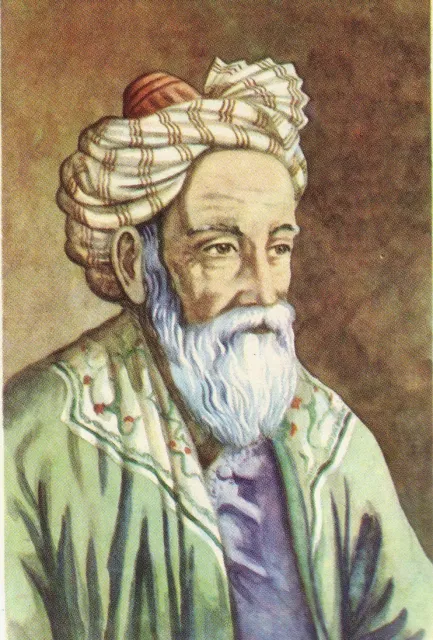
Omar Khayyam
Persian mathematician, astronomer and poet from Nishapur (1048–1131) who classified and geometrically solved cubic equations, led the team behind the Jalali calendar and is credited with the famous Rubaiyat.
Biography
Ghiyath al-Din Abu’l-Fath Umar ibn Ibrahim Khayyam Nishapuri was born in 1048 in Nishapur, one of the chief cities of Khorasan (now north-eastern Iran), which had been under Seljuk rule since 1038. The year of his birth is known from a horoscope recorded by the historian al-Bayhaqi, who knew him personally. The name “Khayyam” means “tent-maker” in Arabic, and his father Ibrahim or earlier forebears may have practised that trade.
Khayyam studied in Nishapur and, according to the National Encyclopedia of Uzbekistan, later in Balkh, Bukhara and Samarkand. In philosophy he called Avicenna (Ibn Sina) his teacher, although he could never have met him: Avicenna died eleven years before Khayyam was born. While still young he wrote “The Difficulties of Arithmetic”, a now lost treatise on extracting roots of any degree, and an essay on dividing a quadrant of a circle, in which he reduced a geometric problem to a cubic equation and solved it by intersecting a hyperbola with a circle.
Around 1070 Khayyam settled in Samarkand. There he enjoyed the patronage of the city’s chief judge, Abu Tahir, and, as al-Bayhaqi relates, the Karakhanid ruler Shams al-Mulk Nasr treated him with marked honour. In Samarkand he completed his “Treatise on Demonstration of Problems of Algebra”. He sorted all equations of the first, second and third degree into 25 types, singled out the 14 types of cubic equation that cannot be reduced to simpler ones, and gave each a geometric solution as the intersection of two conic sections. He did not find a general numerical solution and expressed the hope that those who came after him would; Italian algebraists achieved it in the 16th century.
In 1074 Sultan Malik-Shah and his vizier Nizam al-Mulk invited Khayyam to the Seljuk capital, Isfahan. He directed a team of eight astronomers who made observations at a new observatory and prepared a reform of the calendar. The result was a solar calendar called Jalali after one of the sultan’s titles, Jalal al-Dawla, introduced on 15 March 1079. Its year begins with Nowruz at the vernal equinox, and eight years in every 33 are leap years, a scheme more accurate than the Gregorian calendar adopted in Europe five centuries later. The observatory also produced the astronomical tables “Zij-i Malikshahi”, of which only part of the star catalogue survives.
In December 1077 Khayyam completed his “Commentary on the Difficulties Concerning the Postulates of Euclid’s Elements”. In its first part he replaced Euclid’s fifth, parallel, postulate with principles he regarded as more self-evident and studied the quadrilateral now known as the Khayyam–Saccheri quadrilateral; in the second and third parts he reworked the theory of ratios and proposed treating the ratio of any two magnitudes, commensurable or not, as a number. He also wrote philosophical treatises in Arabic and Persian on being, obligation and necessity, and translated Avicenna’s sermon on divine unity into Persian with his own explanations. His method for finding the proportions of gold and silver in an alloy survives in “The Balance of Wisdom” by his student al-Khazini.
In 1092 Nizam al-Mulk was assassinated, and a month later Malik-Shah died. The sultan’s widow withdrew support from the observatory and its work came to an end. Khayyam lost his standing at court; opponents accused him of free-thinking, and according to the historian al-Qifti he made the pilgrimage to Mecca. Later he lived at the court of Malik-Shah’s son, Sultan Sanjar, in Merv, and in 1112–1113 he was in Balkh, where his student Nizami Aruzi of Samarkand was in his company.
Khayyam spent his last years in Nishapur. Al-Bayhaqi relates that shortly before his death he was reading the metaphysics of Avicenna’s “Book of Healing”. The Encyclopaedia Iranica and the Encyclopaedia Britannica date his death to 1131, while some scholars place it in the 1120s. Four years later Nizami Aruzi visited his grave and found it, as Khayyam had once foretold, covered with blossoms from the trees of the neighbouring garden. In 1963 a new mausoleum designed by the architect Hooshang Seyhoun was built over the grave in Nishapur.
In his lifetime Khayyam was known above all as a scientist. Quatrains under his name appear in sources written after his death, and the number of poems attributed to him grew many times over the centuries; which of them are genuinely his is still debated. The Rubaiyat won worldwide fame through Edward FitzGerald’s free English rendering of 1859. In Uzbek literature Abdurauf Fitrat devoted a study to him, “The Persian Poet Omar Khayyam” (1929), and the Uzbek translations of the quatrains are associated above all with the orientalist Shoislom Shomuhamedov. A crater on the far side of the Moon and the asteroid 3095 Omarkhayyam bear his name.
Career
- Court of the Great SeljuksCourt scholar and astronomer · 1074–…
Life path
- 1048Birth in Nishapur
Born in Nishapur, one of the chief cities of Khorasan, under Seljuk rule since 1038.
- 1060sYears of study
Studied in Nishapur and, according to the National Encyclopedia of Uzbekistan, later in Balkh, Bukhara and Samarkand; learned mathematics, astronomy and the philosophy of Avicenna.
- c. 1070Samarkand
Under the patronage of the chief judge Abu Tahir, completed his treatise on algebra with its classification and geometric solution of cubic equations.
- 1074Call to Isfahan
Invited by Sultan Malik-Shah and the vizier Nizam al-Mulk, directed the astronomers of a new observatory in the Seljuk capital.
- 1077Commentary on Euclid
In December completed his treatise on the difficulties in Euclid’s postulates: parallel lines, ratios and the concept of number.
- 1079Jalali calendar
On 15 March the solar calendar devised by his team came into force: Nowruz falls on the vernal equinox, with eight leap years in every 33.
- 1092Observatory closed
After the murder of Nizam al-Mulk and the death of Malik-Shah the observatory lost court support and its work ceased.
- 1090sPilgrimage to Mecca
According to the historian al-Qifti, made the hajj at a time when he was accused of free-thinking.
- early 12th centuryMerv
Lived at the court of Sultan Sanjar, Malik-Shah’s son, in Merv.
- 1112–1113Balkh
Stayed in Balkh with the astronomer Muzaffar al-Isfizari, joined there by his student Nizami Aruzi of Samarkand.
- 1131Death
Died in Nishapur and was buried there; some scholars date his death to the 1120s.
Works
- “Rubaiyat”Lyric poetry (quatrains)
Philosophical quatrains on the brevity of life, fate and the limits of human knowledge. The authorship of many of the quatrains attributed to Khayyam is disputed; Edward FitzGerald’s English rendering (1859) made them famous worldwide.
- “The Difficulties of Arithmetic”Mathematical treatise
On extracting roots of any degree from whole numbers. Khayyam refers to it in his “Algebra”; the text is lost, and only its title survives on the title page of a Leiden manuscript.
- “Treatise on the Division of a Quadrant of a Circle”Mathematical treatise
An early work written before the “Algebra”: a geometric problem is reduced to a cubic equation, solved by intersecting a hyperbola and a circle and approximately with trigonometric tables.
- “Treatise on Demonstration of Problems of Algebra”Mathematical treatise
Completed in Samarkand around 1070. Equations up to the third degree are sorted into 25 types; 14 types of cubic equation are solved geometrically by intersecting conic sections.
- “Commentary on the Difficulties Concerning the Postulates of Euclid’s Elements” (1077)Mathematical treatise
Three books: on parallel lines, on ratios and on the compounding of ratios. His reasoning on parallels reached European mathematicians through Nasir al-Din al-Tusi.
- Jalali calendar (1079)Calendar reform
A solar calendar devised in Isfahan by astronomers under Khayyam’s direction: Nowruz falls on the vernal equinox, and eight years in every 33 are leap years. It is the basis of the modern Iranian calendar.
- “Zij-i Malikshahi”Astronomical tables
Tables of the Isfahan observatory named after Sultan Malik-Shah; only a fragment of the star catalogue survives.
- “On Being and Obligation”Philosophical treatise
An Arabic treatise on existence and human obligation written in the tradition of Avicenna; his Persian “On Existence” and other philosophical essays follow the same line.
- Translation of Avicenna’s “Sermon on Divine Unity”Annotated translation
A Persian translation, with Khayyam’s own explanations, of Avicenna’s Arabic sermon on divine unity; Khayyam called Avicenna his teacher.
- “On the Art of Determining the Quantities of Gold and Silver in an Alloy”Treatise on hydrostatics
A method of finding the proportions of gold and silver in an alloy by weighing it in air and in water; it survives in al-Khazini’s “Balance of Wisdom”.
- “Nowruznama”Prose work (authorship disputed)
A Persian book on the origins and customs of the Nowruz festival. Tradition ascribes it to Khayyam, but its style and the errors in the text lead many scholars to doubt his authorship.
Legacy
Khayyam was the first to classify systematically all equations up to the third degree and to give a geometric solution for every type of cubic; historians see in this a forerunner of Descartes’ analytic geometry, and the numerical solution he hoped posterity would find was reached by Italian algebraists in the 16th century. His reasoning on parallels passed through Nasir al-Din al-Tusi and John Wallis to Girolamo Saccheri, and the quadrilateral both men studied is called the Khayyam–Saccheri quadrilateral. The Jalali calendar remained in use across the Iranian world for centuries and underlies the present Iranian calendar. The quatrains attributed to him have been translated into many languages; in Uzbekistan Abdurauf Fitrat wrote a study of him, and the Uzbek translations of the Rubaiyat are associated above all with Shoislom Shomuhamedov.
Era: The Great Seljuk era, 11th – early 12th century: Khorasan, Transoxiana and Isfahan- The Jalali calendar devised by Khayyam’s team came into force (1079)
- Nizami Aruzi of Samarkand visited Khayyam’s grave in Nishapur (1135)
- Edward FitzGerald published his English “Rubaiyat of Omar Khayyam” (1859)
- The Jalali calendar became the official calendar of Iran (1911)
- The modern Iranian solar calendar was introduced on its basis (1925)
- Abdurauf Fitrat published his study “The Persian Poet Omar Khayyam” (1929)
- Khayyam’s mausoleum designed by Hooshang Seyhoun opened in Nishapur (1963)
- A crater on the far side of the Moon was named after Khayyam (1970)
- A collection of his quatrains compiled and translated by Shoislom Shomuhamedov was published in Tashkent (1970)
- Asteroid 3095 was named Omarkhayyam (1988)