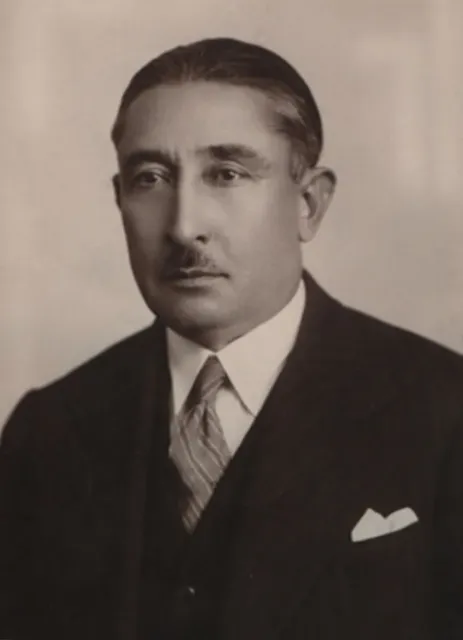
Usmankhodja Pulatkhodjayev
Figure of the Bukharan Jadid movement, first chairman of the Central Executive Committee of the Bukharan People's Soviet Republic; lived in exile in Turkey from 1922.
- Occupation:
- Politician, Minister
- Lived:
- 1878 — July 28, 1968
- Birthplace:
- Bukhara
- Father:
- Qori Po'latxo'ja
- Mother:
- Fotma Oyim
Biography
Usmankhodja Pulatkhodjayev was a representative of the Jadid movement in Bukhara and the first chairman of the Central Executive Committee of the Bukharan People's Soviet Republic (BPSR); he spent his later years in Turkey. He was born in Bukhara in 1878 into a merchant family. After primary schooling at a madrasa he set up one of the first new-method schools in the city, in which children learned their native language, mathematics, history, geography and other subjects.
He studied in Istanbul from 1908 and came back to Bukhara in 1912–1913. He remained an active member of the secret society Tarbiyai atfal and in 1917 was added to the Central Committee of the Young Bukharans party.
After the Kolesov events, in April 1918, he formed a left Socialist-Revolutionary group among the Young Bukharans in Tashkent. In February 1920 he entered the party's Turkestan Central Bureau.
When the Bukharan People's Soviet Republic came into being, he became nazir (minister) of finance (1920) and of state control (1921), and from August 1921 to early 1922 he was the first chairman of the Central Executive Committee. Like most government figures he wanted to turn Bukhara into an independent state with its own national army and government, and he persistently demanded the withdrawal of Red Army units and Bukharan independence.
In 1922 he cut his ties with the Soviets and set out for Kabul; on 29 April, as head of the BPSR, he signed an agreement with Amir Amanullah Khan of Afghanistan. He sought to buy weapons abroad for a Bukharan national army.
Later he emigrated to Turkey, lived in Istanbul and Ankara and became one of the leaders of the Turkestani émigrés. He was actively involved in setting up the Institute for Research on Turkish Culture in Ankara. Many works on the history and culture of Turkestan are his, among them the booklet Turkiston (Istanbul, 1936). He died in Istanbul on 28 July 1968 and was buried in the Özbekler Tekkesi mausoleum in Üsküdar. In Turkey he is also known as Osman Kocaoğlu.
The secret society Tarbiyai atfal came into being in 1910, and Pulatkhodjayev counted among its active participants.
After breaking with the Soviet authorities he spent many years as an émigré, first in Afghanistan, then in Turkey, and later in Poland and Iran as well. From 1927 a journal called Yangi Turkiston, advocating the independence of Turkestan, came out in Istanbul under his involvement; this struggle became the core of his later work.
Career
- Young Bukharans partyMember of the Central Committee · Bukhara · 1917–1921
- Council of People’s Nazirs of the Bukharan People’s Soviet RepublicNazir of finance (1920), nazir of state control (1921), then first chairman of the Central Executive Committee (1921–1922) · Bukhara · 1920–1922
Life path
- 1878Born
In Bukhara, into a merchant family.
- 1908–1912Studied in Istanbul
Returned to Bukhara and opened a new-method school.
- 1917Central Committee member
Young Bukharans party.
- 1918Left SR group
In April formed a left SR group among the Young Bukharans in Tashkent.
- 1920Nazir of finance
Bukharan People's Soviet Republic.
- 1921Nazir of state control
From August headed the Central Executive Committee.
- 1922Left for Kabul
On 29 April signed an agreement with Amanullah Khan.
- 1936Booklet Turkiston
Published in Istanbul.
- 1968Died
On 28 July in Istanbul.
Works
- «Turkiston» (1936)Booklet