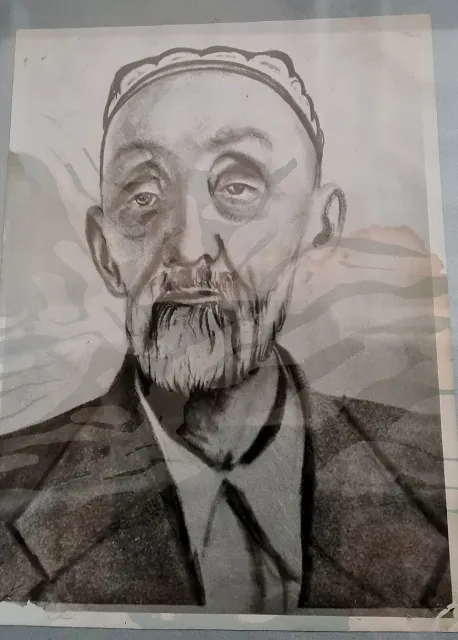
Biography
Usta Shirin Murodov was born on 18 August 1880 in Bukhara into a family of craftsmen. He learned the trade from his father, Usta Murod, and his grandfather, Usta Nosir, and from his youth trained under his uncle, Usta Hayot.
As an independent master he took part in decorating the Emir of Bukhara’s palace at Karmana and the White Hall of the Sitorai Mohi Xossa summer residence, built and ornamented in the 1910s; this work made his name. In ganch carving he developed the traditional methods, gave them new forms and was among the first to use a mirror as the ground of a pattern.
In the Soviet period he also worked in Tashkent, decorating clubs and administrative buildings with carved ganch. In 1938 he contributed to the Uzbek SSR and Turkmen SSR pavilions at the All-Union Agricultural Exhibition, and later worked on the Tashkent clock tower, the Muqimi Theatre and the Alisher Navoi Museum of Literature.
His largest commission was the Bukhara Hall of the Navoi Opera and Ballet Theatre in Tashkent: its carved panels, ceiling panels and cornices were finished in 1947, and in 1948 they earned him the Stalin Prize, first class. In 1943 he was named Honoured Art Worker of the Uzbek SSR and elected an honorary member of the Academy of Sciences of the Uzbek SSR; on 16 January 1950 he received the Order of Lenin, and he also held the Order of the Red Banner of Labour and medals.
Usta Shirin took part in restoring monuments: he rebuilt the damaged part of the Samanid Mausoleum, the domes of the Mir-i Arab and Abdulaziz Khan madrasas, and the tile ornament of the portal of the Magoki Attori Mosque. He taught at the Samarkand school of restorers, the Tashkent school of building art (1940–1942), a Moscow art college (1942–1943) and the Benkov Republican Art College (1952–1957), and trained many pupils.
He died on 12 February 1957 in Tashkent and was buried in the Chigatay cemetery. Streets and schools in Tashkent and Bukhara bear his name, and his bust stands in the courtyard of Sitorai Mohi Xossa. In 2001 he was posthumously awarded the Order “Buyuk xizmatlari uchun”.
Career
- Benkov Republican Art CollegeTeacher · Tashkent · 1952–1957
Awards
 Order «For Outstanding Merit»2001, posthumously · Uzbekistan
- Honoured Art Worker of the Uzbek SSR1943 · Uzbek SSR
 Order of Lenin1950 · USSR

 Stalin Prize1948 · USSR
Life path
- 1880Birth
Born in Bukhara into a family of craftsmen; learned the trade from his father, grandfather and uncle.
- 1910sSitorai Mohi Xossa
Took part in decorating the Emir’s palace at Karmana and the White Hall of Sitorai Mohi Xossa.
- 1938Agricultural exhibition pavilions
Contributed carved decoration to the Uzbek SSR and Turkmen SSR pavilions at the All-Union Agricultural Exhibition.
- 1940–1942Tashkent school of building art
Taught ganch carving.
- 1942–1943Moscow art college
Taught at an art college in Moscow.
- 1943Title and membership
Named Honoured Art Worker of the Uzbek SSR; elected honorary member of the Academy of Sciences of the Uzbek SSR.
- 1947Bukhara Hall of the Navoi Theatre
Completed the carved panels, ceiling panels and cornices for the Opera and Ballet Theatre in Tashkent.
- 1948Stalin Prize
Received the Stalin Prize, first class, for the decoration of the Bukhara Hall.
- 1950Order of Lenin
Awarded the Order of Lenin on 16 January.
- 1952–1957Benkov Art College
Taught at the Republican Art College.
- 1957Death
Died in Tashkent on 12 February and was buried in the Chigatay cemetery.
- 2001Posthumous award
Posthumously awarded the Order “Buyuk xizmatlari uchun”.
Works
- Decoration of the White Hall at Sitorai Mohi XossaGanch carving
Took part in decorating the Emir of Bukhara’s summer residence in the 1910s.
- Pavilions of the All-Union Agricultural Exhibition (1938)Carved decoration
Carved ornament in the Uzbek SSR and Turkmen SSR pavilions.
- Bukhara Hall of the Navoi Theatre (1947)Ganch carving
Carved panels, ceiling panels and cornices; the work earned the Stalin Prize.
- Tashkent clock tower and the Muqimi TheatreCarved decoration
Ornamental decoration of public buildings in Tashkent.
- Restoration of the Samanid Mausoleum and Bukhara madrasasRestoration
Rebuilt the damaged part of the mausoleum and the domes of the Mir-i Arab and Abdulaziz Khan madrasas.