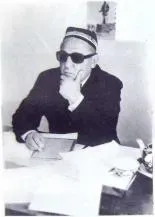
Vali Gofurov
Uzbek writer and teacher, a front-line soldier who lost his sight in the war and wrote his novels by pricking cardboard with a needle; member of the USSR Union of Writers from 1970.
- Occupation:
- Writer, Prose writer
- Born:
- 1922 — August 5, 1995
- Birthplace:
- Tashkent
Biography
Vali Gofurov was born in 1922 on the outskirts of Tashkent into a peasant family. Sources disagree on his birthday: 1 October or 31 December. After seven years of school he finished teacher-training courses and in 1940 was sent to a school in the Samarkand region. In his youth he worked with newspapers and tried his hand at poetry.
In 1941 he entered the infantry school at Nalchik as a cadet. In the summer of 1942 the situation on the Southern Front turned critical, the cadets were graduated early and sent to the front, and he was among them. Gofurov took part in the defence of Stalingrad.
In autumn 1942 he was badly wounded in battle and lost his sight. Coming to terms with it was hard, but he found the strength to go on: he learned Braille, worked as a teacher at a school for blind adults, and then headed the production combine of the Uzbek Society of the Blind.
He did not give up the wish to write: he “wrote” his book with a steel needle, pricking sheets of cardboard, and relatives and friends then copied the text out by hand. The first book of his novel “Vafodor”, written with the needle, came out in the early 1960s and the second in 1973; it was translated into Russian and other languages. The Russian translation by O. Sidelnikov appeared as “A Novel Written with a Needle” (Roman, napisannyi igloi).
After the novel Gofurov wrote the novellas “So‘nggi pushaymon” (“The Last Regret”) and “Botirga o‘lim yo‘q” (“There Is No Death for the Brave”), the memoir “Shoxlardagi mezonlar” and many short stories. In 1970 he was admitted to the USSR Union of Writers. He gave the manuscript of his novel and the implements it was written with to the Nikolai Ostrovsky museum.
Vali Gofurov died in Tashkent: most sources give 5 August 1995, while Uzbek Wikipedia gives 31 July 1994. In his lifetime he held the title of Honoured Cultural Worker; by presidential decree of 23 August 2025 he was posthumously awarded the Order “Fidokorona xizmatlari uchun”.
Career
- Union of Soviet WritersMember · 1970–…
- Uzbek Society of the BlindHead of the production combine · Tashkent
Awards
 Order «For Selfless Service»2025, posthumously · Uzbekistan

Life path
- 1922Birth
Born on the outskirts of Tashkent into a peasant family.
- 1940Village schoolteacher
After teacher-training courses he was sent to a school in the Samarkand region.
- 1941Military school cadet
Entered the infantry school at Nalchik.
- 1942Front and wound
Took part in the defence of Stalingrad; badly wounded, he lost his sight.
- 1940sWork with the Society of the Blind
Learned Braille, taught at a school for the blind, then ran the production combine of the Uzbek Society of the Blind.
- early 1960sFirst book of “Vafodor”
The first book of the novel written with a needle was published.
- 1970Admitted to the USSR Union of Writers
Became a member of the USSR Union of Writers.
- 1973Second book of “Vafodor”
The second book of the novel was published.
- 1995Death
Died in Tashkent (1994 according to Uzbek Wikipedia).
- 2025Order “Fidokorona xizmatlari uchun”
Posthumously awarded by presidential decree of 23 August 2025.
Books
- “Vafodor”1973 · Novel
A novel in two books written with a needle; the first book appeared in the early 1960s, the second in 1973.
- “The Last Regret” (So'nggi pushaymon)· Novella
A novella about outdated customs that hinder the moral growth of young people.
- “There Is No Death for the Brave” (Botirga o'lim yo'q)· Novella
A novella.
- “Shoxlardagi mezonlar”· Memoir
A book of a memoir character.