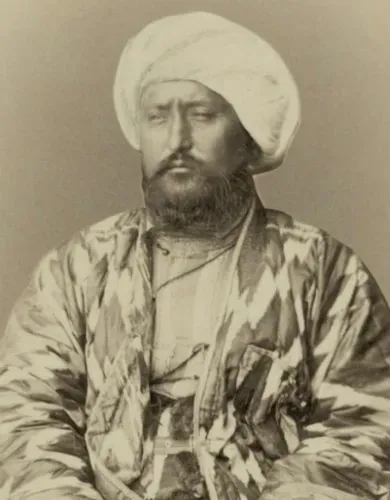
Khudayar Khan
Khan of Kokand (1845–1875, with interruptions) of the Ming dynasty, who signed the 1868 treaty with Russia and built the Khan's Palace in Kokand.
- Occupation:
- Historical figure, Politician, Ruler
- Lived:
- c. 1831 — c. 1884
- Birthplace:
- Kokand, Fergana
- Father:
- Shir Ali Khan
- Children:
- Nasriddinxon, Muhammad Alimbek, Said Aminbek, Oʻrmonbek
Biography
Khudayar Khan was a khan of the Kokand Khanate from the Ming dynasty and a son of Shir Ali Khan. Born in Kokand in 1831, he took the throne four times between 1845 and 1875.
His father-in-law Musulmonqul put him on the throne, but he was so young that Musulmonqul in practice ran the state. Key posts passed to the Kipchaks and internal strife grew, until in 1853 a massacre of Kipchaks killed about twenty thousand people and Musulmonqul was hanged in Kokand. From then Khudayar governed on his own, though his inexperience led to many mistakes.
In 1858 his brother Mallabek made his own bid for the throne and proclaimed himself khan, and Khudayar fled to Bukhara. In 1862–1863 he regained the throne, but the commander Alimqul proclaimed the young Sayid Sultanmurod khan, forcing Khudayar back to Bukhara; Alimqul, as amir ul-umaro, ruled alone. In 1865 Khudoyqul, nicknamed Belbokchikhan, took the throne but after 14 days fled to Kashgar with the treasury, and Khudayar became khan again.
Taking advantage of the infighting, the Russian Empire captured Turkestan, Chimkent (1864) and Tashkent (1865). Khudayar sought ties with the Ottomans and Bukhara and tried to win support from British emissaries, but circumstances drove him closer to K. P. Kaufman, governor-general of Turkestan. Under the 1868 treaty, presented as one between equals, Russian merchants gained the right to stay in all towns and villages of the khanate, build caravanserais and carry goods through its territory duty-free.
His reign saw attention paid to agriculture and the digging of new canals and ditches. The khan's palace in Kokand was completed in 1873, and the madrasas «Madrasai Oliy», «Madrasai Hokim oyim» and «Madrasai Sulton Murodbek» were built in his time. At his order Mahzun (Ziyovuddin Hoqandiy) wrote a 1696-page «Shohnoma», whose manuscript is kept in Istanbul.
The khanate shrank, taxes multiplied, the population suffered and uprisings were frequent; the largest began in 1873 under Polatkhan. Unable to put it down, Khudayar fled with the treasury to Tashkent, was exiled to Orenburg, escaped and went to Mecca. After Russia took the rest of the khanate he asked Kaufman for leave to return to Kokand and was refused; his second petition was considered by the Senate, which granted it. Unaware of this, the khan set out secretly and died on the way. Sources differ on the year and place of his death: the 1880s, in the village of Karrukh near Herat in Afghanistan.
Career
- Court of the Kokand KhanateKhan of Kokand · Kokand · 1845–1875
Life path
- 1831Birth
Born in Kokand into the family of Shir Ali Khan.
- 1845First reign
Raised to the throne by Musulmonqul, who ruled in practice as his father-in-law.
- 1853Massacre of the Kipchaks
Musulmonqul was hanged and the khan began to rule on his own.
- 1858Loss of the throne
His brother Mallabek became khan and Khudayar fled to Bukhara.
- 1862Second reign
Regained the Kokand throne (until 1863).
- 1865Third reign
Became khan again after Khudoyqul fled (until 1875).
- 1868Treaty with Kaufman
A trade treaty described as equal was signed with Russia.
- 1873The khan's palace
The khan's palace in Kokand was completed; Polatkhan's uprising began.
- 1875Exile
Fled the uprising to Tashkent and was exiled to Orenburg.
- 1880Death
Died on the road in the 1880s (sources give 1882, 1884, 1886).