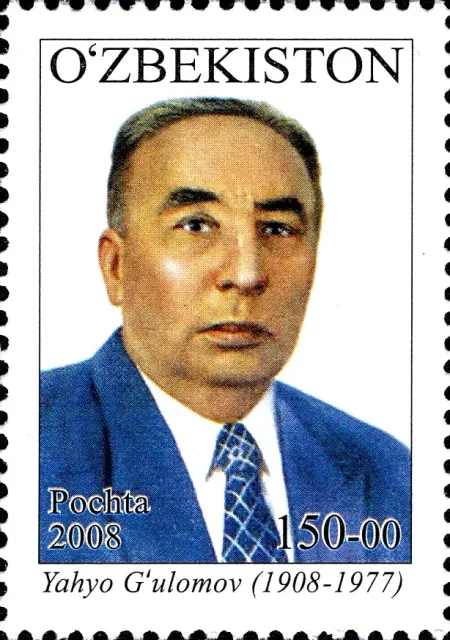
Yahyo Gulomov
Uzbek archaeologist and historian, academician of the Uzbek SSR Academy of Sciences, who studied the history of irrigation in Khorezm and Central Asia and prehistoric cultures; the first Uzbek professional archaeologist.
Biography
Yahyo Gulomov came from Tashkent, where he was born on 1 May 1908; his father taught at a madrasa. When the father died in 1919, the boy was brought up by his mother, a girls'-school teacher, and from 1921 he lived in a children's boarding home. He then spent three years (1923–1926) at the men's institute of education in Tashkent, followed by the Uzbek State Pedagogical Academy in Samarkand, where he completed the social-economic course and received his diploma in 1930.
For a while he taught in a school, then did postgraduate work at the Uzbek Research Institute, and from 1931 he taught at a pedagogical technical school in Tashkent. He entered scholarship in 1933: for seven years, until 1940, he served in Uzkomstaris, the committee for the protection of ancient monuments and works of art, as both researcher and scientific secretary. There he first joined expeditions and surveys, and he began excavating on his own in 1936.
In 1937 he went to the ancient irrigated lands of southern Karakalpakstan, and from 1938 he worked with S. P. Tolstov's Khorezm archaeological and ethnographic expedition. In 1940 he moved to the Uzbek branch of the USSR Academy of Sciences, first as head of the archaeology section of the Institute of History, Language and Literature. From 1943 until his last days he ran the section of ancient and medieval history at the Institute of History and Archaeology of the Uzbek SSR Academy, and between 1956 and 1959 he also stood in as the institute's acting director.
His degrees came in this order: a candidate's thesis, "Khiva and Its Monuments", in 1943, and in 1950 a doctoral dissertation on the irrigation of Khorezm from antiquity to the present. He was confirmed as professor in March 1955, elected a corresponding member of the Uzbek SSR Academy of Sciences in October 1956 and a full member in February 1966. Between those dates, on 18 June 1958, a decree of the Presidium of the Supreme Soviet of the Uzbek SSR named him Honored Scientist of the republic.
Gulomov's main theme was how land was watered in Khorezm and in Central Asia generally. His principal book on the subject appeared in Russian in 1957 and in Uzbek in 1959. Beyond irrigation he studied Neolithic, Eneolithic and Bronze Age sites of the lower Zarafshan, began the first excavations of the Zaman-Baba burial ground, and led a team that surveyed the ancient irrigated lands of the Hungry Steppe. After the Tashkent earthquake of 1966 he proposed setting up the Tashkent Archaeological Expedition, whose Tashkent detachment found a Mousterian site in the Obi-Rakhmat grotto.
Gulomov edited a great many scholarly books, and was among the authors and on the chief editorial board of the four-volume History of the Uzbek SSR (1967–1968). More than thirty researchers and university teachers prepared dissertations in the region's history and archaeology under him. In all, 135 monographs and articles are credited to him, and he lectured on Uzbek history and archaeology at the Nizami Tashkent State Pedagogical Institute.
The scholar died on 10 January 1977 in Tashkent, the city where he had started his career. In 2002, after his death, he was given the Order of Outstanding Merit, and in 2008 the post office issued a stamp with his portrait. The "Academician Ya. Gulomov Readings" are held every year; a street in Tashkent and the Institute of Archaeology of the Academy of Sciences of Uzbekistan are named for him.
Education
- Tashkent Men's Institute of EducationCollege · Tashkent · 1923–1926
- Uzbek Pedagogical AcademyUniversity · Samarkand · 1930 · Social-economic department
Career
- Academy of Sciences of UzbekistanCorresponding member (1956), academician (1966) · Tashkent · 1956–1977
- Institute of History and Archaeology of the Uzbek SSR Academy of SciencesHead of the department of ancient and medieval history; acting director in 1956–1959 · Tashkent · 1943–1977Everyone who held this post →
- Uzbekistan Committee for the Protection of Antiquities and Art (Uzkomstaris)Researcher and scientific secretary · Tashkent · 1933–1940
- Nizami Tashkent State Pedagogical InstituteLecturer in Uzbek history and archaeology · Tashkent
Awards
 Order «For Outstanding Merit»2002, posthumously · Uzbekistan
- Honoured Science Worker of the Uzbek SSR1958 · Uzbek SSR
Life path
- 1923–1930Student years
Studied at the men's institute of education in Tashkent (1923–1926), then at the pedagogical academy in Samarkand; received his diploma in 1930.
- 1933–1940Uzkomstaris staff
Served as researcher and scientific secretary of the monument-protection committee and first went on archaeological expeditions.
- 1936–1950Fieldwork
Began his own excavations in 1936, worked in southern Karakalpakstan in 1937 and in the Khorezm expedition from 1938.
- 1940Joined the Academy
Took charge of the archaeology section of the Institute of History, Language and Literature in the Uzbek branch of the USSR Academy of Sciences.
- 1943Candidate's defence
Defended "Khiva and Its Monuments" and became head of the ancient and medieval history section at the Institute of History and Archaeology.
- 1950Doctoral defence
Defended his doctoral dissertation on the history of irrigation of Khorezm.
- 1955–1956Professor, corresponding member
Confirmed as professor in 1955 and elected a corresponding member of the Uzbek SSR Academy in 1956.
- 1956–1959Acting head of the institute
Acted as director of the Institute of History and Archaeology.
- 1958Honored Scientist
The title was conferred by a decree of the Presidium of the Supreme Soviet of the Uzbek SSR.
- 1966Academician
Elected a full member of the Uzbek SSR Academy; after the earthquake he proposed the Tashkent Archaeological Expedition.
- 1967–1968History of the Uzbek SSR
Became one of the authors of the four-volume work and a member of its chief editorial board.
- 1977Death
Died in Tashkent on 10 January.
Works
- "The History of Irrigation of Khorezm from Ancient Times to the Present" (1957)Monograph
A history of Khorezm's irrigation systems; published in Russian in 1957 and in Uzbek in 1959.
- "The Monuments of the City of Khiva" (1941)Book
A study of Khiva's architectural monuments (in Russian).
- "Primitive Culture and the Emergence of Irrigated Agriculture in the Lower Zarafshan" (1966)Monograph
Written with U. Islamov and A. Askarov.
- "History of the Uzbek SSR" (1967)Collective work
One of the authors and a member of the chief editorial board of the four-volume edition published in 1967–1968.
- "History of the Uzbek SSR" (one volume) (1958)Editing
Responsible editor of the edition.
- "Varakhsha" (V. A. Shishkin) (1963)Editing
Responsible editor of the book on the Varakhsha site in the Bukhara oasis.