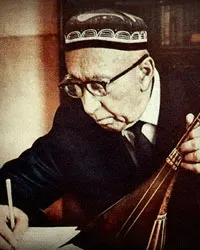
Tashkent-born composer, singer and instrumentalist (nay, dutar) who collected Uzbek musical heritage; People's Artist of the Uzbek SSR, academician, founder and artistic director of the Maqom ensemble.
- Occupation:
- Composer, Singer, Musician, Folk singer
- Lived:
- January 17 1897(79 years old) ♑ — April 23, 1976
- Birthplace:
- Tashkent
- Father:
- Rajab-aka
- Mother:
- Oysha-bibi
Biography
Yunus Rajabi was a Tashkent-born composer, singer and instrumentalist (nay and dutar) who gathered Uzbek musical heritage. He was born in Tashkent on 17 January 1897. He studied first at a madrasa and then at the Turkestan People's Conservatory (1919–1923); in 1934 he completed the preparatory course of the Tashkent Higher School of Music, and in 1940–1941 a composers' course in Moscow. Mirza Qosim taught him the dutar, while the classical Uzbek tradition he absorbed from Shorahim Shoumarov, Hoji Abdulaziz, Toychi Hofiz and Domla Halim.
His working life began in Samarkand, where he was a music teacher at the pedagogical school (1923–1925) and then music director of the city's theatre (1925–1927). He organised the folk-instrument ensemble, later orchestra, of the Uzbek Radio Committee and directed it artistically in 1927–1942 and 1945–1959. In 1942–1945 he was music director of the Yangiyol theatre. From 1959 until his death he created and led the Maqom ensemble of Uzbek television and radio.
From his youth he was known as a singer with a sweet, moving voice and a skilled nay and dutar player. His repertoire contained maqom excerpts and cycles of songs and tunes such as “Giryo”, “Ushshoq”, “Kucha bogi”, “Eshvoy”, “Qalandariy”, “Gulyor–Shahnoz”, “Bayot” and “Chorgoh”. He reworked and revived many ancient melodies and songs, among them “Subhidam”, “Yolg‘iz”, “Sayqal”, “Fig‘on”, “Oraz” and “Begi Sulton”.
As a composer he had a part in the emergence of Uzbek musical drama. At first, building on folk songs, he wrote music for the stage works “Farhod and Shirin” (1922–1925; with Sh. Shoumarov), “Layli and Majnun” (1926), “Rustam” (1933), “Avaz” (1935) and “Kholiskhon” (1940). Later, working with co-authors, he produced the musical dramas “Revenge” (1941), “Kuchkor Turdiyev” (1942), “Muqanna” (1943), “Nodira” (1942–1943), “Marrying Off the Son” (1964) and “Navoi in Astrabad” (1968), and joined the creation of the opera “Zaynab and Omon” (1958). Among his songs are “Fabrika yallasi”, “Bizning davron”, “Wedding in the Mirzachul”, “Uzbekistan” and “Chapandoz”; he also wrote dance tunes such as “Oyin Bayoti”, “Oyin Dugohi” and “Paxta”.
His greatest contribution was in collecting musical heritage. From 1935 he began setting folk tunes and songs down in notation, and 29 of his transcriptions were included in the 1939 collection “Uzbek Folk Songs”. In 1955–1959 the five-volume “Uzbek Folk Music”, edited by I. Akbarov, came out, holding nearly a thousand tunes and songs of various genres. Working with the Maqom ensemble he prepared a new six-volume Shashmaqom (1966–1974; edited by F. Karomatov) and, in the 1970s, a complete set of gramophone recordings. His pupils include T. Sodiqov, D. Zokirov, K. Jabborov and N. Hasanov, among many others.
He received the title People's Artist of the Uzbek SSR in 1953 and became an academician of the Academy of Sciences of Uzbekistan in 1966. In 1971 he was awarded the Hamza State Prize, and posthumously, in 2000, the Order “Buyuk xizmatlari uchun”. He died in Tashkent on 23 April 1976. His name is carried by the Maqom ensemble of Uzbek television and radio, the Jizzakh musical drama and comedy theatre, the Tashkent music pedagogical college, and a street and metro station in the city. A house museum opened in 1997 in the house where he lived in 1957–1976, and a cultural centre in his name was founded in 2001.
Education
- Turkestan People's ConservatoryOther · Tashkent · 1919–1923
Career
- Academy of Sciences of the Uzbek SSRAcademician · Tashkent · 1966–…now Academy of Sciences of Uzbekistan
- Uzbek RadioOrganiser and artistic director of the folk instruments ensemble (orchestra) · Tashkent · 1927–1959
- Yunus Rajabi Maqom Ensemble of UzteleradioOrganiser and artistic director · Tashkent · 1959–1976
Awards
 Order «For Outstanding Merit»2000, posthumously · Uzbekistan
 People's Artist of the Uzbek SSR1953 · Uzbek SSR
 Hamza State Prize of the Uzbek SSR1971 · Uzbek SSR
Life path
- 1897Born in Tashkent
Born on 17 January 1897.
- 1919–1923Turkestan People's Conservatory
Studied at the conservatory after the madrasa.
- 1923–1927In Samarkand
Music teacher at the pedagogical school, then music director of the Samarkand theatre.
- 1927–1942Radio Committee ensemble
Organiser and artistic director of the folk instruments ensemble (orchestra) of the Uzbek Radio Committee; held the post again in 1945–1959.
- 1935Notating folk tunes
Began writing down folk tunes and songs in notation.
- 1940–1941Composers' course in Moscow
Studied composition.
- 1942–1945Yangiyol theatre
Music director of the theatre.
- 1953People's Artist
Title of People's Artist of the Uzbek SSR.
- 1955–1959“Uzbek Folk Music”
Five-volume collection published.
- 1959–1976Maqom ensemble
Organiser and artistic director of the Maqom ensemble of Uzbek television and radio.
- 1966Academician
Elected academician of the Academy of Sciences of Uzbekistan.
- 1966–1974New edition of the Shashmaqom
Six-volume edition prepared.
- 1971Hamza State Prize
Laureate of the State Prize.
- 1976Death
Died on 23 April 1976 in Tashkent.
- 1997House museum
House museum opened in the house where he lived.
- 2000Posthumous award
Awarded the Order “Buyuk xizmatlari uchun”.
Works
- “Farhod and Shirin” (1925)Musical drama
With Sh. Shoumarov, 1922–1925.
- “Layli and Majnun” (1926)Musical drama
- “Rustam” (1933)Musical drama
- “Avaz” (1935)Musical drama
- “Kholiskhon” (1940)Musical drama
- “Qasos” (Revenge) (1941)Musical drama
With B. Nadezhdin.
- “Kuchkor Turdiyev” (1942)Musical drama
With N. Mironov.
- “Nodira” (1943)Musical drama
With O. Halimov, 1942–1943.
- “Muqanna” (1943)Musical drama
With G. Mushel.
- “Zaynab and Omon” (1958)Opera
Took part in its creation with B. Zeidman, D. Zokirov and T. Sodiqov.
- “Og‘il uylantirish” (1964)Musical drama
With B. Zeidman.
- “Navoi in Astrabad” (1968)Musical drama
With Sayfi Jalil.
- “Fabrika yallasi”Song
- “Bizning davron”Song
- “Mirzachulda toy”Song
- “Uzbekistan”Song
- “Chapandoz”Song
- “Oyin Bayoti”Dance tune
- “Oyin Dugohi”Dance tune
- “Paxta”Dance tune
- “Uzbek Folk Music” (5 vols.) (1959)Collection
1955–1959, ed. I. Akbarov; nearly a thousand tunes and songs.
- Shashmaqom (6 vols.) (1974)Edition
1966–1974, ed. F. Karomatov.