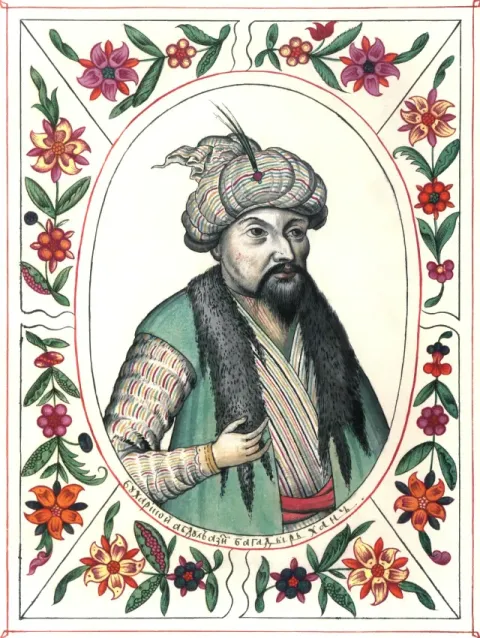
Abd al-Aziz Khan
Ashtarkhanid (Janid) khan of Bukhara (1645–1681) who drove the Mughal army out of Balkh and Badakhshan and kept up diplomatic contacts with Russia, India, Iran and the Ottoman Empire.
- Occupation:
- Historical figure, Politician
- Real name:
- Abd al-Aziz ibn Nadr Muhammad
- Born:
- 1614 — 1683
- Birthplace:
- Bukhara
- Father:
- Nadr Muhammad Khan
Biography
Abd al-Aziz was born in 1614 in Balkh. He belonged to the Ashtarkhanid (Janid) dynasty that ruled the Khanate of Bukhara, traced his descent to Jochi, and was the son of Nadr Muhammad Khan, the fourth khan of Bukhara.
Nadr Muhammad’s tax increases turned the population and the nobility against him, and after withdrawing to Balkh he met with defiance from his own sons. In 1645 the begs and large landholders proclaimed Abd al-Aziz khan. His father later went to Iran, to the Safavids.
Nadr Muhammad had appealed to the Mughal emperor Shah Jahan for help. In 1646–1647 a Mughal army led by Shah Jahan’s sons Aurangzeb and Murad Bakhsh briefly occupied Balkh and Badakhshan. In 1647 Abd al-Aziz attacked the Mughal forces at Balkh and drove them out of the country; Balkh was then governed by his brother Subhan Quli.
In the following years the two brothers fell out over power. From 1660 to 1680 the khanate suffered campaigns by the rulers of Khwarazm, Abu’l-Ghazi and Anusha Khan, and by the Kazakhs. During the first decade of his reign the governor of Samarkand, Yalangtush Bahadur, held great influence in the state.
Abd al-Aziz pursued an active foreign policy. In 1669 he sent an embassy under Mullah Farrukh to Tsar Alexis of Russia, and in 1670 the Russian envoys, the Pazukhin brothers, came to Bukhara. His envoys were also received at the court of Aurangzeb, in Iran and in Istanbul. His reign saw the building of the madrasa that bears his name in Bukhara and of the Tillya-Kari Madrasa in Samarkand; he put together a library of finely copied manuscripts, and his contemporaries described him as a lover of learning.
In 1680–1681 Abd al-Aziz gave up the throne in favour of his brother Subhan Quli Khan and set out on the hajj through Iran; in June 1681 he was received by the Safavid shah Suleiman. He died in 1683 during the pilgrimage, in Mecca according to most sources. He is the central figure of the poet Khurrami’s work “Al-Ashiq risalai ravzati Khurrami”, written in 1836–1837.
Career
Life path
- 1614Birth
Born in Balkh into the family of Nadr Muhammad Khan.
- 1645Proclaimed khan
Begs and landholders dissatisfied with his father’s policy proclaimed him khan of Bukhara.
- 1646–1647Mughal invasion
Shah Jahan’s army occupied Balkh and Badakhshan; in 1647 Abd al-Aziz drove it out of the country.
- 1647Balkh to his brother
Gave the government of Balkh to his brother Subhan Quli.
- 1660–1680Raids from Khwarazm and the Kazakhs
The khanate suffered raids by Abu’l-Ghazi, Anusha Khan and the Kazakh khans.
- 1669–1670Embassies with Russia
An embassy under Mullah Farrukh went to Tsar Alexis; the Pazukhin brothers came to Bukhara in return.
- 1673Contact with the Ottomans
His envoys were received in Istanbul.
- 1680–1681Abdication
Handed power to his brother Subhan Quli Khan and set out on the hajj.
- 1681Reception in Iran
On the way to the hajj he was received with ceremony by the Safavid shah Suleiman.
- 1683Death
Died during the pilgrimage, in Mecca according to most sources.
Legacy
Abd al-Aziz kept the Ashtarkhanid state intact against the Mughal invasion of Balkh and strengthened the position of the Khanate of Bukhara, which maintained diplomatic contacts with Russia, India, Iran and the Ottoman Empire. The madrasas built in Bukhara and Samarkand in his reign and the library of manuscripts he assembled remain part of the cultural legacy of the period.
Era: Ashtarkhanid (Janid) period, 17th century- Mughal campaign against Balkh and Badakhshan (1646)
- Mullah Farrukh’s embassy to Russia (1669)
- Power passes to Subhan Quli Khan (1681)