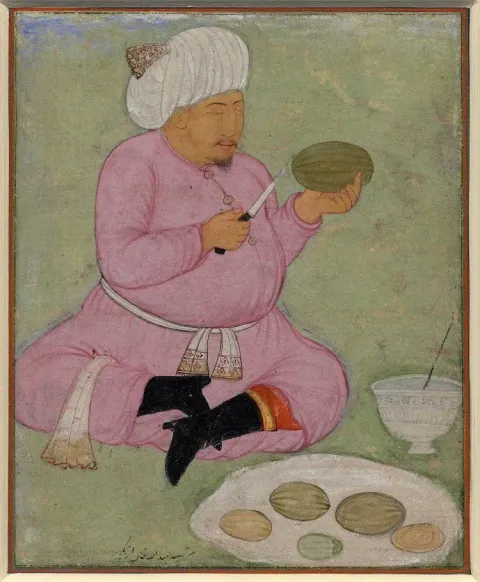
Abdullah Khan II
Shaybanid khan of Bukhara (1583–1598) who made Bukhara his capital in 1557, reunited the divided Shaybanid appanages and brought Badakhshan, Khorasan and Khwarazm under his rule.
- Occupation:
- Historical figure, Politician, Military officer
- Real name:
- Abdullah ibn Iskandar
- Born:
- c. 1534 — February 8, 1598
- Birthplace:
- Samarkand
- Father:
- Iskandar Khan
- Children:
- Abdulmo'minxon
Biography
Abdullah Khan II, in full Abdullah ibn Iskandar, belonged to the Shaybanid house descended from Abu’l-Khayr Khan. Sources give his year of birth as 1533 or 1534 (the Encyclopaedia Iranica has 1532–33). He was born near Samarkand, in the small town of Afarinkent in Miankal, the valley between two arms of the Zarafshan, which his father Iskandar Sultan governed at the time. His grandfather Jani Beg Sultan had held Karmana and Miankal from 1512–13, and Karmana later passed to Iskandar as well.
After the death of Shaybani Khan the state had split into appanages held by members of the dynasty, and from the early 1550s the young Abdullah Sultan had to defend his family’s lands against other Shaybanid princes. In 1551, when Nawruz Ahmad Khan (Baraq Khan) of Tashkent and Abd al-Latif Khan of Samarkand attacked Karmana, his father fled across the Amu Darya and it was Abdullah who beat off the attack. In the following years his attempts to extend his rule to Bukhara, Qarshi and Shahrisabz failed, and in 1556 he was even forced to withdraw to Maymana. With troops from his uncle Pir Muhammad Khan, the ruler of Balkh, and the backing of the Juybari shaykh Khwaja Muhammad Islam, he took Bukhara in late spring 1557 and made it his capital.
In 1561 Abdullah had his father proclaimed supreme khan. Iskandar Khan held the throne only in name until 1583, while his son ran the state. Over the next two decades Abdullah took over, one after another, the appanages of the Shaybanid princes who refused to submit to central authority: he captured Balkh after a long siege in 1573–74 and Samarkand in 1578, and in 1582 he took Tashkent and the towns on the Syr Darya, overcame his chief rival Baba Sultan and campaigned into the Dasht-i Kipchak. The lands of Shaybani Khan’s state were thus united under one ruler again. When his father died in 1583, Abdullah himself was proclaimed khan.
As khan he went on enlarging the realm. Badakhshan was taken in 1584 and joined to the appanage of Balkh, governed by his son and heir Abd al-Mumin. Taking advantage of the succession struggle in Safavid Iran, Uzbek armies moved into Khorasan: Herat fell at the end of February 1588 after an eleven-month siege, Abd al-Mumin took Mashhad in November 1589, and by 1591 more than twenty towns of Khorasan were in Uzbek hands. In 1593 and 1595–96 Abdullah Khan led two campaigns against Khwarazm and brought it under his rule too.
Abdullah Khan worked to strengthen central government and carried out a monetary reform: the minting of silver coins was concentrated in Bukhara, and the issue of gold and copper coins was put in order. His reign saw the building of madrasas, caravanserais, covered cisterns (sardobas) and bridges, and to this day popular tradition credits him with many old structures. In Bukhara the Modari Khan madrasa (1566–67) and the Abdullah Khan madrasa (1588–90) together form the Kosh Madrasa ensemble, and in 1577 a covered market for costly fabrics, the Tim of Abdullah Khan, was built. The dam of the Abdullakhan Bandi reservoir at the foot of the Nuratau mountains also dates from the 1580s.
Abdullah Khan exchanged embassies with Mughal India, the Ottoman Empire and Muscovy and corresponded with Akbar. His support for Kuchum, khan of Sibir, strained relations with Russia in the early 1580s. In his last years he fell out with his son Abd al-Mumin, who ruled Balkh, and only the intervention of the ulama kept father and son from open war. Learning of the quarrel, the Kazakh khan Tawakkul invaded the Tashkent region and defeated the army sent against him. Abdullah Khan set out against the Kazakhs but died in Samarkand on 8 February 1598; he was buried in the Bahauddin Naqshband complex near Bukhara.
Abd al-Mumin, who succeeded him, was killed within a few months; Shaybanid rule soon came to an end, and the throne of Bukhara passed to the Ashtarkhanid (Janid) dynasty. The events of Abdullah Khan’s reign were recorded in detail by the court historian Hafiz-i Tanish Bukhari in his “Sharafnama-yi shahi” (“Abdullanama”). The National Encyclopedia of Uzbekistan describes him as the most important Shaybanid ruler of the Khanate of Bukhara. The Kosh Madrasa and the Tim of Abdullah Khan are part of the UNESCO World Heritage site “Historic Centre of Bukhara”, inscribed in 1993, and the Abdullakhan Bandi has been on UNESCO’s Tentative List since 2008.
Career
- Khanate of BukharaRuler of Bukhara (from 1557, in 1561–1583 in his father’s name), khan (1583–1598) · Bukhara · 1557–1598Everyone who held this post →
Life path
- 1533/1534Birth
Born to Iskandar Sultan in the small town of Afarinkent in Miankal, near Samarkand.
- 1551Defence of Karmana
Beat off the attack of Nawruz Ahmad Khan and Abd al-Latif Khan on Karmana in his father’s place.
- 1557Capture of Bukhara
With the help of his uncle Pir Muhammad Khan and the Juybari shaykhs took Bukhara and made it his capital.
- 1561Ruling in his father’s name
Had his father Iskandar proclaimed supreme khan and ran the state himself.
- 1573–1582Reuniting the Shaybanid appanages
Took Balkh (1573–74), Samarkand (1578), and Tashkent and the towns on the Syr Darya (1582).
- 1583Khan of Bukhara
Proclaimed khan after his father’s death.
- 1584Conquest of Badakhshan
Badakhshan was joined to the appanage of Balkh, governed by his son Abd al-Mumin.
- 1588–1591Campaigns in Khorasan
Herat (1588) and Mashhad (1589) were taken, and more than twenty towns of Khorasan passed to the Uzbeks.
- 1593–1596Campaigns against Khwarazm
Led two campaigns against Khwarazm and brought it under his rule.
- 1598Death
Died in Samarkand on 8 February, setting out against the Kazakh khan Tawakkul; buried in the Bahauddin Naqshband complex.
Legacy
Abdullah Khan II reunited the lands that had been divided among members of the dynasty after Shaybani Khan’s death and made Bukhara the capital of a centralised state; under him the khanate reached its greatest extent. His monetary reform and the building of trading and irrigation works revived the country’s economy. The Kosh Madrasa and the Tim of Abdullah Khan in Bukhara and the Abdullakhan Bandi dam in the Nuratau mountains are regarded as monuments of his time, and the story of his reign survives in Hafiz-i Tanish Bukhari’s chronicle “Sharafnama-yi shahi”.
Era: The Shaybanid era, second half of the 16th century- The Modari Khan madrasa was built in Bukhara in honour of Abdullah Khan’s mother (1567)
- A covered market for the cloth trade, the Tim of Abdullah Khan, was built in Bukhara (1577)
- The Abdullah Khan madrasa was completed, forming the Kosh Madrasa ensemble with the Modari Khan madrasa (1590)
- The Kosh Madrasa and the Tim of Abdullah Khan were inscribed on the UNESCO World Heritage List as part of the “Historic Centre of Bukhara” (1993)
- The Abdullakhan Bandi was added to UNESCO’s World Heritage Tentative List (2008)