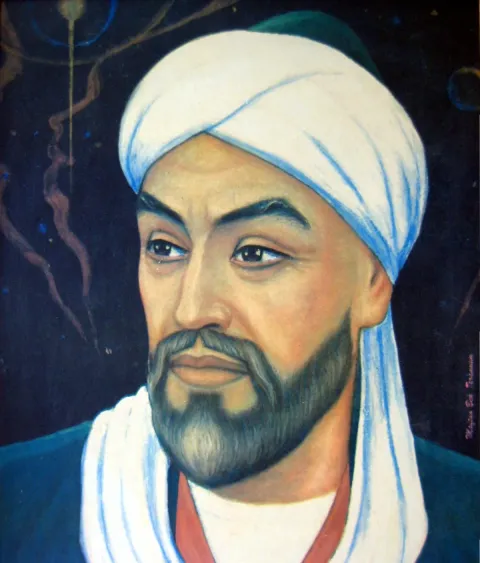
Al-Farghani
Ninth-century astronomer and engineer known in Europe as Alfraganus, whose summary of Ptolemaic astronomy served for centuries as a standard textbook in the Islamic world and in Europe.
- Occupation:
- Scientist, Astronomer
- Real name:
- Abu al-Abbas Ahmad ibn Muhammad ibn Kathir al-Farghani
- Born:
- c. 798 — c. 865
- Birthplace:
- Fergana
Biography
Abu al-Abbas Ahmad ibn Muhammad ibn Kathir al-Farghani was a ninth-century astronomer and engineer, known in Europe by the Latinised name Alfraganus. His year of birth is not known for certain: Uzbek scholars place it around 797–798, and in 1998 the 1200th anniversary of his birth was marked under the auspices of UNESCO. The nisba “al-Farghani” points to the Fergana Valley; Uzbek tradition names Quva as his birthplace. Nothing is known of his family or early years.
His career belongs to the scholarly centres of the Abbasid Caliphate. The eleventh-century Andalusian scholar Said al-Andalusi counts him among the astronomers of the caliph al-Ma’mun (813–833), and many sources link him with the House of Wisdom (Bayt al-Hikma) in Baghdad; Uzbek historians believe he came to Baghdad from Merv with al-Ma’mun’s court in 819. Other scholars date his work to the period when the caliphs resided at Samarra (after 836).
His principal work, “The Compendium of the Science of the Stars” (“Jawami‘ ‘ilm al-nujum”), was written some time between about 833 and 857. In thirty chapters it sets out Ptolemaic astronomy in plain language and without heavy mathematics: the calendars of different peoples, the celestial spheres, the seven climes and their cities, the motions of the Sun, the Moon and the planets, the fixed stars, the distances and sizes of the heavenly bodies, and eclipses. It records the result of the measurement of a degree of the meridian carried out on al-Ma’mun’s orders — 56⅔ Arabic miles.
Al-Farghani wrote one of the oldest surviving treatises on the theory of the astrolabe, setting out the geometrical and computational basis of the instrument together with tables for drawing its circles. He also wrote a commentary on the astronomical tables of al-Khwarizmi; it is lost, but later astronomers, al-Biruni among them, drew on it. The sources also mention his books on the celestial spheres and on sundials.
He worked as an engineer as well. Under the caliph al-Mutawakkil (847–861), the sons of Musa ibn Shakir, Muhammad and Ahmad, entrusted him with digging a canal for the new city of al-Ja‘fariyya near Samarra, but an error in the design meant that too little water entered the canal. In Egypt, on Rawda Island in Cairo, the Nilometer used to measure the level of the Nile was built under his direction (some sources say restored); it was completed in 861 and survives to this day.
The year 861 is the last firm date in al-Farghani’s life. He died in Egypt some time after it (Uzbek sources give 865) and is believed to have been buried in Cairo; his grave has not survived.
In the twelfth century his main work was translated into Latin twice, and in the thirteenth into Hebrew; it became the standard textbook of Ptolemaic astronomy in medieval Europe and was printed at Ferrara in 1493. The lunar crater Alfraganus is named after him. In 1998 a symbolic grave was created for him in Quva, the central park of Fergana bears his name, and in 2007 a monument to him was unveiled beside the Nilometer in Cairo.
Career
Life path
- 798Birth
Approximate date. Born in the Fergana Valley, according to Uzbek tradition in Quva; nothing is known of his family.
- 819Move to Baghdad
According to Uzbek historians, came from Merv to Baghdad with the court of the caliph al-Ma’mun and joined his astronomers.
- 830sMeasuring a degree of the meridian
Recorded in his book the result of the measurement made on al-Ma’mun’s orders — 56⅔ Arabic miles to a degree; Uzbek sources hold that he took part in it himself.
- 833–857“The Compendium of the Science of the Stars”
Wrote his main work, an account of Ptolemaic astronomy in thirty chapters.
- 850sTreatise on the astrolabe
Wrote one of the oldest surviving treatises setting out the geometrical and computational basis of the astrolabe.
- 861The al-Ja‘fari canal
Under the caliph al-Mutawakkil, directed the digging of a canal near Samarra for the sons of Musa ibn Shakir; a design error left it short of water.
- 861The Nilometer in Cairo
The structure for measuring the level of the Nile on Rawda Island was completed under his direction; it survives today.
- after 861Death
Died in Egypt (Uzbek sources give 865) and is believed to have been buried in Cairo.
Works
- “The Compendium of the Science of the Stars and the Principles of Celestial Motions”Astronomical work
“Kitab jawami‘ ‘ilm al-nujum wa usul al-harakat al-samawiyya”. An account of Ptolemaic astronomy in thirty chapters; translated into Latin in the 12th century and into Hebrew in the 13th, printed at Ferrara in 1493, and published in Arabic at Amsterdam in 1669.
- “The Complete Book on the Making of the Northern and Southern Astrolabe”Treatise on an astronomical instrument
One of the oldest surviving treatises on the theory of the astrolabe: the geometrical and computational basis of the instrument and tables for drawing its circles.
- “Commentary on the Zij of al-Khwarizmi”Astronomical commentary
A commentary on al-Khwarizmi’s astronomical tables; lost, but used by al-Hashimi, Ibn al-Muthanna and al-Biruni.
- “The Book of the Causes of the Spheres”Astronomical work
A work on the celestial spheres; an excerpt survives in the book of the tenth-century author Ibn Rusta.
- “The Book on the Making of Sundials”Treatise on an astronomical instrument
A work on horizontal sundials, known from mentions in the sources.
Legacy
Al-Farghani’s main work drew Arabic commentaries from al-Qabisi, al-Juzjani and al-Biruni. In the twelfth century it was translated into Latin by John of Seville (1135) and Gerard of Cremona (before 1175), and in the thirteenth into Hebrew by Jacob Anatoli; medieval European readers often knew Ptolemaic astronomy only through this book. Dante is thought to have drawn his astronomy from it, and Regiomontanus lectured on it at Padua in 1464. Christopher Columbus relied on al-Farghani’s value for the length of a degree but took his Arabic miles for the shorter Roman mile and so underestimated the circumference of the Earth. The lunar crater Alfraganus is named after him.
Era: The flowering of science in the Abbasid Caliphate, 9th century- His main work translated into Latin by John of Seville (1135)
- The Latin translation first printed at Ferrara (1493)
- Jacob Golius published the Arabic text with a new Latin translation at Amsterdam (1669)
- The 1200th anniversary of his birth marked under UNESCO auspices; a symbolic grave created in Quva (1998)
- A monument to him unveiled beside the Nilometer on Rawda Island in Cairo (2007)