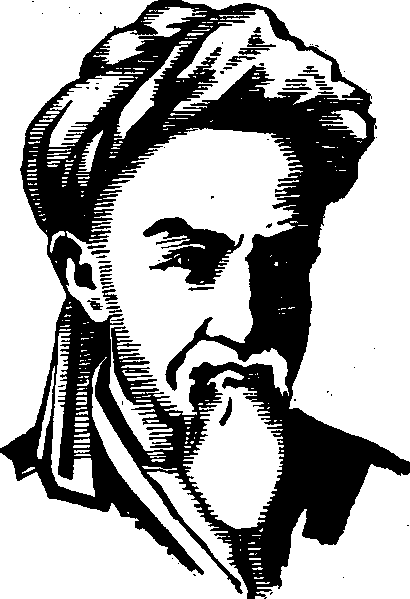
Biography
Ahmad Donish (full name Ahmad Makhdum; also known as Ahmad Kalla and Ahmad Muhandis) was born around 1827 in Bukhara; sources give a year between 1827 and 1829. He grew up in the family of a poor mullah, the imam of a small mosque. His mother taught him to read, and at school he cared less for memorising the Qur’an than for street storytellers and tales of history.
While studying at a madrasa he taught himself astronomy, geometry, medicine, history, literature and music, and became skilled in calligraphy and painting. The court architect noticed his talent and took him under his wing. Around 1850 Donish entered the service of Emir Nasrullah as a calligrapher and painter; he later became court astronomer and a go-between for the emir and the clergy.
As a freethinker he was unpopular at court: both Nasrullah and his successor Muzaffar wanted to use his knowledge while keeping him away from the palace. He was therefore sent three times to St Petersburg as secretary of a Bukharan embassy, in November 1857, October 1869 and January 1874. The journeys convinced him of Bukhara’s backwardness and of the need for reform; he also favoured the teaching of Russian.
His ideas on change are set out in “Risola dar nazmi tamaddun va ta’avun”, a part of his work “Nawadir al-waqayi'”. He proposed putting the treasury in order, fixing salaries and ethical standards for officials, and adding science and technology to the madrasa curriculum. For such views religious circles denounced him as an unbeliever. In 1879–1880 he withdrew from court; Emir Muzaffar, displeased with his treatise, sent him in 1885 as a judge to the remote districts of Guzar and Nahrpay. After the emir’s death Donish returned to Bukhara and devoted the rest of his life to writing; according to one source, under the new emir Abdulahad he ran the library of one of the madrasas.
His best-known book is “Nawadir al-waqayi'” (“Rare Events”), written in 1875–1882: moral tales, reflections on the state, family, learning and travel, and accounts of his journeys to Russia. In a history written in 1895–1897 he traced the Bukharan emirs from Daniyal Biy to the age of Abdulahad and criticised the emirate’s institutions and Tsarist colonial policy, so it had to circulate in secret. Donish wrote in Persian (Tajik) and composed ghazals, qasidas and rubais; his style is plain, with images taken from the oral tradition.
In Bukhara a literary circle of poets and musicians formed around him, among them Shohin, Hayrat and Dilkash; he influenced later Bukharan reformers such as Sadriddin Ayni and Tash-Khoja Asiri. He died in Bukhara in 1897. Manuscripts of his works are kept in Tashkent, Dushanbe and St Petersburg, above all at the Institute of Oriental Studies of the Academy of Sciences of Uzbekistan; in 1972 the Tajikfilm studio made a film about him, “A Star in the Night”.
Career
- Khanate of BukharaCourt calligrapher and painter, astronomer, embassy secretary · Bukhara · 1850–1885
Works
- “Nawadir al-waqayi'” (“Rare Events”)Historical, philosophical and memoir work
His main work: moral tales, reflections on the state, family, learning and travel, and accounts of his journeys to Russia; written from the mid-1870s to the early 1880s and surviving in several redactions.
- “Risola dar nazmi tamaddun va ta’avun” (“Treatise on the Order of Civilisation and Cooperation”)Reform treatise
A part of “Nawadir al-waqayi'”: proposals to reform government, to set salaries and ethical standards for officials and to give weight to science.
- “Risola dar a’moli kura” (“Treatise on Operations with the Globe”)Scientific treatise
A treatise on working with the globe, dated 1878–1879.
- “Me’yor ut-tadayyun” (“The Measure of Religiosity”) (1893)Religious treatise
A work on a religious theme written in 1893–1894.
- History of the Bukharan emirs (“Tarjimai ahvoli amironi Bukhoroi sharif”)Historical work
A history of the rulers of Bukhara from Daniyal Biy to the time of Abdulahad, with an account of his journeys to St Petersburg and the wars between Bukhara and Russia; written in 1895–1897 and circulated in secret.
- PoemsLyric poetry
Mostly ghazals, qasidas and rubais; some are preserved within his prose works and in anthologies of poets.
Life path
- c. 1827Birth
Born in Bukhara to a poor mullah, the imam of a small mosque; sources give a year between 1827 and 1829.
- c. 1850Court service
Entered the service of Emir Nasrullah as a calligrapher and painter, later becoming court astronomer.
- 1857First embassy
In November he left for St Petersburg as secretary of a Bukharan embassy.
- 1869Second embassy
In October he went to St Petersburg again with the embassy of Emir Muzaffar.
- 1874Third embassy
In January he visited St Petersburg for the third time as an embassy secretary.
- 1875–1882“Nawadir al-waqayi'”
Wrote his main work, including the treatise “Risola dar nazmi tamaddun va ta’avun”.
- 1879–1880Withdrawal from court
Disillusioned with court circles, he left service.
- 1885Judge and return
Emir Muzaffar sent him as a judge to Guzar and Nahrpay; after the emir’s death he returned to Bukhara.
- 1895–1897History of the emirs
Wrote a historical work on the emirs of Bukhara.
- 1897Death
Died in Bukhara.
Legacy
Donish was among the first Bukharan thinkers to write openly about the need for reform and for the study of secular sciences; later Bukharan reformers such as Sadriddin Ayni and Tash-Khoja Asiri drew on him. His course, from court functionary to historian critical of the emirate’s institutions, shows the cultural change of nineteenth-century Central Asia. Streets in Tashkent and Dushanbe bear his name, and in 1972 a film about him, “A Star in the Night”, was made.
Era: The Emirate of Bukhara in the 19th century- First embassy to St Petersburg (1857)
- Second embassy to St Petersburg (1869)
- Third embassy to St Petersburg (1874)
- Tajikfilm’s “A Star in the Night” (1972)