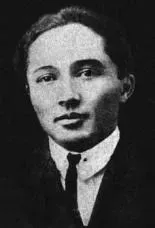
Botu
Uzbek poet and public figure, author of “Sparks of Hope”, who led the publications “Farg‘ona” and “Alanga” in the 1920s; shot in 1938 and rehabilitated in 1958.
Biography
Mahmud Khodiev, who wrote under the pen name Botu (Russian spelling Batu), was born on 15 May 1904 in Tashkent. He attended a Russian-native school in 1914–1917 and teacher-training courses in 1918–1920, and began to publish in 1919. From 1921 to 1927 he studied economics in Moscow.
As a young man he was among the initiators of replacing the Arabic script with the Latin alphabet for Uzbek (1920). In 1922 he founded the newspaper “Farg‘ona” and led it until 1930; from 1924 he worked with the journal “Maorif va o‘qituvchi”, and in the late 1920s he was editor-in-chief of “Alanga” (“Flame”), the organ of the Central Committee of the New Turkic Alphabet in Uzbekistan. He was also secretary of the Anti-Religious Commission and of the commission for the emancipation of women (the “Hujum”).
In 1928–1930 Botu served as deputy People’s Commissar of Education of the Uzbek SSR, and by 1930 he also headed the agitation, propaganda and press department of the Central Committee of the Communist Party of Uzbekistan.
His poems celebrate new life, youth and the liberation of women. His first collection, “Umid uchqunlari” (“Sparks of Hope”), appeared in 1925 and the second, “To‘lqin tovushlari” (“Sounds of Waves”), in 1929; in “Yangi qishloq”, “Hoshimjon”, “Tursun” and in stories for children he portrayed the new social relations. According to the National Encyclopedia of Uzbekistan, his early poems show the influence of Munavvar Qori’s ideas of national independence, and the Literary Encyclopedia of 1929–1930 called him the largest and most popular Uzbek poet of the day. He also wrote articles on linguistics and literary studies.
In August 1930 the OGPU arrested Botu as a “bourgeois nationalist” in the case of the “Milliy Ittihod” organization; he was sentenced to death, the sentence was commuted to ten years, and he was held in the Solovki camp. He was shot on 9 May 1938. His family was not told: letters to his wife stopped in 1936, and his daughter Naima learned of the sentence from the KGB archive many years later. He was rehabilitated in 1958.
His wife, the writer Valentina Petrovna Vasilyeva, was arrested in June 1941 and sentenced to ten years; their son Erkli was arrested in 1942 and later became a professor and children’s surgeon; their daughter Naima Mahmudova became a doctor of medical sciences and Deputy Minister of Health of the Uzbek SSR. A street and a school in Tashkent bear Botu’s name, and his centenary was marked in 2004.
Education
- Moscow State UniversityUniversity · 1921–1927 · Economics
Career
- Central Committee of the Communist Party of UzbekistanHead of the agitation, propaganda and press department · Tashkent · …–1930
- People's Commissariat of Education of the Uzbek SSRDeputy People's Commissar · 1928–1930
Life path
- 1914–1920Schooling
Studied at a Russian-native school (1914–1917) and then on teacher-training courses (1918–1920).
- 1919First publications
Began to publish poems and articles.
- 1920Latin-alphabet initiative
One of the initiators of moving Uzbek writing from the Arabic to the Latin script.
- 1921–1927Studies in Moscow
Received a higher education in economics in Moscow.
- 1922–1930“Farg‘ona” newspaper
Founded and led the newspaper; from 1924 he also worked with the journal “Maorif va o‘qituvchi”.
- 1925“Umid uchqunlari”
His first collection of poems came out in Tashkent.
- 1928–1930Deputy People’s Commissar of Education
Served as deputy commissar in the People’s Commissariat of Education of the Uzbek SSR.
- 1929“To‘lqin tovushlari”
His second collection of poems was published.
- 1930Arrest
Arrested by the OGPU in August; a death sentence was commuted to ten years in prison.
- 1938Execution
Shot on 9 May; letters to his family had stopped in 1936.
- 1958Rehabilitation
Rehabilitated for lack of a crime.
Works
- “Umid uchqunlari” (“Sparks of Hope”) (1925)Poetry collection
The poet’s first collection.
- “Yangi qishloq” (“The New Village”) (1928)Work
A work about the new social relations in the countryside.
- “To‘lqin tovushlari” (“Sounds of Waves”) (1929)Poetry collection
His second collection, praising novelty, youth and freedom.
- “Tursun” (1929)Work
About the clash of the new and the old way of life.
- “Hoshimjon”Work
A work devoted to the new social relations.
- “Bolalar yolg‘oni” (“Children’s Lie”)Short story
A story about the inner world of children.
- “Mening kitobim” (“My Book”)Short story
A story written for children.
- “Yoz kuni” (“A Summer Day”) (1980)Selected works
A posthumous volume of poems, long poems, stories and articles.
Legacy
Botu was one of the poets who celebrated the new life in Uzbek poetry of the 1920s; his name was kept out of print during the repressions, and his books returned to readers after his rehabilitation in 1958. A street and a school in Tashkent are named after him.
Era: Soviet Uzbekistan, 1920s–1930s- Arrest (1930)
- Execution (1938)
- Rehabilitation (1958)
- Centenary of his birth (2004)