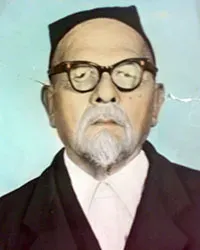
Muhammadjan Hindustani
Islamic scholar and teacher from the Kokand region, educated in India; repeatedly imprisoned in Soviet times, he worked on translation and commentary in Tajikistan and wrote a translation of the Quran's meanings.
- Occupation:
- Religious figure, Scientist, Educator
- Lived:
- 1892 — 1989
- Birthplace:
- Fergana
Biography
Muhammadjan Rustam ugli was an Islamic scholar also remembered as Haji Hindustani, Mavlavi Hindustani, Haji Domla and Hazrat Mavlavi. He was born in 1892 in the village of Chorbogh in the Kokand district, close to the Khoja Muhammad Vali cemetery. His parents were learned people too and saw to his schooling from early childhood; at fourteen he had learned the Quran by heart and become a hafiz.
His studies began in the madrasas of Kokand and Bukhara and went on in the Afghan cities of Balkh and Mazar-i-Sharif. Advised by his teachers, he travelled to India, where he spent a further eight years at the Usmaniya madrasa in Ajmer; the name Hindustani dates from then. He came home in 1929.
Under the Soviet government he was punished several times. The sources say that in 1932 he was branded a «class enemy» and held for a year. After release in 1933 he kept changing his residence to escape denunciations. He was then charged with having studied «in foreign countries», sentenced to three years and put to work in a camp in the Sverdlovsk region. In 1942 he was seriously wounded in the war and stayed in a labour camp until 1946. In 1949 he was charged with opposing «the existing political system», given twenty-five years and sent to a camp in Kazakhstan. He kept petitioning Moscow, however; his case was re-examined and after four years and three months he was released.
After the war the Muslim Spiritual Board of Central Asia and Kazakhstan, in Tashkent, sent him to work in Tajikistan. There, for about two years, he translated Arabic books into Persian and Uzbek in the manuscripts department of the Institute of Oriental Studies of the republic's Academy of Sciences. From Arabic into Persian he rendered al-Zamakhshari's «Nawabigh al-kalim» and «Maqamat», plus al-Busiri's «Qasidat al-Burda»; Imam Barzanji's «Mawlid al-nabi» went into Uzbek.
His eyesight deteriorated and doctors forbade him to work with books continuously. Judging that the time had come to pass on what he had gathered, he wrote several works. One is the Quran translation «Bayan al-Furqan fi tarjimat al-Qur'an»; Sayfiddin Rafiddinov of the Academy of Sciences of Uzbekistan prepared it for the press, and Movarounnahr published it in 2006. Hindustani also wrote commentaries on Imam al-Bukhari's «al-Jami' al-sahih», on al-Marghinani's «Hidaya», on the «Fiqh al-akbar» of Imam Abu Hanifa, on Jami's «Sharh-i Mulla» and on «Mirqat al-mantiq», and translated «Usul al-Shashi», «Nur al-anwar» and «Mukhtasar al-ma'ani» into Uzbek and Persian. His commentary on the ghazals of Abdulqadir Bedil drew particular praise. Students taped his lectures on tafsir, hadith, fiqh, Islamic history, Sufism and literature on hundreds of reels.
Muhammadjan Hindustani died in 1989, reportedly at about 97, and, as he had wished, was laid to rest in the Mavlono Ya'qub Charkhi cemetery. Sources contradict each other on his birthplace: some name Chorbogh near Kokand, while English Wikipedia gives Chorbogh in Tajikistan.
Career
- Spiritual Administration of the Muslims of Central Asia and KazakhstanPosted to Tajikistan through the spiritual board · Tashkent · 1946–…
- Academy of Sciences of TajikistanTranslator (manuscripts department, Institute of Oriental Studies)
Life path
- 1892Birth
The village of Chorbogh (Kokand area).
- 1906Becomes a hafiz of the Quran
At the age of fourteen.
- Madrasas of Kokand, Bukhara, Balkh and Mazar-i-Sharif
- Usmaniya madrasa in Ajmer
Eight years of study, hence the name Hindustani.
- 1929Returns home
- 1932First sentence
Sentenced to one year of imprisonment.
- 1930-yillarThree years in a camp
On a charge of studying abroad; Sverdlovsk region.
- 1942Wounded at the front
Held in labour camps until 1946.
- 1949Second sentence
Twenty-five years; camp in Kazakhstan; released after four years and three months.
- 1950-yillarTranslator at the Tajik Academy of Sciences
Manuscripts department of the Institute of Oriental Studies, about two years.
- 1989Death
Buried in the Mavlono Ya'qub Charkhi cemetery.
- 2006«Bayonul Furqon» published
Published posthumously by Movarounnahr.
Works
- «Bayanul Furqon fi tarjimatil Qur'on»
Translation of the meanings of the Quran; published in 2006.
- Translation of al-Zamakhshari's «Nawabigh al-kalim» and «Maqamat»
From Arabic into Persian.
- Translation of al-Barzanji's «Mawlid al-nabi»
Into Uzbek.
- Translation of al-Busiri's «Qasidat al-Burda»
Into Persian.
- Commentary on Bedil's ghazals
- Commentaries on «Hidaya», «Fiqh al-akbar», «Sharh-i Mulla», «Mirqat al-mantiq» and others