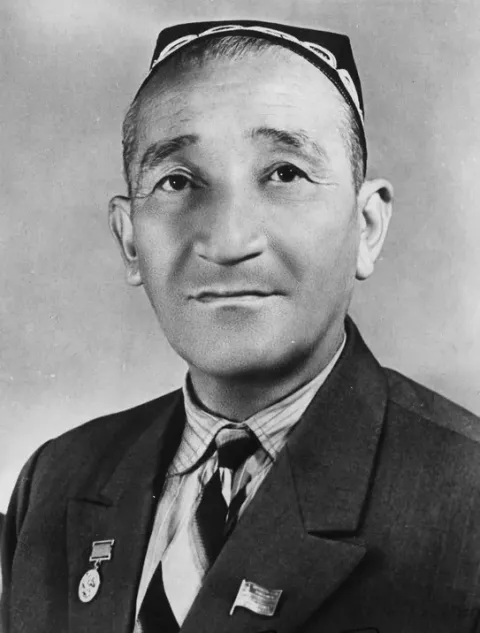
Ghafur Ghulam
Uzbek poet, prose writer and translator, People’s Poet of the Uzbek SSR, author of the novella “Shum bola” (“The Mischievous Boy”) and the wartime poem “You Are Not an Orphan”.
Biography
Ghafur Ghulam (born Ghafur Ghulomov) was born on 10 May 1903 in the Qo'rg'ontegi quarter of Tashkent. His father, Ghulom Mirza Orif, knew Russian and wrote verse himself, and local poets used to gather at the family home. The boy was orphaned early: he lost his father at nine and his mother soon afterwards, and the care of his sisters fell to him.
He studied at the traditional school and madrasa of his neighbourhood, from 1916 at a Russian-native school and in 1918 at the “Hayot” school. To earn a living he worked as a cobbler, a tinsmith and a typesetter at a printing house. After a teacher-training course he taught at the “Cho'lpon” (1919) and “Hayot” (1924) schools, worked at an orphanage (1926) and in 1928 became head of the “Urfon” school.
His poems began to appear in print in 1923. From 1928 he was executive secretary of the newspaper “Kambag'al dehqon”, from 1929 of “Sharq haqiqati”, and in 1930–1942 a literary staff member of the magazines “Mushtum” and “Yer yuzi” and the newspaper “Qizil O'zbekiston”. The collections “Dynamo” (1931) and “Living Songs” (1932) made his name as a young poet. In the 1930s he also turned to prose, writing the novellas “Netay”, “The Corpse that Came Alive” and “Yodgor”, and the autobiographical “Shum bola” (“The Mischievous Boy”), about a quick-witted boy who wriggles out of every scrape. Documents on the case of Abdulla Qodiriy published in 1992 include reviews, signed among others by Ghafur Ghulam, that accused the novelist of nationalism.
His best-known poems date from the Second World War: “You Are Not an Orphan” (1942), addressed to children who had lost their parents and been brought to Uzbekistan, “Seeing Off”, “Longing” and “There Will Be a Holiday on Our Street Too”. The collection of his wartime verse, “I Am Coming from the East” (1943), won a Stalin Prize in 1946. The National Encyclopedia of Uzbekistan describes “Time”, written in the first months after the war, as a new stage in Uzbek philosophical lyric poetry.
In 1943 he was elected a full member of the Academy of Sciences of Uzbekistan, and for the rest of his life he was a senior research fellow at its Institute of Language and Literature. He wrote on Navoi, Muqimiy and folklore and prepared Navoi’s “Farhod and Shirin” for publication. He translated Shakespeare’s “Othello” and “King Lear”, Beaumarchais’s “The Marriage of Figaro” and works by Pushkin, Lermontov, Nekrasov, Shevchenko and Mayakovsky into Uzbek. He joined the Communist Party in 1946 and was named People’s Poet of the Uzbek SSR in 1963.
Ghafur Ghulam died in Tashkent on 10 July 1966 and was buried in the Chig'atoy cemetery. He was posthumously awarded the Lenin Prize (1970) and the Order “For Outstanding Merit” (“Buyuk xizmatlari uchun”, 2000). A publishing house, a metro station and a park in Tashkent bear his name; his house became a museum in 1983, and in 2003, his centenary year, a monument to him was put up in the park. “Shum bola” was filmed in 1977, and in 2023 the BBC included it in its list of the 100 greatest children’s books.
Career
- Mushtum magazineLiterary staff member
- Academy of Sciences of UzbekistanAcademician, senior research fellow at the Institute of Language and Literature · Tashkent · 1943–1966
- Qizil O'zbekiston newspaperLiterary staff member · Tashkent
Awards
 Order «For Outstanding Merit»2000, posthumously · Uzbekistan
- People's Poet of the Uzbek SSR1963 · Uzbek SSR
 Order of Lenin1950 · USSR
- Order of Lenin1957 · USSR
 Order of the Red Banner of Labour1939 · USSR
- Order of the Red Banner of Labour1951 · USSR
- Order of the Red Banner of Labour1963 · USSR
 Order of the Badge of Honour1944 · USSR
 Lenin Prize1970, posthumously · USSR
 Stalin Prize1946 · USSR
Life path
- 1916–1918Russian-native and “Hayot” schools
After the neighbourhood school and madrasa he entered a Russian-native school in 1916 and the “Hayot” school in 1918.
- 1919–1928Teaching
After a teacher-training course he taught at the “Cho'lpon” and “Hayot” schools, worked at an orphanage and in 1928 became head of the “Urfon” school.
- 1923First poems
His first poems appeared in print.
- 1928–1942Newspapers and magazines
Executive secretary of the newspapers “Kambag'al dehqon” and “Sharq haqiqati”; in 1930–1942 a literary staff member of the magazines “Mushtum” and “Yer yuzi” and the newspaper “Qizil O'zbekiston”.
- 1931–1932First collections
The poetry collections “Dynamo” and “Living Songs” came out.
- 1942–1943Wartime poetry
Wrote “You Are Not an Orphan”; the collection “I Am Coming from the East” was published.
- 1943Academician
Elected a full member of the Academy of Sciences of Uzbekistan; senior research fellow at its Institute of Language and Literature for the rest of his life.
- 1946Stalin Prize
Awarded for the collection “I Am Coming from the East”.
- 1956–1959“Selected Works”
His selected works were published in four volumes.
- 1963People’s Poet of the Uzbek SSR
Received the honorary title.
- 1966Death
Died in Tashkent on 10 July and was buried in the Chig'atoy cemetery.
- 1970Lenin Prize
Awarded the prize posthumously.
Works
- “Dynamo” (1931)Poetry collection
One of the poet’s first collections, which launched his literary career.
- “Living Songs” (1932)Poetry collection
Together with “Dynamo”, it showed the young poet’s distinctive voice.
- “Netay”Novella
The fate of an orphan girl brought by wealthy men to amuse the Emir of Bukhara; the plot is based on a real event.
- “Yodgor” (1936)Novella
The story of Jo'ra, an ordinary man who raises another man’s child.
- “Shum bola” (“The Mischievous Boy”)Autobiographical novella
The adventures of a boy who wriggles out of every scrape; written in the 1930s and later revised. Filmed in 1977 and included in the BBC’s list in 2023.
- “You Are Not an Orphan” (1942)Poem
Dedicated to children who lost their parents in the war and were brought to Uzbekistan.
- “I Am Coming from the East” (1943)Poetry collection
A collection of wartime verse; awarded a Stalin Prize in 1946.
- “Time” (1945)Poem
A philosophical poem written in the first months after the war.
- “My Little Thief of a Son” (1965)Short story
A humorous story later adapted for the stage and the screen.
- Translation of Shakespeare’s “Othello”Translation
Translated Shakespeare’s tragedies “Othello” and “King Lear” into Uzbek.
Legacy
The Great Soviet Encyclopedia names Ghafur Ghulam, together with Hamza Hakimzoda Niyoziy, among the founders of modern Uzbek versification. His translations of Shakespeare and the Russian classics opened new literature to Uzbek readers, and in 2023 a BBC poll placed “Shum bola” among the 100 greatest children’s books. A publishing house, a metro station and a park in Tashkent, as well as a literary museum in Kokand, bear his name.
Era: Uzbek Soviet literature of the mid-20th century- The Literature and Art Publishing House was named after Ghafur Ghulam (1966)
- Posthumously awarded the Lenin Prize (1970)
- The film “Shum bola” was made (1977)
- The Ghafur Ghulam House Museum opened in Tashkent (1983)
- Posthumously awarded the Order “For Outstanding Merit” (2000)
- His centenary was marked and a monument unveiled in Tashkent (2003)
- “Shum bola” was included in the BBC’s list (2023)