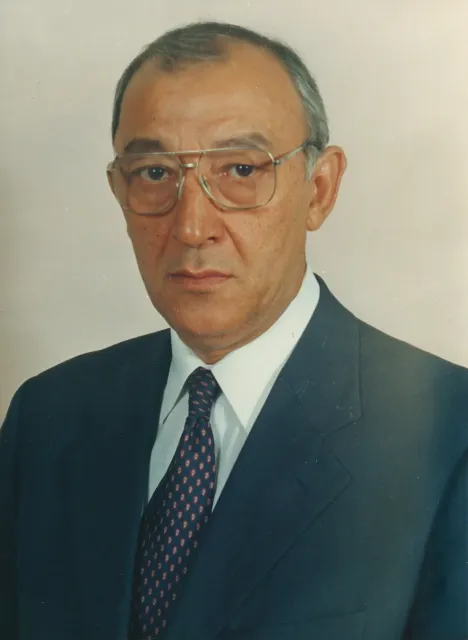
Kadyr Gulamov
Physicist, academician of the Academy of Sciences of Uzbekistan; the country’s first civilian minister of defence (2000–2005); son of the poet Ghafur Ghulam.
- Occupation:
- Scientist, Politician, Physicist
- Born:
- February 17 1945(81 years old) ♒
- Birthplace:
- Tashkent
- Father:
- G'afur G'ulom
Biography
Kadyr Gafurovich Gulamov was born in Tashkent on 17 February 1945. He is the son of the Uzbek poet Ghafur Ghulam. In 1963 he began his studies at Tashkent State University, today the National University of Uzbekistan.
In 1967 he was sent to the High Energy Laboratory of the Joint Institute for Nuclear Research in Dubna, where he studied under Bruno Pontecorvo, Mikhail Meshcheryakov, Alexander Baldin and other physicists. From 1968 he worked at the Institute of Nuclear Physics of the Uzbek Academy of Sciences, in the high-energy laboratory led by Sodiq Azimov. In 1971 the laboratory was transferred to the Physical-Technical Institute, which later became part of the Physics-Sun association.
His research concerns multiple particle production in collisions of hadrons and nuclei with nuclei at accelerator energies. He led a number of emulsion experiments at CERN, at Fermilab and Brookhaven in the United States, in Dubna and in Protvino, and critically examined several theoretical models of particle production on nuclei. He has published more than 300 scientific papers, mostly in international journals.
He became a Doctor of Physical and Mathematical Sciences in 1980, a corresponding member of the Uzbek Academy of Sciences in 1989 and a full academician in 1995, and a member of the Islamic World Academy of Sciences in 1997. In 1983 he received the Beruni State Prize of the Uzbek SSR. From 1989 to 1999 he was general director of the Physics-Sun association, and from 1991 to 1999 chief scientific secretary of the Academy; at his initiative and under his direction the Academy’s Institute of Materials Science was founded in 1993 and the Uzbek research and education network UZSCINET in 1995. From 1993 to 2000 he represented Uzbekistan on NATO’s Science Committee.
In 1999–2000 he was deputy minister of defence and head of the Academy of the Armed Forces, and from 2000 to 2005 the country’s first civilian minister of defence, after which he became State Advisor to the President. At the ministry he set up a military postgraduate programme and a series of military publications, created a language training centre and, in 2004, founded the Armed Forces’ Centre for Simulation and Modelling.
Since 2006 he has been a leading researcher of the Physics-Sun association. In 1997 and 2010 he proposed an international solar energy centre; the International Solar Energy Institute opened in Tashkent in 2013. By presidential decree of 26 August 2023 he was given the honorary title Honoured Science Worker of Uzbekistan. He has also received the Oliy Majlis medal “Mustaqillik” (1992) and the Order of Shon-sharaf (2003).
Education
- National University of UzbekistanUniversity · Tashkent · 1963
Career
- Presidency of the Republic of UzbekistanState Advisor to the President · 2005–2006
- Academy of Sciences of UzbekistanChief scientific secretary (1991–1999); corresponding member (1989), academician (1995) · Tashkent · 1989–present
- Physical-Technical Institute of the Academy of Sciences of the Uzbek SSRJunior and senior researcher, head of laboratory (1971–1988); chief researcher (in 2023) · Tashkent · 1971–present
- Institute of Nuclear Physics of the Academy of Sciences of the Uzbek SSRResearcher, high-energy laboratory · Tashkent · 1968–1971
- Physics-Sun research and production associationDeputy general director (1988–1989), general director (1989–1999), leading researcher (from 2006) · Tashkent · 1988–…
- Ministry of Defence of UzbekistanDeputy minister and head of the Academy of the Armed Forces (1999–2000), minister of defence (2000–2005) · Tashkent · 1999–2005
Awards
 Honoured Science Worker of Uzbekistan2023 · Uzbekistan
 Beruni State Prize of the Uzbek SSR1983 · Uzbek SSR
Life path
- 1945Birth
Born in Tashkent into the family of the poet Ghafur Ghulam.
- 1963University
Began studying at Tashkent State University.
- 1967–1968Dubna
Studied at the High Energy Laboratory of the Joint Institute for Nuclear Research.
- 1968–1971Institute of Nuclear Physics
Sent to the Institute of Nuclear Physics of the Uzbek Academy of Sciences, to Sodiq Azimov’s laboratory.
- 1971–1988Physical-Technical Institute
After the laboratory’s transfer, worked as junior and senior researcher and head of the laboratory.
- 1980Doctorate
Became a Doctor of Physical and Mathematical Sciences.
- 1983State Prize
Received the Beruni State Prize of the Uzbek SSR.
- 1989–1999Physics-Sun association
General director of the association; elected a corresponding member of the Academy in 1989.
- 1991–1999Academy of Sciences
Chief scientific secretary of the Academy of Sciences of Uzbekistan.
- 1995Academician
Elected a full member of the Academy; the UZSCINET network was created the same year.
- 1999–2005Ministry of Defence
Deputy minister of defence and head of the Academy of the Armed Forces (1999–2000), then civilian minister of defence (2000–2005).
- 2005–2006State Advisor to the President
Served as State Advisor to the President after leaving the ministry.
- 2006–presentResearch
Leading researcher of the Physics-Sun association; given the title Honoured Science Worker of Uzbekistan in 2023.
Works
- “Is the tube approach to the multiple production on nuclei credible?” (1978)Article
Co-authored with S. A. Azimov and others; Physics Letters B 73; on the “tube” model of multiple particle production on nuclei.
- “Search for shock waves in nucleus-nucleus collisions” (1976)Article
Co-authored with E. S. Basova and others; JETP Letters 24; on the search for shock waves in collisions of nuclei.
- “Nuclear interactions of 21 GeV/c protons and 50 GeV/c negative pions in emulsions exposed in a strong magnetic field” (1981)Article
Co-authored with S. A. Azimov and others; Zeitschrift für Physik A 300; results of emulsion experiments in a strong magnetic field.
- “Rapidity density distributions in 16O, 28Si, 36S, 197Au and 208Pb induced heavy ion interactions at 4–200 A GeV” (1992)Article
Co-authored with M. I. Adamovich and others; Physical Review Letters 69; on the distribution of particles in heavy-ion collisions.