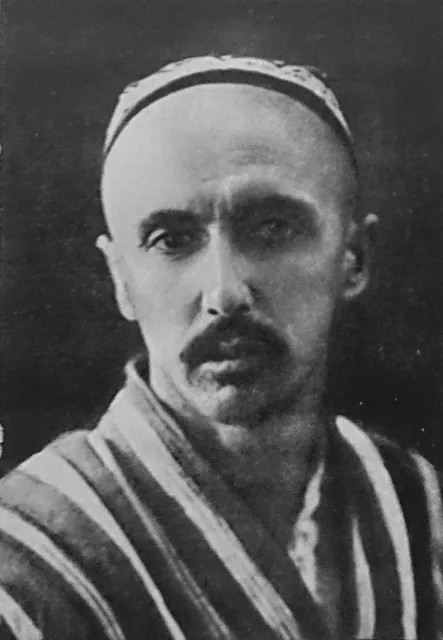
Hamza Hakimzade Niyazi
Kokand poet, playwright, composer and teacher who opened Jadid schools and wrote textbooks for them; hailed in Soviet times as the founder of Uzbek Soviet literature, he was killed in Shohimardon in 1929.
Biography
Hamza Hakimzade Niyazi was born on 6 March (22 February, Old Style) 1889 in Kokand into a healer’s family. His father, Ibn Yamin Niyoz o'g'li, farmed in his youth, then learned medicine in Bukhara and became known locally as “hakimcha”, the little doctor, which gave his son the name Hakimzade, “the doctor’s son”. His mother was called Jahonbibi. In 1896–1906 Hamza studied at the old-style school and madrasa of Kokand’s Solkashon quarter, and in 1908 he spent eight months at a madrasa in Namangan. In 1909 he went to Bukhara to study Arabic in depth, but unrest in the city drove him away, and for a short time he worked at a printing house in Kogon.
He began writing poetry while still a madrasa student, in 1905–1906, signing ghazals in the classical manner with the pen name Nihoniy. In 1914 he gathered his Uzbek and Tajik poems of 1905–1914 into a manuscript divan, which was found and published only after his death. From 1908 he read the Crimean Tatar newspaper “Tercüman”, the Tatar “Vaqt” and the Jadid press of Tashkent, joined the Jadid movement and called Munavvar Qori Abdurashidxonov his spiritual mentor; his first poems and articles appeared in these papers and journals.
In 1910 in Tashkent he studied the curricula of the new-method schools and opened such a school in the Kashgar quarter. In 1911 he opened a free school for poor children in Kokand’s Hojibek quarter, and in 1914 another in Margilan. Conservative clerics accused him of godlessness and tried to have the schools closed; he reopened them elsewhere. For his pupils he compiled the readers “Easy Literature”, “Reading Book” (1914) and “Qiroat kitobi” (1915). In 1913–1914 he travelled through Afghanistan and India to Arabia, performed the hajj and visited Syria and Turkey.
From 1914 his articles calling for education appeared in the newspapers “Sadoyi Turkiston” and “Sadoyi Farg'ona” and the journal “Oyina”. The novella “New Happiness” (1915), about a poor youth, Olimjon, whom learning brings happiness, was followed by the drama “Poisoned Life, or Victims of Love” (1916), about young lovers destroyed by their parents’ rigidity. In 1915–1919 he issued a series of verse collections under the general title “National Poems for National Songs”, each named after a flower; Soviet criticism called the poems of “The Fragrant Rose” (1919) the first examples of proletarian poetry in Uzbek.
Hamza supported the revolution of 1917. That year he briefly taught at the Russian-native school in Kokand, worked as a scribe for the Shuroi Islom organisation and edited the journals “Kengash” and “Hurriyat”. In 1918 he served in the culture and education department of the Fergana Region, and in 1919 he was playwright and director of a touring troupe attached to the political administration of the Turkestan Front, which performed for Red Army units. Soviet sources credited Hamza with founding it, while the National Encyclopedia of Uzbekistan notes that it was led by G'afur Musaxonov. Most of his plays from these years — “The Slanderers’ Punishment”, “The Bey and the Servant” (1918), “The Fergana Tragedy” — are lost. In 1920 he joined the Russian Communist Party (Bolsheviks) and ran the Dor ush-shafaqa school; in 1921 he led a theatre troupe in Bukhara, in 1921–1924 he worked in the trade unions’ cultural institutions in Khorezm and opened a boarding school for Kazakh children in Khojeyli, and in 1924 he worked for the Fergana education committee.
On 27 February 1926, on the same day as Muhammadsharif So'fizoda, Hamza received the title of People’s Poet of Uzbekistan (some sources call it People’s Writer). From then on he devoted himself mainly to writing. His best-known stage works remain the comedy “The Old Judges, or the Case of Maysara” (1926), in which the quick-witted Maysara makes fools of a corrupt qadi and his officials, and the drama “The Secrets of the Veil, or the Case of the Yalla Singers” (1927); in the same years he also wrote propaganda plays about elections and the world revolution. In 1927–1928 he wrote poems for the hujum campaign to unveil women, among them “Elegy for Tursunoy”. Hamza collected folk songs, performed them on traditional instruments and composed several dozen songs himself; some of his tunes were included in the collection “Songs of Fergana, Bukhara and Khiva” (1931).
In 1928 the party sent him to do propaganda work in Shohimardon, a mountain village belonging to the Fergana Region. There he opened a school, campaigned for the emancipation of women and sought to close a shrine that pilgrims venerated as the tomb of the caliph Ali, which angered the local clergy and part of the villagers. On 18 March 1929 a crowd stoned him to death near the shrine. In June of that year several dozen people were tried in the village of Vodil, and several of them were sentenced to death. Hamza was buried in Shohimardon, where a mausoleum stands over his grave. The details of the killing and the question of who organised it remain disputed: the Soviet account blamed religious fanatics, while some authors, among them the writer Nabijon Boqiy, question that version.
In Soviet times Hamza was celebrated as the founder of Uzbek Soviet literature and a martyr of the revolution. In 1931 the Uzbek State Academic Drama Theatre was named after him, and in 1959 a museum opened in his house in Kokand; Oybek wrote a narrative poem about him and Komil Yashin a play and a novel, the feature film “Hamza” came out in 1961, and in 1977–1984 Shuhrat Abbosov made the multi-part film “Fiery Roads”. A state prize of the Uzbek SSR, a district of Tashkent, a metro station and many streets, schools and farms bore his name. After independence his role as a Soviet propagandist was reassessed: the prize named after him was abolished, the theatre (2001), the Tashkent district (2014) and the metro station (2015) were renamed, and his monuments were removed. The National Encyclopedia of Uzbekistan notes that “The Bey and the Servant” was rewritten in Soviet times by Komil Yashin on the basis of the surviving playbill and long presented as a model of Hamza’s drama. In 2019 the Academy of Sciences and the Writers’ Union of Uzbekistan held a conference for the 130th anniversary of his birth.
Career
- Communist Party of the Soviet UnionMember (from 1920, then the Russian Communist Party (Bolsheviks)) · 1920–1929
- Kengash magazineEditor · 1917–1917
- Regional Muslim political troupe of the Turkestan Front’s political administrationPlaywright and director · 1919–1919
Awards
- People's Poet of the Uzbek SSR1926 · Uzbek SSR
Life path
- 1896–1908School and madrasa
Studied at the school and madrasa of Kokand’s Solkashon quarter, then at a madrasa in Namangan.
- 1905–1914The Nihoniy divan
Wrote ghazals in the classical manner as Nihoniy and in 1914 gathered them into a manuscript divan.
- 1910–1914New-method schools
Opened Jadid schools in Tashkent, Kokand and Margilan and wrote textbooks for them.
- 1913–1914Hajj
Travelled through Afghanistan and India to Mecca and Medina and visited Syria and Turkey.
- 1915–1919Novella, drama and verse collections
“New Happiness”, “Poisoned Life” and the series “National Poems for National Songs” came out.
- 1917The journal “Kengash”
Worked in Kokand as a teacher and scribe and edited the journals “Kengash” and “Hurriyat”.
- 1918–1919Touring troupe
Playwright and director of the troupe of the Turkestan Front’s political administration; wrote “The Bey and the Servant”.
- 1920–1924Bukhara and Khorezm
Joined the Bolshevik party; led a theatre troupe in Bukhara and worked in cultural institutions in Khorezm.
- 1926People’s Poet
Received the title of People’s Poet of Uzbekistan on 27 February; wrote the comedy “The Case of Maysara”.
- 1928Shohimardon
Sent by the party to do propaganda work in the mountain village.
- 1929Death
Killed by a crowd in Shohimardon on 18 March and buried there.
Works
- “Nihoniy’s Divan” (“Devoni Nihoniy”) (1914)Divan
Uzbek and Tajik poems of 1905–1914 written under the pen name Nihoniy; published after his death.
- “Easy Literature” (“Yengil adabiyot”) (1914)Textbook
A reader for his schools in Kokand and Margilan; “Reading Book” (1914) and “Qiroat kitobi” (1915) came out in the same years.
- “New Happiness” (“Yangi saodat”) (1915)Novella
About a poor youth, Olimjon, whom learning brings happiness; some scholars called it the first Uzbek novel, while the National Encyclopedia of Uzbekistan classes it as a novella.
- “Poisoned Life, or Victims of Love” (“Zaharli hayot yoxud Ishq qurbonlari”) (1916)Drama
The tragedy of young lovers kept apart by their parents’ class prejudices, who take their own lives.
- “National Poems for National Songs” (“Milliy ashulalar uchun milliy she'rlar majmuasi”) (1915)Series of collections
Collections of 1915–1919, each named after a flower, among them “The Fragrant Rose” (1919); the poems were written to be sung.
- “The Bey and the Servant” (“Boy ila xizmatchi”) (1918)Drama
The original text is lost; the version staged later was rewritten by Komil Yashin from the surviving playbill.
- “The Old Judges, or the Case of Maysara” (“Burungi qozilar yoxud Maysaraning ishi”) (1926)Comedy
A comedy in three acts in which the resourceful Maysara takes revenge on a corrupt qadi and his officials; an opera and a musical film were later based on it.
- “The Secrets of the Veil, or the Case of the Yalla Singers” (“Paranji sirlaridan bir lavha yoki Yallachilar ishi”) (1927)Drama
About the hard lot of Uzbek women before the revolution.
- “Elegy for Tursunoy” (“Tursunoy marsiyasi”) (1928)Elegy
A poem in memory of the murdered young singer Tursunoy Saidazimova.
Legacy
Having moved from Jadid reformism to Soviet literature, Hamza holds a notable place in the history of Uzbek drama, theatre and modern song: he wrote in the folk syllabic metre barmoq as well as in classical aruz and brought women’s rights, illiteracy and superstition onto the stage. In Soviet times he was canonised as the founder of Uzbek Soviet literature and a martyr of the revolution; since independence his name has been removed from many places, and his work is being studied anew in the context of Jadid literature and Soviet ideology. The historian Adeeb Khalid wrote that the history of modern Central Asian literature is hard to imagine without him.
Era: Turkestan Jadidism, the revolution of 1917 and the early Soviet years- Received the title of People’s Poet of Uzbekistan (1926)
- Killed in Shohimardon (1929)
- The Uzbek State Academic Drama Theatre was named after him (1931)
- A house museum opened in Kokand (1959)
- The feature film “Hamza” was released (1961)
- A Soviet commemorative coin marked the centenary of his birth (1989)
- The drama theatre was renamed the Uzbek National Academic Drama Theatre (2001)
- The Hamza station of the Tashkent metro was renamed Novza (2015)
- A conference marked the 130th anniversary of his birth (2019)