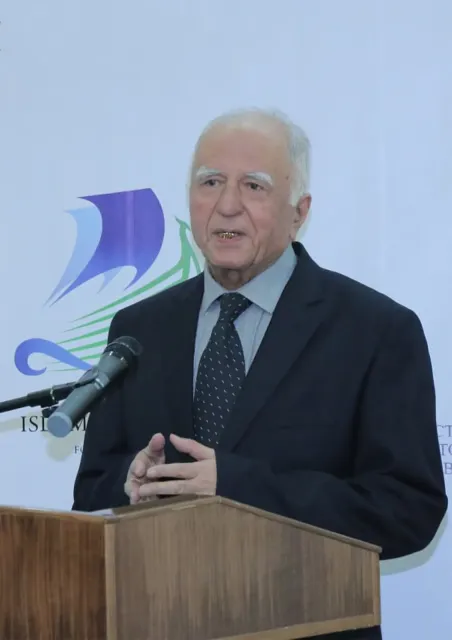
Ibrohim Gafurov
Uzbek literary critic, writer and translator who rendered Joyce’s “Ulysses” into Uzbek, a leader of the Milliy Tiklanish party and Hero of Uzbekistan.
- Occupation:
- Writer, Politician
- Born:
- December 27 1937(88 years old) ♑ — June 6, 2026
- Birthplace:
- Tashkent
- Spouse:
- Oydin Hojiyeva
Biography
Ibrohim Usmonovich Gafurov was born on 27 December 1937 in Tashkent into an artisan’s family. After school he studied at the philology faculty of Tashkent State University (now the National University of Uzbekistan) from 1956 to 1961.
He began working in 1961 as an editor at the State Publishing House of Fiction; later, at the Ghafur Ghulam Publishing House of Literature and Art, he became head of an editorial department and deputy editor-in-chief. From 1982 to 1995 he was deputy editor-in-chief of the newspaper “Oʻzbekiston adabiyoti va sanʼati”. In 1973 he received the degree of Candidate of Philological Sciences.
As a literary critic he published “The Diamond Facets of Beauty” (1964), “Charm” (1970), “The Burning Word” (1973), “The Heart Is a Flame” (1980), “The Heart of Lyric Poetry” (1982) and “The Confession of Thirty Years” (1987), which discuss the work of Usmon Nosir, Mirtemir, Maqsud Shayxzoda, Said Ahmad and others. Later he wrote prose poems, essays and stories and published the collection “Dil erkinligi” (“Freedom of the Heart”, 1998).
As a translator he rendered into Uzbek Maupassant’s “Bel-Ami”, Dostoevsky’s “Crime and Punishment”, “The Idiot” and “The Gambler”, Hemingway’s “The Old Man and the Sea” and “A Farewell to Arms”, Aitmatov’s “Qiyomat” (“The Scaffold”) and García Márquez’s “The Autumn of the Patriarch”. His best-known translation is James Joyce’s “Ulysses”.
In 1995, when the Milliy Tiklanish (National Revival) Democratic Party was formed, he became its first deputy chairman and editor-in-chief of its newspaper, and from 1996 he chaired the party’s Central Council. He sat in the Oliy Majlis and led the party’s parliamentary group. Later he taught at the National University of Uzbekistan and at the Uzbek State University of World Languages.
He received the Order of Friendship (“Doʻstlik”) in 1995 and the Order of Labour Glory (“Mehnat shuhrati”) in 2007; in 2017 he was named Honoured Art Worker of the Republic of Uzbekistan. By presidential decree of 24 August 2021 he was awarded the title Hero of Uzbekistan.
Ibrohim Gafurov died on 6 June 2026, aged 88; the Writers’ Union of Uzbekistan announced his death.
Education
- National University of UzbekistanUniversity · Tashkent · 1956–1961 · Faculty of Philology
Career
- Writers' Union of UzbekistanMember · Tashkent
- Ghafur Ghulam Publishing House of Literature and ArtEditor, head of an editorial department, deputy editor-in-chief · Tashkent · 1961–1982
- Oliy Majlis of the Republic of UzbekistanDeputy · Tashkent · 1999–2004
- O'zbekiston adabiyoti va san'ati newspaperDeputy editor-in-chief · Tashkent · 1982–1995
- Milliy Tiklanish Democratic PartyFirst deputy chairman, from 1996 chairman of the Central Council; editor-in-chief of the party newspaper · Tashkent · 1995–…
Awards
 Hero of Uzbekistan2021 · Uzbekistan
 Honoured Art Worker of Uzbekistan2017 · Uzbekistan
 Order of Labor Glory2007 · Uzbekistan
 Order «Do'stlik» (Friendship)1995 · Uzbekistan
Life path
- 1937Birth
Born in Tashkent into an artisan’s family.
- 1956–1961Tashkent State University
Studied at the faculty of philology.
- 1961–1982State Publishing House of Fiction
Worked his way from junior editor to head of an editorial department and deputy editor-in-chief.
- 1973Academic degree
Received the degree of Candidate of Philological Sciences.
- 1982–1995Newspaper “Oʻzbekiston adabiyoti va sanʼati”
Served as deputy editor-in-chief.
- 1995Milliy Tiklanish party
When the party was formed he became its first deputy chairman and editor-in-chief of its newspaper; awarded the Order of Friendship (“Doʻstlik”).
- 1996Chairman of the party’s Central Council
Began to head the Central Council of the Milliy Tiklanish Democratic Party.
- 1999–2004Deputy of the Oliy Majlis
Sat in the Oliy Majlis of the second convocation.
- 2007Order of Labour Glory
Awarded the Order “Mehnat shuhrati”.
- 2017Honoured Art Worker
Named Honoured Art Worker of the Republic of Uzbekistan.
- 2021Hero of Uzbekistan
Awarded the title Hero of Uzbekistan by presidential decree of 24 August.
- 2026Death
Died on 6 June, aged 88.
Books
- “The Diamond Facets of Beauty”1964 · Literary criticism
A book of literary reflections published in Tashkent (“Goʻzallikning olmos qirralari”).
- “Charm”1970 · Literary-critical articles
A collection of critical articles (“Joziba”).
- “The Burning Word”1973 · Literary-critical articles
A collection of critical articles (“Yonar soʻz”).
- “The Heart Is a Flame”1980 · Literary-critical articles
A collection of critical articles (“Yurak — alanga”).
- “The Poet of Prose: The Craft of Said Ahmad”1981 · Literary study
A book on the work of the writer Said Ahmad.
- “The Heart of Lyric Poetry”1982 · Literary-critical articles
Articles on poetry (“Lirikaning yuragi”).
- “Poetry Means Seeking”1984 · Literary-critical essay
An essay on the search for new forms in poetry (“Sheʼriyat — izlanish demak”).
- “The Confession of Thirty Years”1987 · Literary-critical book
A critical study of the literary process (“Oʻttiz yilning izhori”).
- “Dil erkinligi” (“Freedom of the Heart”)1998 · Poems, stories, novellas
A collection of his creative writing.
- “Hayo — xaloskor”2006 · Selected works
A selection of poems and essays.
Works
- Maupassant, “Bel-Ami”Translation
Uzbek translation of Maupassant’s novel, one of his first major translations from world literature.
- Dostoevsky, “Crime and Punishment”Translation
Uzbek translation of the Russian novel.
- Dostoevsky, “The Idiot”Translation
Uzbek translation of Dostoevsky’s novel.
- Dostoevsky, “The Gambler”Translation
Uzbek translation of Dostoevsky’s novella.
- Hemingway, “The Old Man and the Sea”Translation
Uzbek translation of Hemingway’s well-known novella.
- Hemingway, “A Farewell to Arms”Translation
Uzbek translation of Hemingway’s novel.
- Aitmatov, “The Scaffold” (“Qiyomat”)Translation
Uzbek translation of Chingiz Aitmatov’s novel.
- García Márquez, “The Autumn of the Patriarch”Translation
Uzbek translation of Gabriel García Márquez’s novel.
- Joyce, “Ulysses”Translation
Uzbek translation of James Joyce’s novel; the translator’s best-known work.