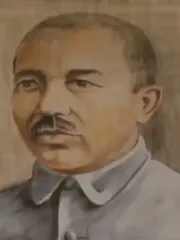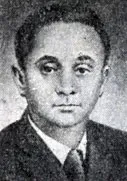
Iskandar Ikromov
Graphic artist and one of the founders of Uzbek book design, who dressed editions of Navoi, Ibn Sina and other classics in the tradition of naqsh ornament; People’s Artist of the Uzbek SSR (1944).
Biography
Iskandar Ikromov was born on 15 April 1904 in Tashkent. Drawn to art from childhood, he received a traditional upbringing and knew the history of Islamic culture, Arabic script, Uzbek music and applied art. In 1922–1924 he studied at the Turkestan regional art school, and from 1925 he learned the craft of the book at the Leningrad Art and Industry Technical School, graduating in 1929.
In his youth his caricatures appeared in the satirical magazine “Mushtum”, whose editors included Abdulla Qodiriy and G‘ozi Yunus. From 1929 to 1959 Ikromov headed the design department of the State Publishing House of Uzbekistan, one of the country’s first printing designers. In the 1930s he designed the journals “Yangi yo‘l”, “Maorif va o‘qituvchi” and “Alanga”, taught at the Samarkand teacher-training school and other colleges, and wrote drawing manuals (“Uzbek Cursive Script for Drawing”, 1932; a drawing handbook and “Let Us Learn to Write Letters”, 1935).
His book graphics rest on the tradition of Uzbek naqsh ornament: he drew on motifs such as “qush jadval”, “tamg‘a” and “islimi”, and on geometric and floral patterns. His first major experiments were the score of Vasily Uspensky’s musical drama “Farhad and Shirin” (1937), Muqimi’s poems (1938) and “Uzbek Folk Songs” (1939). Later, for the 500th and 525th anniversaries of Alisher Navoi, he designed the “Khamsa”, the four-volume “Khazain ul-maani” (1959–1960) and the collection “Lyrics” (1964), as well as the first book of Ibn Sina’s “Canon of Medicine” (1954), the multi-volume “Uzbek Folk Music” (1955), Qodiriy’s “Selected Works” (1958), Oybek’s novel “Navoi” and Navoi’s “Works” (1968–1970).
Books he designed won a diploma and a medal at the International Book Exhibition in Leipzig in 1959. That year he was appointed chairman of the board of the Union of Artists of Uzbekistan, a post he held until 1965. In 1944 he was named People’s Artist of the Uzbek SSR; he also received two orders and medals.
In 1964, for the artist’s 60th birthday, an exhibition of his work was held at the State Museum of Arts; a catalogue of his book graphics appeared in 1965 and S. Krukovskaya’s monograph on him in 1967. Iskandar Ikromov died on 6 November 1972.
Education
- Benkov Republican Art CollegeCollege · Tashkent · 1922–1924 · Then the Turkestan regional art school
- Leningrad Art and Industry Technical SchoolCollege · 1925–1929 · Book graphic artist and drawing-teaching methodologist
Career
- State Publishing House of UzbekistanHead of the design department · Tashkent · 1929–1959
- Union of Artists of UzbekistanChairman of the board · Tashkent · 1959–1965Everyone who held this post →
Awards
 People's Painter of the Uzbek SSR1944 · Uzbek SSR
Life path
- 1922–1924Turkestan regional art school
Took the first stage of his art education in Tashkent.
- 1925–1929Leningrad Art and Industry Technical School
Studied book art and the teaching of drawing, and graduated.
- 1929–1959Head of design at the State Publishing House
Directed the design of fiction, music and technical books at the State Publishing House of Uzbekistan.
- 1930sJournal design and teaching
Designed the journals “Yangi yo‘l”, “Maorif va o‘qituvchi” and “Alanga” and taught at the Samarkand teacher-training school and other colleges.
- 1937Score of “Farhad and Shirin”
Created ornamental compositions for the score of Uspensky’s musical drama.
- 1944People’s Artist of the Uzbek SSR
Received the republic’s title of People’s Artist.
- 1954–1955Editions of Ibn Sina and folk music
Designed the first book of the “Canon of Medicine” and the first volume of “Uzbek Folk Music”.
- 1959Prize in Leipzig
Books he designed won a diploma and a medal at the International Book Exhibition.
- 1959–1965Chairman of the Union of Artists
Headed the board of the Union of Artists of Uzbekistan.
- 1959–1960Navoi’s “Khazain ul-maani”
For Navoi’s 500th anniversary he designed the poet’s four-volume divan.
- 1964Exhibition for his 60th birthday
His work of recent years was shown at the State Museum of Arts.
- 1968–1970Navoi’s “Works”
Designed the edition of Navoi’s collected works.
Works
- Score of “Farhad and Shirin” (1937)Book design
Ornamental compositions for the score of Vasily Uspensky’s musical drama.
- Muqimi, “Poems” (1938)Book design
Design of the collection of Muqimi’s poems.
- “Uzbek Folk Songs” (1939)Book design
Design of the collection of folk songs.
- Ibn Sina, “Canon of Medicine”, book 1 (1954)Book design
Design of the edition of Ibn Sina’s work.
- “Uzbek Folk Music”, vol. 1 (1955)Book design
The first volume of a multi-volume edition.
- Qodiriy, “Selected Works” (1958)Book design
Design of the collection of Abdulla Qodiriy’s works.
- Navoi, “Khazain ul-maani” (1959)Book design
Navoi’s four-volume divan, published in 1959–1960.
- Navoi, “Lyrics” (1964)Book design
Design of the collection of Navoi’s lyric poetry.
- Navoi, “Works” (1968)Book design
Navoi’s collected works, published in 1968–1970.
- “Uzbek Cursive Script for Drawing” (1932)Manual
A teaching manual on drawing and lettering.