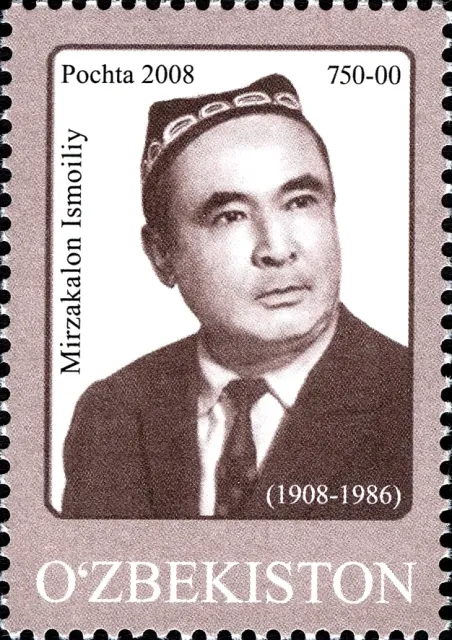
Mirzakalon Ismoili
Uzbek writer and translator, author of the historical novel “Fergana Until Dawn”; he translated more than 200 works by Tolstoy, Sholokhov and others into Uzbek.
- Occupation:
- Writer, Prose writer
- Born:
- October 15 1908 ♎ — 1986
- Birthplace:
- Buloqboshi District, Andijan
- Spouse:
- Zuhra Axunjon qizi
Biography
Mirzakalon Ismoili was born on 15 October 1908 in the city of Osh, into a peasant family. He studied first at a village school and then at a town boarding school. After moving to Tashkent he graduated from the institute of education in 1928, then in 1928–1930 studied at the Oriental Faculty of the Central Asian State University and taught at its workers’ faculty.
His first play, “March the Eighth — the Liberation of Women”, appeared in 1927, and he entered translation in 1928 with “Yanko the Musician”. He worked at the State Publishing House of Uzbekistan in 1932–1937, at the Tashkent film studio in 1937–1938 and at the Writers’ Union of Uzbekistan in 1939. In 1938 he translated Leo Tolstoy’s novel “Resurrection” into Uzbek.
In 1942 he went to the front and served until 1947, working on the army newspaper “Red Army” as executive secretary, deputy editor and war correspondent. In the first days of the war he wrote the film script “We Will Win!”, which was made into a film. His wartime sketches and stories were collected in “A Song About a Free Man” (1948), and his play “Wide Fields” was published in 1949. He was awarded the Order of the Red Star.
In 1948–1949 he worked at the newspaper “Qizil O‘zbekiston” and in 1949–1950 at the magazine “Sharq yulduzi”. In 1950 he was arrested and served his sentence in the mines of Karaganda, where he wrote the first book of his novel “Fergana Until Dawn”. He was cleared and released in 1955 and in 1955–1958 headed a department at the Ghafur Ghulam Publishing House of Literature and Art.
The first book of “Fergana Until Dawn”, “The Rumble of the Depths”, came out in 1958 and the second, “The Last Night”, in 1967; the novel portrays the lives of ordinary people in early twentieth-century Turkestan and their longing for education. His later works — “Our Novel” (1963), “Human Beauty”, “A Tale of Humaneness” (1972), “The Girls’ Notebook” (1980) and “Blame Yourself” (1986) — deal with the conduct of young people, harmony in the family and mutual respect.
He translated more than 200 works of world literature into Uzbek, among them Tolstoy’s “Anna Karenina”, Sholokhov’s “The Fate of a Man”, Voynich’s “The Gadfly” and Reşat Nuri Güntekin’s “Çalıkuşu”. In 1983 he was named Honoured Art Worker of the Uzbek SSR. He died in Tashkent in 1986. A neighbourhood in Tashkent’s Darkhan area and a school and cinema in Buloqboshi bear his name, and in 2008 Post of Uzbekistan issued a stamp with his portrait.
Education
- Central Asian State UniversityUniversity · Tashkent · 1928–1930
Career
- Qizil O'zbekiston newspaperStaff member · Tashkent · 1948–1949
- «Sharq yulduzi» magazineStaff member · Tashkent · 1949–1950
- Writers' Union of UzbekistanStaff member · Tashkent · 1939–1939
- Ghafur Ghulam Publishing House of Literature and ArtHead of a department · Tashkent · 1955–1958
- State Publishing House of UzbekistanStaff member · Tashkent · 1932–1937
Awards
- Honoured Art Worker of the Uzbek SSR1983 · Uzbek SSR

Life path
- 1908Born in Osh
Born into a peasant family; studied first at a village school and then at a town boarding school.
- 1927–1928First play and first translation
His play “March the Eighth — the Liberation of Women” was printed in 1927; in 1928 he began translating with “Yanko the Musician”.
- 1928–1930Central Asian State University
After graduating from Tashkent’s institute of education in 1928, he studied at the university’s Oriental Faculty and taught at its workers’ faculty.
- 1932–1939Publishing, film studio, Writers’ Union
Worked at the State Publishing House of Uzbekistan (1932–1937), the Tashkent film studio (1937–1938) and the Writers’ Union (1939); translated Tolstoy’s “Resurrection” in 1938.
- 1942–1947Military service
On the army newspaper “Red Army” he was executive secretary, deputy editor and war correspondent.
- 1948–1950Work in the press
Worked at the newspaper “Qizil O‘zbekiston” (1948–1949) and the magazine “Sharq yulduzi” (1949–1950); “A Song About a Free Man” (1948) and the play “Wide Fields” (1949) were published.
- 1950–1955Arrest and exoneration
Arrested in 1950 and served his sentence in the mines of Karaganda; cleared and released in 1955. In prison he wrote the first book of “Fergana Until Dawn”.
- 1955–1958Ghafur Ghulam publishing house
Headed a department at the Publishing House of Literature and Art; the first book of “Fergana Until Dawn”, “The Rumble of the Depths”, appeared in 1958.
- 1967“The Last Night”
The second book of “Fergana Until Dawn” was published.
- 1983Honorary title
Named Honoured Art Worker of the Uzbek SSR.
- 1986Death
Died in Tashkent.
Books
- “A Song About a Free Man”1948 · Collection of stories and sketches
Sketches and stories from the war years printed in front-line newspapers; reissued in 1965 in the series “Library of War Stories”.
- “Wide Fields”1949 · Play
A play written in the first postwar years.
- “Fergana Until Dawn”1958 · Historical novel
In two books, “The Rumble of the Depths” (1958) and “The Last Night” (1967); about ordinary people in early twentieth-century Turkestan and their longing for education.
- “Our Novel”1963 · Novella
A novella about the lives of young people.
- “Human Beauty”1965 · Book on ethics
A book on conduct and upbringing.
- “A Tale of Humaneness”1972 · Novella
A novella about morality and decent conduct.
- “The Girls’ Notebook”1980 · Novella
On the conduct of young people, harmony in the family and mutual respect.
- “Blame Yourself”1986 · Novella
One of his last works on the conduct of young people and family relations.
Works
- “Resurrection” (1938)Translation
Novel by Leo Tolstoy.
- “Anna Karenina”Translation
Novel by Leo Tolstoy, translated after “Resurrection”.
- “The Fate of a Man”Translation
Story by Mikhail Sholokhov.
- “The Gadfly”Translation
Novel by Ethel Lilian Voynich.
- “Çalıkuşu”Translation
Novel by Reşat Nuri Güntekin.
- “The Mysterious Island”Translation
Novel by Jules Verne.