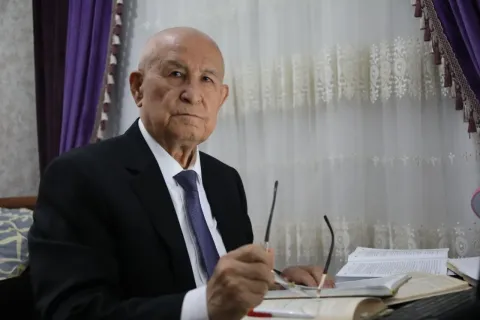
Muhammad Ali
Uzbek poet, novelist and translator, author of “The Great Realm” (“Ulug' Saltanat”), a four-book epic novel about Amir Timur and his sons, and People’s Writer of Uzbekistan (1992).
- Occupation:
- Writer, Poet, Prose writer
- Real name:
- Muhammad Ali Ahmedov
- Born:
- March 1 1942(84 years old) ♓
- Birthplace:
- Bo'z District, Andijan
Biography
Muhammad Ali (born Muhammad Ali Ahmedov) was born on 1 March 1942 into a peasant family in the village of Beshkal in the Bo'z (now Bo'ston) district of the Andijan region. He began writing poetry at school: his first poem was printed on 17 February 1957, when he was still in his teens, in the newspaper “Qizil O'zbekiston” (today “O'zbekiston ovozi”). After finishing the Navoi secondary school in the Bekobod district of the Tashkent region in 1959, he worked for a time at a sand and gravel quarry in Bekobod.
From 1960 to 1966 he studied at the Gorky Literature Institute in Moscow, breaking off in 1962–1963 to teach in schools in the Andijan and Fergana regions. After graduating he joined the magazine “Sharq yulduzi” as a literary staff member, and from 1967 he worked at the Ghafur Ghulam Publishing House of Literature and Art — as an editor, from 1975 as head of a department and in 1982–1985 as editor-in-chief. In 1985–1988 he was editor-in-chief of the literary and drama department of Uzbek Television.
His first book of poems, “Feelings in the Skies”, came out in 1967, followed by the collections “Twilight” (1968), “The Land of Our Fathers” (1970), “White Light” (1977), “The Muse” (1980), “To Love and Be Loved” (1983), “You Are a Flower” (1989) and “A Mother’s Prayer” (1994). He also wrote the narrative poems “Mashrab” (1966) and “Light on the Dome” (1967). His novel in verse “The Eternal World”, finished in 1979 and published in 1981, deals with the Andijan uprising led by Dukchi Ishan (1898) and the Jizzakh uprising (1916); a Russian translation appeared in Tashkent in 1984.
As a translator he rendered into Uzbek the ancient Indian epic “Ramayana” (1978), the Karakalpak folk epics “Shahriyor” (1977) and “Masposhsho” (1985), and poems by Robert Burns (1971) and Galaktion Tabidze (1982), as well as works by Goethe, Schiller, Byron, Pushkin, Lermontov, Magtymguly, Abai, Tagore and Rasul Gamzatov. His translation of “Shahriyor” won him the Berdaq State Prize of Karakalpakstan in 1984. A study of how the poetics of the “Ramayana” can be carried into Uzbek earned him the degree of Candidate of Philological Sciences in 1992.
In 1989–1993 he headed the Centre for Literary Translation and Literary Relations at the Writers’ Union of Uzbekistan, and in 1992 he was named People’s Writer of Uzbekistan. In 1993–1996 he was a professor at Tashkent State University (now the National University of Uzbekistan), heading its department of ethics and aesthetics from 1994, and from 1992 to 2005 he taught Uzbek language and literature to students of the University of Washington in the United States. He chaired the board of the Oltin Meros International Charitable Foundation in 1999–2003 and, from 2003, that of the Amir Temur International Public Foundation. From 2013 until April 2018 he was chairman of the Writers’ Union of Uzbekistan.
His first work of prose, the two-part novel “The Sarbadars”, appeared in 1989. Between 1993 and 2013 he wrote “The Great Realm” (“Ulug' Saltanat”), an epic novel in four books about the age of Amir Timur and his sons: “Jahangir Mirza” (2003), “Umar Shaikh Mirza” (2006), “Miran Shah Mirza” (2010) and “Shah Rukh Mirza” (2013). The first two books brought him the State Prize of the Republic of Uzbekistan in 2007. “Jahangir Mirza” was published in Turkish in Istanbul in 2008, and the first three novels in Russian in 2015–2019. He is also the author of the chronicle novel “Eternal Longings” (2005; published in English in 2006), the play “Navoi and Bayqara” (2015), the essays “Know Yourself” (1988) and “Do Not Stray from the Truth, History!” (1990), the book “America as I Saw It” (2000) and the children’s book “A Tale of the Dragonfly” (1976).
His works have been translated into more than twenty-five languages. He holds the orders “Mehnat Shuhrati” (1999) and “El-yurt Hurmati” (2014), and in 2021 he received the title of Honoured Mentor of Youth of Uzbekistan. His 80th birthday was marked in 2022. In 2026 he again chairs the Amir Temur International Public Foundation; that year his historical novella “Temurbek”, about the young Amir Timur, came out as a book.
Education
- Maxim Gorky Literature InstituteUniversity · 1960–1966
Career
- «Sharq yulduzi» magazineLiterary staff member · Tashkent · 1966–1966
- Oltin Meros International Charitable FoundationChairman of the board · Tashkent · 1999–2003Everyone who held this post →
- Writers' Union of UzbekistanHead of the Centre for Literary Translation and Literary Relations (1989–1993), chairman of the Union (2013–2018) · Tashkent · 1989–2018Everyone who held this post →
- Ghafur Ghulam Publishing House of Literature and ArtEditor, head of department, editor-in-chief; head of the Uzbek literature department in 1997–1998 · Tashkent · 1967–1985Everyone who held this post →
- National University of UzbekistanProfessor, head of the department of ethics and aesthetics (then Tashkent State University) · Tashkent · 1993–1996
- Uzbek TelevisionEditor-in-chief of the literary and drama department · Tashkent · 1985–1988
- Amir Temur International Public FoundationChairman of the board · Tashkent · 2003–presentEveryone who held this post →
Awards
 People's Writer of Uzbekistan1992 · Uzbekistan
 Honoured Youth Mentor of Uzbekistan2021 · Uzbekistan
 Order «El-yurt hurmati»2014 · Uzbekistan
 Order of Labor Glory1999 · Uzbekistan
Life path
- 1957First poem
On 17 February his first poem appeared in the newspaper “Qizil O'zbekiston”.
- 1960–1966Literature Institute
Studied at the Gorky Literature Institute in Moscow; taught in schools in the Andijan and Fergana regions in 1962–1963.
- 1967First book
The poetry collection “Feelings in the Skies” came out.
- 1967–1985Publishing house
Editor, head of department and, from 1982, editor-in-chief of the Ghafur Ghulam Publishing House of Literature and Art.
- 1981“The Eternal World”
Published his novel in verse about the Andijan and Jizzakh uprisings.
- 1985–1988Uzbek Television
Editor-in-chief of the literary and drama department.
- 1989“The Sarbadars”
His first prose work, a two-part novel, came out; until 1993 he headed the Writers’ Union’s Centre for Literary Translation and Literary Relations.
- 1992People’s Writer
Named People’s Writer of Uzbekistan; earned a candidate’s degree for his study of translating the “Ramayana”.
- 1993–1996University
Professor at Tashkent State University and head of its department of ethics and aesthetics.
- 1999–2013Charitable foundations
Chairman of the board of the Oltin Meros foundation (1999–2003), then of the Amir Temur International Public Foundation.
- 2003–2013“The Great Realm”
The four books of the epic novel were published; the first two won the State Prize in 2007.
- 2013–2018Chairman of the Writers’ Union
Led the Writers’ Union of Uzbekistan.
Books
- “Feelings in the Skies”1967 · Poetry collection
The poet’s first book.
- “The Land of Our Fathers”1970 · Poems and a narrative poem
- “Ramayana”1978 · Translation
The Uzbek translation of the ancient Indian epic; a study of its poetics earned him a candidate’s degree in 1992.
- “The Eternal World”1981 · Novel in verse
About the Andijan (1898) and Jizzakh (1916) uprisings; finished in 1979 and published in Russian in 1984.
- “The Sarbadars”1989 · Novel in two parts
The writer’s first work of prose.
- “A Mother’s Prayer”1994 · Poetry collection
- “Jahangir Mirza”2003 · Historical novel
The first book of the epic “The Great Realm”; published in Turkish in Istanbul in 2008.
- “Eternal Longings”2005 · Chronicle novel
Published in English in Tashkent in 2006.
- “Umar Shaikh Mirza”2006 · Historical novel
The second book of “The Great Realm”; together with the first it won the State Prize in 2007.
- “Miran Shah Mirza”2010 · Historical novel
The third book of “The Great Realm”.
- “Shah Rukh Mirza”2013 · Historical novel
The fourth book, completing the epic he had worked on for twenty years.
- “Navoi and Bayqara”2015 · Play
About Alisher Navoi and Husayn Bayqara.