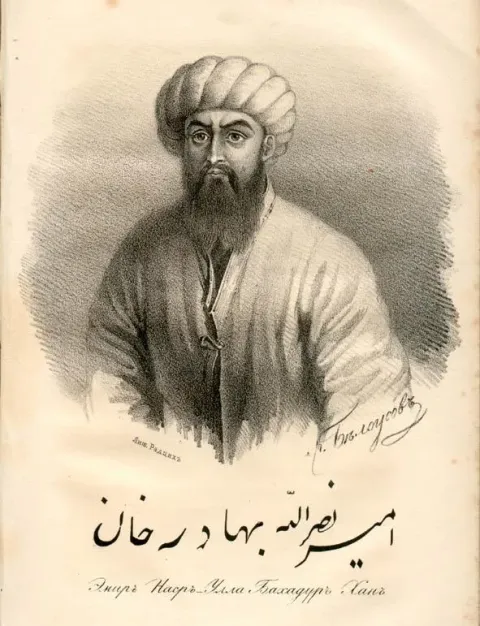
Nasrullah Khan
Emir of Bukhara from the Manghit dynasty (1827–1860): fought Kokand and Shahrisabz, built a standing army of sarbaz and in 1842 had the British officers Stoddart and Conolly executed.
- Occupation:
- Historical figure, Politician, Military officer
- Real name:
- Sayyid Nasrullah Bahadur Khan
- Born:
- 1806 — 1860
- Birthplace:
- Bukhara
- Father:
- Amir Haydar
- Children:
- Muzaffar
Biography
Nasrullah was born in 1806 in Bukhara, the third son of Haydar, ruler of the Bukharan emirate from the Manghit dynasty. His father drew him into government early: in 1821 the young prince led the army sent to put down the revolt at Miyankal and took Katta-Kurgan, held by the rebels. The harsh reprisals that followed earned him the nickname “qassab” (“butcher”) among the people. From the autumn of that year he was governor of Karshi.
After Haydar died in 1826 his elder sons took the throne in turn: Mir Husayn (October–December 1826) and Mir Umar (December 1826 to April 1827). With the backing of the powerful qushbegi Hakim, Nasrullah seized power and became emir in April 1827.
At home he worked to strengthen central authority. In 1837–1838 he had the qushbegi Muhammad Hakim executed, abolished the post and appointed viziers who were not tied to the tribal nobility. Modelling it on the army of Qajar Iran, he created a standing force of sarbaz infantry, trained by an Iranian fugitive named Abdulsamad; it also included artillery.
Wars with neighbours fill much of his reign. In 1841–1842 he fought the Khanate of Kokand, taking Khojand and Ura-Tyube and occupying Kokand itself in 1842, when the poet Nodirabegim and members of the khan’s family were put to death. The struggle with the rulers of Shahrisabz dragged on for years and ended with the city’s subjugation in 1856.
The emirate kept up diplomatic and trade contacts with the Russian Empire: the missions of Butenev (1841–1842) and Ignatiev (1858) visited Bukhara. Relations with Britain suffered after the execution in 1842 of the British officers Charles Stoddart and Arthur Conolly, who had long been held prisoner; Joseph Wolff, who came in 1843 to learn their fate, was imprisoned but later released.
Nasrullah died in the autumn of 1860 and was succeeded by his son Muzaffar. According to one account, he was poisoned by his wife, the daughter of the ruler of Shahrisabz.
Career
Life path
- 1821Campaign against Miyankal
Led the Bukharan army against the rebels at Miyankal and took Katta-Kurgan.
- 1821Governor of Karshi
Appointed by his father governor of Karshi from the autumn.
- 1827Emir of Bukhara
With the support of the qushbegi Hakim he seized the throne and became emir in April.
- 1837Army of sarbaz
Created a standing army on the Iranian model, with artillery.
- 1837–1838Abolition of the qushbegi’s post
Executed Muhammad Hakim and replaced the qushbegi with viziers outside the tribal nobility.
- 1841–1842War with Kokand
Took Khojand and Ura-Tyube, and in 1842 occupied Kokand.
- 1842Execution of Stoddart and Conolly
Had two British officers held prisoner in Bukhara put to death.
- 1843Imprisonment of Joseph Wolff
Wolff, who came to learn the officers’ fate, was jailed and later released.
- 1856Subjugation of Shahrisabz
Conquered Shahrisabz after many years of struggle.
- 1858Ignatiev’s mission
Received the Russian mission led by Nikolay Ignatiev in Bukhara.
- 1860Death
Died in the autumn; his son Muzaffar succeeded him.
Legacy
Under Nasrullah the Bukharan emirate gained a stronger central authority and a standing army, yet the country lay in the zone where Russian and British interests collided: in 1868, under his son Muzaffar, Bukhara became a vassal of the Russian Empire. Soviet and Russian historiography remembers him as the “butcher emir”.
Era: Emirate of Bukhara, 19th century- Execution of Charles Stoddart and Arthur Conolly (1842)
- Subjugation of Shahrisabz (1856)
- Accession of Muzaffar (1860)