Nodira
Poet of the Kokand literary school, daughter of the governor of Andijan and wife of Umar Khan of Kokand, who wrote in Uzbek and Persian under the pen names Nodira, Komila and Maknuna.
- Occupation:
- Writer, Politician, Poet
- Real name:
- Mohlaroyim
- Born:
- 1792 — 1842
- Birthplace:
- Andijan
- Father:
- Rahmonqulbiy
- Spouse:
- Umarxon
- Children:
- Muhammad Alixon (Madalixon), Sulton Mahmudxon
Biography
Nodira (born Mohlaroyim) was born in 1792 in Andijan into the family of Rahmanqul Biy, the governor of Andijan, of the Uzbek Ming clan. Her father was an uncle of Alim Khan, the ruler of Kokand. In her youth she studied history and literature and became fluent in both Uzbek and Persian.
In 1807 (1808 in some sources) Alim Khan made his brother Umar governor of Margilan and married him to Nodira; the couple spent their first years in Margilan. When Alim Khan was killed in 1810 and Umar took the throne of Kokand, Nodira moved to the capital. Umar Khan himself wrote poetry under the pen name Amiri and gathered poets and scholars at his court, and the couple took part in poetry contests. They had two sons, Muhammad Ali (Madali Khan) and Sultan Mahmud.
After Umar Khan’s death in 1822 the fourteen-year-old Madali became khan, and in the first years of his reign Nodira in effect ran the affairs of state. She built madrasas, mosques, caravanserais and market rows, among them the Chalpak madrasa in the Guristoni Kalon cemetery and the Mohlaroyim madrasa in the Taqagarlik row, and supported calligraphers, painters and scholars. A circle of women poets, Uvaysiy and Mahzuna among them, formed around her; Uvaysiy, whom she invited to the court, is named in the sources as her teacher in poetry.
Nodira wrote in Uzbek under the pen names Nodira (“rare”) and Komila (“perfect”), and in Persian as Maknuna (“hidden”); her legacy amounts to about ten thousand lines. She wrote ghazals, mukhammases, musaddases, musammans, tarjibands and tarkibbands, as well as a firoqnoma, a verse letter of separation. She regarded Navoi, Fuzuli and Bedil as her masters and wrote mukhammases on their ghazals. The main themes of her lyric poetry are love and fidelity and, after her husband’s death, the grief of separation from him.
In 1842 Emir Nasrullah of Bukhara captured Kokand. Nodira was accused of breaking sharia and executed together with her sons Madali Khan and Sultan Mahmud and her fourteen-year-old grandson Muhammad Amin. She was buried in Kokand in the Modari Khan mausoleum; in the mid-20th century her remains were moved to a new white marble tomb.
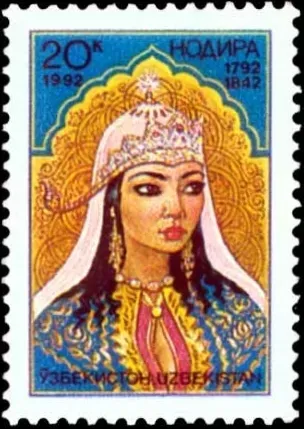
Manuscripts of her divans are kept at the Beruni Institute of Oriental Studies of the Academy of Sciences of Uzbekistan; in 1962 her complete divan was found in Namangan, with 180 poems, 136 of them in Uzbek and 44 in Persian. Her work has been studied and published since the 1960s. In 1992 the 200th anniversary of her birth was widely marked in Uzbekistan, and a postage stamp was issued in her honour. Her life inspired the musical dramas “Nodira” by H. Razzoqov and “Nodirabegim” by Turob To‘la, and the film “Nodirabegim”.
Career
- Court of the Kokand KhanateKhan’s consort, in effect ran the state from 1822 · Kokand · 1810–1842
Life path
- 1792Birth
Born in Andijan into the family of Rahmanqul Biy, the governor of Andijan, of the Ming clan.
- 1807Marriage
Alim Khan made his brother Umar governor of Margilan and married him to Nodira (1808 in some sources); the family lived in Margilan.
- 1810At the court of Kokand
After Alim Khan was killed and Umar became khan of Kokand, Nodira moved to the capital; with her husband, who wrote as Amiri, she took part in poetry contests.
- 1822Running the state
After Umar Khan’s death she in effect governed during the first years of the reign of their fourteen-year-old son Madali Khan.
- Patronage and building
Built the Chalpak and Mohlaroyim madrasas, mosques, caravanserais and market rows; supported the poets Uvaysiy and Mahzuna, calligraphers and scholars.
- 1842Execution
After Emir Nasrullah of Bukhara captured Kokand she was executed together with her sons and grandson; buried in the Modari Khan mausoleum in Kokand.
Works
- “Divan” (as Nodira)Collected poems
The complete divan found in Namangan in 1962: 180 poems, 136 in Uzbek and 44 in Persian; besides ghazals it holds mukhammases, musaddases, a tarjiband and poems in other forms.
- Uzbek divanIncomplete divan
A manuscript divan of 109 ghazals (1,704 couplets), kept at the Beruni Institute of Oriental Studies.
- Poems as KomilaDivan
A 19th-century manuscript of 19 ghazals (328 couplets).
- Divan as MaknunaPersian divan
333 ghazals in Persian; the manuscript is kept at the Beruni Institute of Oriental Studies.
- MukhammasesTakhmis poems
Mukhammases on ghazals by Navoi, Fuzuli and Bedil, whom Nodira regarded as her masters.
- “Firoqnoma”Verse letter
A verse letter on the grief of separation, included in Nodira’s divan.
Legacy
Nodira is regarded as one of the central figures of the literary life of Kokand in the first half of the 19th century: she supported poets, calligraphers and scholars and brought women poets such as Uvaysiy and Mahzuna to the court. Her public activity is recorded in the works of her contemporaries Hakimkhan, Hotif and Mushrif. Uzbek literary scholarship values her as a continuer of Navoi’s tradition, a poet of love and fidelity who gave voice to a woman’s inner world; in the 19th and 20th centuries her poems were copied into many manuscript anthologies.
Era: The Kokand Khanate, first half of the 19th century- Death of Umar Khan and accession of Madali Khan; Nodira in effect runs the state (1822)
- Emir Nasrullah of Bukhara captures Kokand; Nodira is executed (1842)
- Her complete divan is found in Namangan (1962)
- The 200th anniversary of her birth; a postage stamp is issued in her honour (1992)