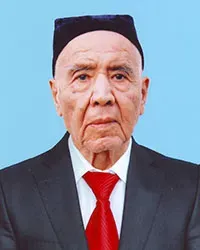
Translator and screenwriter who rendered works by Jack London, Tagore, Gorky, Boccaccio, Bulgakov and Homer into Uzbek and served as artistic director of the dubbing group at Uzbekfilm.
- Occupation:
- Writer, Screenwriter
- Lived:
- October 12 1920 ♎ — 2012
- Birthplace:
- Tashkent
Biography
Qodir Mirmuhamedov (Qodir Mirqosimovich) was a translator and screenwriter who brought authors such as Jack London, Tagore, Gorky, Boccaccio, Bulgakov and Homer to Uzbek readers. He was born in Tashkent in 1920. Sources disagree on the day of his birth, so only the year is given here. He fought in the Second World War and graduated from the Tashkent Evening Pedagogical Institute in 1950.
His career ran as follows: senior editor at the Uzbek radio committee in 1956–1958; editor-in-chief of the literature editorial office of Uzbek Television in 1958–1959; head of the translation section at the Gafur Gulom publishing house in 1959–1961. The longest period, 1961–1989, was tied to the Uzbekfilm studio, first as an editor in the script department and then as chief editor and artistic director of the dubbing group.
He took up translation in 1951, initially rendering fairy tales and stories for children. His first large work was the novel “Surapati” (1958) by the Indonesian writer Abdul Muis. Later he translated many works from Russian into Uzbek. From the classics: Homer's “The Iliad” (1988), Giovanni Boccaccio's “The Decameron” (1978–1979) and Victor Hugo's “Bug-Jargal” (1982). From Russian and Soviet literature: Mikhail Bulgakov's “The Master and Margarita” (1987) and parts 2 and 3 of Maxim Gorky's novel “The Life of Klim Samgin” (1974–1975). By other authors: Jack London's “Martin Eden” (1968), Rabindranath Tagore's “The Last Poem” and “The Home and the World” (1973), and Krishan Chander's “Bir qizga ming oshiq” (1976).
He also put into Uzbek several plays by foreign authors and a great many feature films.
Mirmuhamedov held the titles Honoured Culture Worker (1981) and Honoured Art Worker of Uzbekistan (1999). He died in 2012.
Education
- Tashkent Evening Pedagogical InstituteUniversity · Tashkent · 1950
Career
- Adabiyot va sanʼat nashriyotiHead of the translation department · Tashkent · 1959–1961now Ghafur Ghulam Publishing House of Literature and Art
- Uzbek RadioSenior editor of the radio committee · Tashkent · 1956–1958
- Uzbekfilm studioEditor in the script department, chief editor and artistic director of the dubbing group · Tashkent · 1961–1989
- Uzbek TelevisionEditor-in-chief of the literature department · Tashkent · 1958–1959
Awards
 Honoured Art Worker of Uzbekistan1999 · Uzbekistan
 Honoured Worker of Culture of the Uzbek SSR1981 · Uzbek SSR
Life path
- 1920Born in Tashkent
- Took part in the Second World War
- 1950Graduated from the Tashkent Evening Pedagogical Institute
- 1951Began translating with children's tales and stories
- 1956–1958Senior editor of the Uzbek radio committee
- 1958–1959Editor-in-chief of the literature department of Uzbek Television
- 1958First major translation, the novel Surapati by A. Muis
- 1959–1961Head of the translation department at the Gafur Gulom publishing house
- 1961–1989Editor, chief editor and artistic director of the dubbing group at Uzbekfilm
- 1981Honoured Culture Worker
- 1999Honoured Art Worker of Uzbekistan
- 2012Died
Works
- “Surapati” (1958)Translation of A. Muis's novel
- “Martin Eden” (1968)Translation of J. London's novel
- “The Home and the World” (1973)Translation of R. Tagore's novel
- “The Last Poem” (1973)Translation of R. Tagore's novel
- “The Life of Klim Samgin” (1975)Translation of parts 2 and 3 of M. Gorky's novel (1974–1975)
- “Bir qizga ming oshiq” (1976)Translation of K. Chander's work
- “The Decameron” (1979)Translation of G. Boccaccio's work (1978–1979)
- “Bug-Jargal” (1982)Translation of V. Hugo's novel
- “The Master and Margarita” (1987)Translation of M. Bulgakov's novel
- “The Iliad” (1988)Translation of Homer's epic