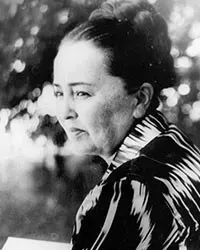
Saida Zunnunova
Uzbek poet and prose writer, author of the poetry collections “Your Daughter Has Written” and “The Lotus” and of novellas and stories about women’s lives; wife of the writer Said Ahmad.
- Occupation:
- Writer, Poet, Prose writer
- Born:
- February 15 1926(51 years old) ♒ — March 20, 1977
- Birthplace:
- Andijan
- Spouse:
- Said Ahmad
- Children:
- Nodira Husanxo'jayeva
Biography
Saida Zunnunova was born on 15 February 1926 in Andijan, into the family of an office worker. She lost her father early and helped her mother bring up her younger brothers. After secondary school she studied at the Andijan Pedagogical (Teachers’) Institute in 1941–1943, then taught in schools of the region and worked on newspaper staffs.
Her first poem was printed in 1945 by “Paxta fronti”, the Andijan regional newspaper. In 1947–1952 she studied at the Faculty of Philology of the Central Asian State University in Tashkent. As a student she wrote the narrative poems “Sodiq and Anor” (1947) and “Xayrixon” (1949); her first poetry collection, “Your Daughter Has Written”, came out in 1948, followed by “New Poems” (1950).
In November 1949 she married the writer Said Ahmad; their daughter, Nodira, later co-wrote the screenplay of a film about her parents. When Said Ahmad was arrested as an “enemy of the people” in May 1950, the Writers’ Union demanded that Zunnunova renounce him. She refused, was expelled from the Union, and for a time her work went unpublished. She spent those years with her mother-in-law, waiting for her husband’s return, and the couple kept each other informed of their writing by letter. Said Ahmad was released in 1955.
She worked as a literary staff member of the magazine “Gulxan” in 1953–1956 and of the newspaper “O'zbekiston madaniyati” in 1956–1957, as an editor at the fiction publishing house in 1957–1958, and as a literary consultant to the Writers’ Union of Uzbekistan in 1962–1967. In 1959 she was awarded the Order of the Badge of Honour.
From the 1950s to the 1970s she published the poetry collections “The Valley of Flowers” (1954), “Girls” (1962), “Poems” (1964), “Thoughts of One Year” (1967) and “The Lotus” (1972), and the narrative poems “Conversation with a Portrait” (1966) and “My Neighbours” (1968). The literary scholar Naim Karimov notes that her skill at conveying subtle states of mind shows most clearly in “Conversation with a Portrait”. She also wrote the plays “Mother” (1966) and “Eyes” (1968).
From the mid-1950s she wrote a good deal of prose. The stories and novellas in “Gulbahor” (1956), “The Bonfire”, “The Wing” (1961), “Fire” (1962), “Bright Streets” (1965) and “I Adore You” (1972) deal mostly with work, family and love, and women stand at their centre. The novella “The Bonfire” is about Uzbek women and their struggle in the 1920s. The National Encyclopedia of Uzbekistan points out that in the novellas “The New Director”, “Fire” and “Among People”, under the guise of attacking “survivals of the past”, she also exposed the ills of Soviet society.
Saida Zunnunova died after a serious illness on 20 March 1977 in Tashkent, at the age of 51, and was buried in the Chig'atoy cemetery. On 10 June 2013 a monument to her and Said Ahmad was unveiled on the Alley of Writers in Tashkent. In March 2019 the feature film “Said and Saida”, directed by Nozim Abbosov, about the couple’s life, had its premiere. Streets and schools in Tashkent and Andijan and an academic lyceum in the Bo'z district bear her name. On 28 May 2026 she was posthumously awarded the Order “For Selfless Service” (“Fidokorona xizmatlari uchun”).
Education
- Andijan Pedagogical InstituteUniversity · Andijan · 1941–1943 · Teachers’ institute
- National University of UzbekistanUniversity · Tashkent · 1947–1952 · Faculty of Philology (then the Central Asian State University)
Career
- Gulxan magazineLiterary staff member · Tashkent · 1953–1956
- Writers' Union of UzbekistanLiterary consultant · Tashkent · 1962–1967
- Ghafur Ghulam Publishing House of Literature and ArtEditor (the house was then the fiction publishing house) · Tashkent · 1957–1958
- O'zbekiston madaniyati newspaperLiterary staff member · Tashkent · 1956–1957
Awards
 Order «For Selfless Service»2026, posthumously · Uzbekistan
 Order of the Badge of Honour1959 · USSR
Life path
- 1941–1943Andijan Pedagogical Institute
Studied at the teachers’ institute, then taught in schools of the Andijan region.
- 1945First poem
Her first poem was printed in the newspaper “Paxta fronti”.
- 1947–1952Central Asian State University
Studied at the Faculty of Philology; wrote the narrative poems “Sodiq and Anor” and “Xayrixon”.
- 1948“Your Daughter Has Written”
Her first poetry collection came out while she was still a student.
- 1949Family
In November she married the writer Said Ahmad.
- 1950Standing by her husband
After Said Ahmad’s arrest she refused to renounce him and was expelled from the Writers’ Union; he returned in 1955.
- 1953–1958Magazine, newspaper, publisher
Literary staff member of the magazine “Gulxan” and the newspaper “O'zbekiston madaniyati”, editor at the fiction publishing house.
- 1956“Gulbahor”
Her first book of prose, a collection of stories, came out.
- 1959Order of the Badge of Honour
Awarded for her services to literature.
- 1962–1967Writers’ Union
Literary consultant to the Writers’ Union of Uzbekistan.
- 1977Death
Died on 20 March in Tashkent.
- 2026Order “For Selfless Service”
Awarded posthumously, in the year of her centenary.
Works
- “Sodiq and Anor” (1947)Narrative poem
A narrative poem written at the start of her student years.
- “Your Daughter Has Written” (1948)Poetry collection
The poet’s first collection.
- “Xayrixon” (1949)Narrative poem
A narrative poem of her early period.
- “The Valley of Flowers” (1954)Poetry collection
Lyric poems of the early 1950s.
- “Gulbahor” (1956)Short stories
Her first book of prose, about workers’ lives, family and love.
- “The Bonfire”Novella
About Uzbek women and their struggle in the 1920s.
- “Fire” (1962)Novella
A novella built around its heroine that criticises the ills of society.
- “Among People”Novella
Shows the vices of its time through a critique of “survivals of the past”.
- “Conversation with a Portrait” (1966)Narrative poem
Singled out by Naim Karimov as the clearest instance of her skill at conveying states of mind.
- “Mother” (1966)Play
One of her two plays.
- “The Lotus” (1972)Poetry collection
A collection from the last years of her life.
- “I Adore You” (1972)Novellas and stories
A book of prose about women’s lives.
Legacy
Saida Zunnunova is counted among the founders of modern Uzbek women’s writing: the work, family life and inner world of Uzbek women became the main theme of both her poetry and her prose. Her refusal to renounce her husband during the repressions and her life with Said Ahmad remain, in the memory of the literary community, an example of loyalty; memoirs have been written and a film made about it. Streets and schools in Tashkent and Andijan bear her name.
Era: Uzbek literature of the 1940s–1970s- A monument to Said Ahmad and Saida Zunnunova was unveiled on the Alley of Writers in Tashkent (2013)
- The feature film “Said and Saida” was released (2019)
- Centenary of her birth (2026)
- Posthumously awarded the Order “For Selfless Service” (2026)