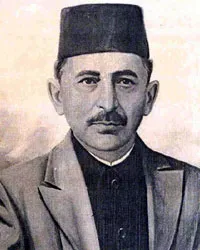
Samarkand-born Jadid educator, journalist, publisher and translator, founder of the journal Sharq mash'ali; repressed in 1937.
- Occupation:
- Writer, Educator, Publicist
- Lived:
- February 15 1887(58 years old) ♒ — December 24, 1945
- Birthplace:
- Samarkand
- Father:
- Mirmuhsin
Biography
Saidrizo Alizoda (Sayyid Rizo Alizoda; in the Russian tradition Said Rizo Ali-zade) was born on 15 February 1887 in Samarkand, in the Boghishamol quarter. His father came from Iran, moving from Khorasan to Bukhara and then Samarkand, and traded in silk and carpets. Saidrizo studied for six years in a Samarkand madrasa and at a new-method school run by the Azerbaijani educator Sheikh Abulqosim, then helped his father sell carpets.
An acquaintance with a Russian officer helped him learn Russian; he became a compositor at the Demurov printing house and stayed loyal to the press for life. He wrote for newspapers and journals in Uzbek, Tajik and Russian, worked closely with Mahmudkhoja Behbudi on the journal Oyina and the newspaper Samarqand, and in 1914 published the Uzbek-language leaflet Telegraf xabarlari at his own expense.
In 1917 he was a translator and correspondent at the newspaper Hurriyat and edited the newspaper Sharq. In 1919 he founded and ran the weekly Persian-Tajik journal Sharq mash'ali, with a print run of about 4,000 copies, which reached Afghanistan, Iran, Turkey, India and some Arab countries besides Central Asia and the Transcaucasus. From 1922 he headed a department at the newspaper Zarafshon and was among the founders and the executive secretary of the newspaper Ovozi tojik. His articles and satirical pieces appeared under about twenty pen names, among them Bahlul, Zambur, Ranjbar, Boghishamoliy and Shapaloq.
His educational work was broad: he opened a school in Samarkand for the children of poor peasants and taught there, compiled eleven textbooks (including Sarfi arab, a Turkic alphabet, history, geography, mathematics, geometry, natural science and astronomy), and wrote the primer Birinchi yil for Uzbek schools, distributing it free. In 1933–1934 he published a two-volume Russian-Tajik dictionary of about 61,000 words, and from 1933 to 1937 he taught Arabic and Persian at Samarkand State University.
As a translator he rendered Pushkin's The Captain's Daughter, Dubrovsky and Eugene Onegin, Tolstoy's Resurrection, Gogol's The Government Inspector and Abdulla Qodiriy's Bygone Days and The Scorpion from the Altar into Tajik and Persian, and works by Ibn Sina, Firdawsi, Nizami, Fuzuli and Navoi into Russian. His historical, religious and scholarly books, entrusted to a publisher from Lahore, were printed there in 1923–1933, a fact that long remained unknown.
He was arrested in December 1937 on a political charge (Wikipedia says espionage). He spent eight years in prisons in Samarkand, Tashkent, Tobolsk and Vladimir, and died of tuberculosis in Vladimir prison on 24 December 1945. In 1987, through the efforts of his grandson Farhod Alizoda, his remains were brought back to Samarkand and buried in the Panjob cemetery. Samarkand has his house-museum (open since November 1998), and a neighbourhood, a street and a school bear his name.
Career
- Oyina magazineContributor · Samarkand
- Узбекский государственный университетLecturer in Arabic and Persian · Samarkand · 1933–1937now Samarkand State University
Life path
- 1887Born
In Samarkand, in the Boghishamol quarter.
- 1904–1906First pamphlets
Became known for the pamphlets Nizomnoma (1904) and Risolat ul-ittihodiya (1906).
- 1905–1907Compositor at a printing house
Worked at the Demurov printing house.
- 1913–1915Collaboration with Oyina
Worked closely with Behbudi.
- 1914Telegraf xabarlari
Published an Uzbek-language leaflet at his own expense.
- 1917–1920Primers and textbooks
Compiled and published primers for Uzbek and Tajik schools.
- 1917Hurriyat and Sharq
Translator and correspondent at Hurriyat, editor of Sharq.
- 1919Sharq mash'ali
Founded and ran a weekly journal in Persian-Tajik.
- 1922Zarafshon
Head of a department; a founder of Ovozi tojik.
- 1933–1937Samarkand State University
Taught Arabic and Persian.
- 1933–1934Russian-Tajik dictionary
Published a two-volume dictionary of about 61,000 words.
- 1937Arrest
Arrested in December on a political charge.
- 1945Death
Died of tuberculosis in Vladimir prison on 24 December.
- 1987Remains returned to Samarkand
Buried in the Panjob cemetery.
- 1998House-museum
His house-museum in Samarkand opened in November.
Works
- «Nizomnoma» (1904)Pamphlet
- «Risolat ul-ittihodiya» (1906)Pamphlet
- «Ilmi hisob» (1906)Textbook
Arithmetic textbook for Jadid schools.
- «Sarfi arab»Textbook
Arabic grammar textbook.
- «Birinchi yil»Primer
Primer for Uzbek schools, distributed free.
- «Alifbe» (1917)Primer
Primers for Uzbek and Tajik schools.
- «Saodat asri»Novel
- Ruscha-tojikcha lug'at (1933)Dictionary
Two volumes, about 61,000 words (1933–1934).
- Pushkin, «Kapitan qizi» va «Dubrovskiy»Translation
Translated into Tajik.
- Qodiriy, «O'tgan kunlar» va «Mehrobdan chayon»Translation
Translated into Tajik.