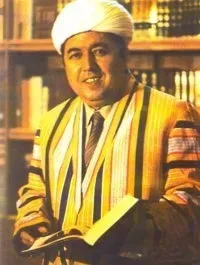
Shamsiddinkhan Babakhanov
Mufti of five Soviet republics and chairman of the Spiritual Administration of the Muslims of Central Asia and Kazakhstan (1982–1989), an Arabist and doctor of philology, later Uzbekistan’s ambassador to Egypt and Saudi Arabia.
- Occupation:
- Religious figure, Scientist, Educator
- Born:
- April 8 1937(66 years old) ♈ — April 15, 2003
- Birthplace:
- Tashkent
- Father:
- Ziyauddinkhan ibn Ishan Babakhan

Biography
Shamsiddinkhan Ziyovuddinkhan ugli Babakhanov was born in Tashkent on 8 April 1937 into a family of Islamic scholars: his grandfather Ishan Babakhan and his father Ziyauddinkhan ibn Ishan Babakhan had successively headed the Spiritual Administration of the Muslims of Central Asia and Kazakhstan (SADUM). He received his first religious education at home, finished Tashkent School No. 28 and in 1955 entered the English faculty of the Tashkent Institute of Foreign Languages.
From 1961 he was a postgraduate student at the USSR Academy of Sciences’ Institute of Oriental Studies in Moscow, specialising in Arabic philology. From 1962 he worked in the Department of International Relations of Muslim Organisations of the USSR and in the 1960s studied at Al-Azhar University in Cairo. In 1973 he defended the candidate’s dissertation “The Category of the Dual Number in the Arabic Language” and later became a doctor of philological sciences.
In 1974 he became pro-rector and in 1975 rector of the Imam al-Bukhari Tashkent Islamic Institute, the only higher Islamic school in the USSR. He brought leading theologians and orientalists to teach there, strengthened its facilities and promoted the publication of study aids.
In October 1982 a congress in Tashkent elected him to succeed his father as chairman of SADUM and mufti of five republics; after his father’s death in December 1982 he also headed the USSR Muslim organisations’ Department of International Relations. Under him monuments of Islamic culture were restored, the administration’s printing house moved into a new building, and in 1985 he chaired the council for a new edition of the Quran. From 1985 he was a full member of the Royal Islamic Academy of Jordan. He received the Abu Ali ibn Sina International Prize and the Soviet Order of Friendship of Peoples.
In February 1989, after clerics gathered at the Barakhan madrasa demanded his removal, he resigned as head of the administration. He then worked as a senior researcher at the Biruni Institute of Oriental Studies of the Academy of Sciences of Uzbekistan. From 1994 to 2001 he was Uzbekistan’s ambassador to the Arab Republic of Egypt and the Kingdom of Saudi Arabia, and from 2001 to 2003 an adviser to the foreign minister.
His publications include a book about his father (in Russian in 1999, in Uzbek in 2001). Shamsiddinkhan Babakhanov died on 15 April 2003 and was buried in the family crypt at the Gʻoyib-ota cemetery in Tashkent.
Education
- Tashkent Pedagogical Institute of Foreign LanguagesUniversity · Tashkent · 1955–1960
- Institute of Oriental Studies of the USSR Academy of SciencesOther · 1961–1973 · Candidate of Philological Sciences
- Al-Azhar UniversityUniversity · 1962–1966
Career
- Imam al-Bukhari Tashkent Islamic InstitutePro-rector (1974), rector (1975–1982) · Tashkent · 1974–1982Everyone who held this post →
- Spiritual Administration of the Muslims of Central Asia and KazakhstanChairman and mufti of five republics · Tashkent · 1982–1989Everyone who held this post →
- Department of International Relations of Muslim Organisations of the USSRReferent (from 1962), head of the department (1982–1989) · 1962–1989
- Abu Rayhan Biruni Institute of Oriental StudiesSenior researcher · Tashkent · 1989–1994
- Ministry of Foreign Affairs of the Republic of UzbekistanAmbassador to Egypt and Saudi Arabia (1994–2001), adviser to the minister (2001–2003) · Tashkent · 1994–2003
Awards
Life path
- 1937Birth
Born in Tashkent in the family of SADUM mufti Ziyauddinkhan ibn Ishan Babakhan.
- 1955Entering the Institute of Foreign Languages
After School No. 28 he entered the English faculty of the Tashkent Institute of Foreign Languages.
- 1961Postgraduate studies in Moscow
Began studying Arabic philology as a postgraduate at the USSR Academy of Sciences’ Institute of Oriental Studies.
- 1962–1966Study at Al-Azhar
While working in the Department of International Relations of Muslim Organisations of the USSR, he studied at Al-Azhar University in Cairo and mastered Arabic.
- 1973Candidate’s dissertation
Defended in Moscow a dissertation on the dual number in Arabic and became a candidate of philological sciences.
- 1974–1982At the Tashkent Islamic Institute
At the Imam al-Bukhari Tashkent Islamic Institute he served first as pro-rector (1974), then as rector (from 1975).
- 1982Chairman of SADUM and mufti
At the October congress he succeeded his father as chairman of the Spiritual Administration of the Muslims of Central Asia and Kazakhstan and mufti of five republics.
- 1985Quran edition council and Jordanian academy
Chaired the council for a new edition of the Quran and became a full member of the Royal Islamic Academy of Jordan.
- 1989Resignation and research
Resigned as head of the administration in February; then a senior researcher at the Biruni Institute of Oriental Studies of the Academy of Sciences of Uzbekistan.
- 1994–2001Diplomatic service
Served as Uzbekistan’s ambassador to the Arab Republic of Egypt and the Kingdom of Saudi Arabia.
- 2001–2003Adviser to the foreign minister
Worked as an adviser at Uzbekistan’s Ministry of Foreign Affairs.
- 2003Death
Died on 15 April; buried in the family crypt at the Gʻoyib-ota cemetery in Tashkent.
Works
- “The Category of the Dual Number in the Arabic Language” (1973)Candidate’s dissertation
Defended in Moscow; earned him the degree of candidate of philological sciences.
- “Catalogue of Sources and Studies on Amir Timur and the Timurids Held in the Libraries of Egypt” (1996)Catalogue
Bibliographic work prepared with Professor Nasrullah Mubashir at-Tarazi and published in Egypt in 1996.
- “Sunmas Ziyo” (“The Undying Light”) (1998)Book
Book published in Tashkent in 1998.
- “Mufti Ziyauddinkhan ibn Ishan Babakhan” (1999)Book
Book on the life of his father and grandfather, the muftis Ziyauddinkhan and Ishan Babakhan: published in Russian in 1999 and in Uzbek (“Shaykh Ziyovuddinkhan ibn Eshon Boboxon”) in 2001.